

What The Wavy Lines On Your Crock-Pot Actually Mean
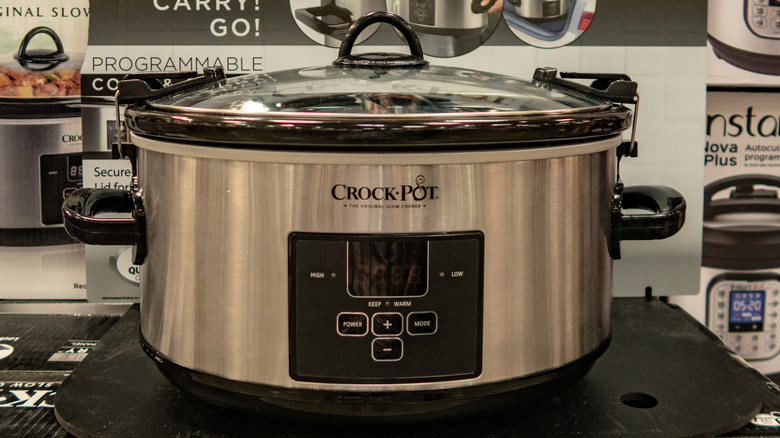
While slow cookers were introduced to the American market all the way back in the 1950s, it wasn't until the 1970s that they really gained popularity. During this decade, it seemed every kitchen had a slow cooker, and the most popular brand sitting on countertops was arguably Crock-Pot. That's still true today, as Crock-Pot remains one of the top-selling and most widely recognized brands; its name has even become interchangeable with the phrase "slow cooker."
One of the best things about Crock-Pots is how easy they are to use right out of the box. But if you purchased a model with only symbols, you might be wondering what they mean, particularly the three wavy lines. The one and two lines mean Low and High, respectively, and the three wavy lines indicate the Keep Warm setting.
If it's your first time using a Crock-Pot, welcome to the club, and prepare to be obsessed. The manual versions of these appliances don't tend to have a lot of special features — in fact, the Keep Warm setting is about the extent of them — but that's one of the joys of owning and using them: They're straightforward and easy to cook with. While the High and Low settings take different amounts of time to reach 209 degrees Fahrenheit, the Keep Warm setting reduces the heat and holds cooked food at a suitable serving temperature.
Don't misuse the Keep Warm setting
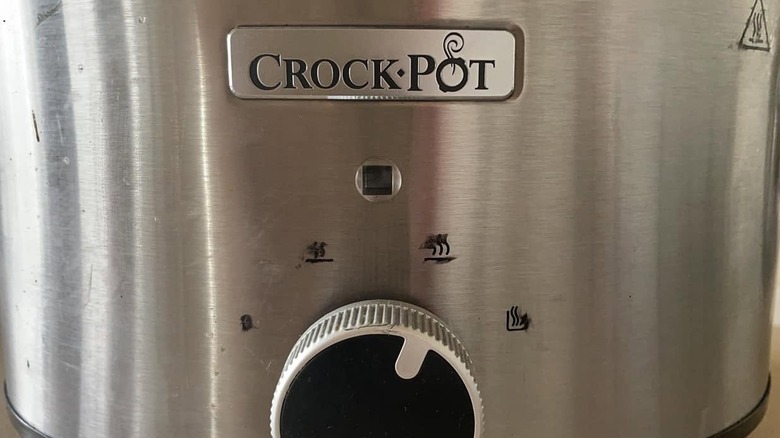
The wavy-lined Keep Warm setting definitely comes in handy, especially when you're hosting and don't want those little Crock-Pot cocktail meatballs to overcook and get mushy, but also don't want them to get cold before everyone is done snacking. That said, as simple as the Crock-Pot feature is, there are a few ways it can be misused — and they're surprisingly dangerous.
The first is that you shouldn't try to cook any raw meat when the knob is turned to Keep Warm. The reason is that it simply doesn't get hot enough quickly enough for the raw food to safely cook through. That means the food lingers in what the USDA calls the "danger zone," the range between 40 and 140 degrees Fahrenheit in which bacteria can multiply rapidly. Perishable food that remains in this temperature range for more than two hours should be discarded. Those bacteria can cause foodborne illness, which can be serious for some people.
The second potential misuse of the Keep Warm setting is assuming that food will remain safe indefinitely without checking its temperature. Whether your Crock-Pot contains sweet and sour chicken, mashed potatoes, or turkey and zucchini meatballs, the food should remain at or above the all-important temperature of 140 degrees. Check it periodically with a food thermometer, particularly if it has been sitting for several hours.