

5 Common Problems With Blackstone Grills
When Blackstone's grills hit the market, they were an innovative appliance that brought the convenience of flat-top cooking into the homes of everyday cooks. While they are delightful tools, they are prone to certain problems, ranging from simple instances of user error to catastrophic breakages that require you to replace major parts.
Cooking with a Blackstone is relatively straightforward thanks to their extremely user-friendly design. While maintaining a commercial kitchen's flat top requires a small amount of training and know-how, you shouldn't need to do more than watch a couple videos and read the instruction manual to assemble, use, and maintain your appliance. Still, some of the worst problems a Blackstone can develop stem from some degree of user error, which has the unfortunate side effect of possibly invalidating your warranty.
To avoid significant issues with your Blackstone, it's vital you keep it cleaned, the griddle seasoned, and store it in a dry, covered area when you aren't using it. While this advice goes for just about any outdoor grill, it's doubly important for a Blackstone because of its many delicate parts. Depending on the part in question, it can end up costing you a pretty penny to replace or, at the very least, quite a bit of time to repair and refurbish.
Blackstone gas regulators are a common headache
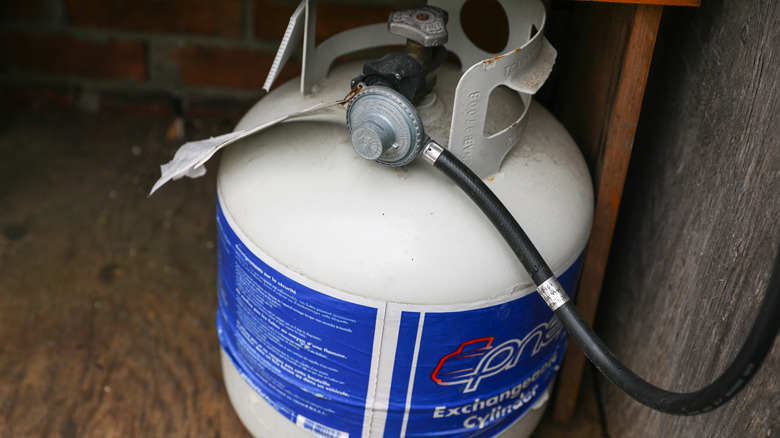
Have you ever looked at the metal disc that helps connect your grill to a propane tank? That's the regulator, a surprisingly intricate device that helps control the exact amount of gas being fed to your appliance. If your tank is full but your Blackstone's flames look low or are failing to ignite altogether, there's a good chance the regulator is to blame.
Fortunately, there are a handful of quick fixes for a Blackstone gas regulator. Oftentimes, users accidentally set off its emergency safety measures, usually from opening the gas valve on the tank too quickly or while a burner is set to "on." All you have to do is turn all the burners off, disconnect the valve from the tank, and give the regulator a few gentle slaps against your palm. Provided the issue was one of these common user errors, the regulator should go back to normal and let the Blackstone function.
Warped flat tops are a major problem customers encounter
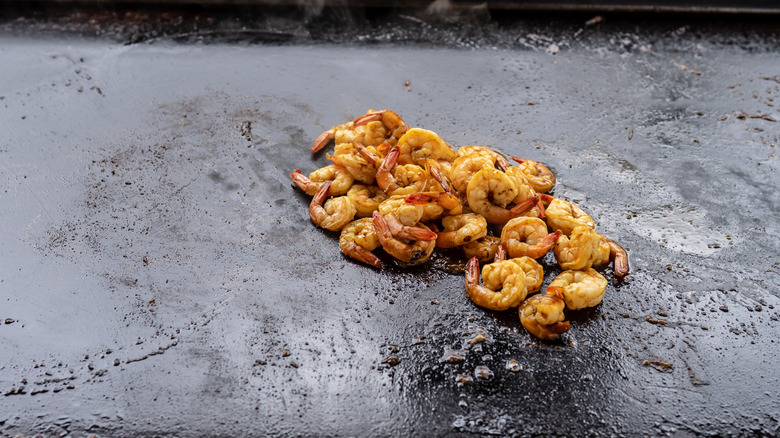
The whole point of a flat-top Blackstone griddle is to have an even cooking surface. Unfortunately, a warped surface seems to be a surprisingly common issue amongst Blackstone's customers and can be a difficult one to resolve. This issue can stem from a few different things, but ultimately it comes down to temperature fluctuations. Metal expands when it heats and contracts when it cools, and the constant ebb and flow over time can change or even damage the griddle's shape. This process speeds up quite a bit when there are rapid temperature changes, such as preheating your griddle to be screaming hot and then adding an ice-cold slab of meat.
While some minor warping here and there is to be expected, a persistent change more than a quarter inch in size is a cause for worry. While you can try to hammer your griddle back into shape, this forced change in the surface may weaken the area further and cause it to eventually break entirely. If the issue isn't abating, your best bet is to call customer service and request a replacement part.
Blackstone parts tend to rust, even when taken care of
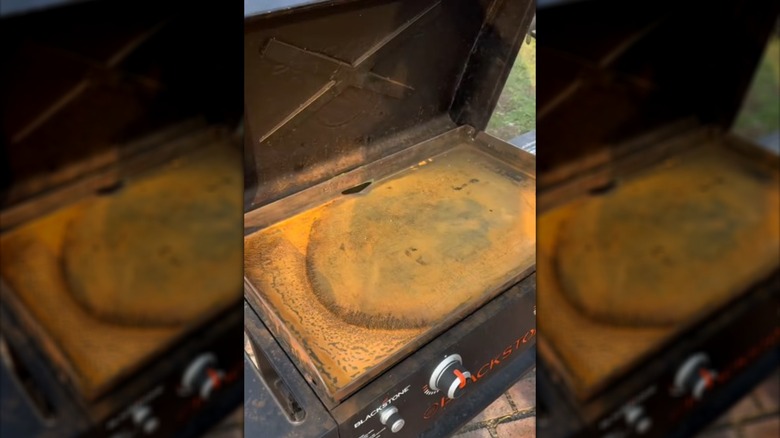
Knowing how to season the griddle on a Blackstone is possibly the most important part of ownership. Since this appliance sits outside and is naturally exposed to weather changes, humidity, and all sorts of airborne bacteria and debris, that layer of seasoning is its best line of defense against rusting.
However, even when you do everything right, you may still notice some rust here or there. While a touch of rust on the outside of the lid or one of the supporting legs isn't a huge deal, it certainly doesn't instill confidence in your new appliance. For exterior rusting, your best bet is to just touch it up with high-temperature paint to keep it from spreading.
If you find yourself needing to clean your rusty Blackstone griddle, consider using a grill stone. These are abrasive enough to strip the faulty layer of seasoning on the metal, but not so harsh they'll scratch the surface. This is a cheap, effective way to rest your cooking surface so you can apply a new layer of seasoning and hopefully prevent rusting in the future.
Cooking while it's windy can pose problems for a Blackstone
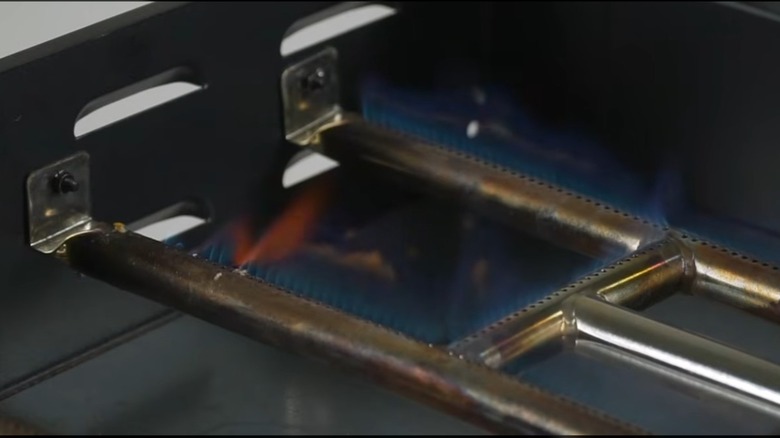
Blackstone is ultimately well-designed when it comes to temperature diffusion and usually consists of two H-shaped flame burners directly underneath a wide metal griddle. However, this design comes with a major drawback, as it's extremely vulnerable to wind. When it's blowing particularly hard, wind tends to slip between the cracks of a Blackstone, sliding underneath the griddle and messing with the burners, making some flames burn low and others flare up.
This is such a significant issue that Blackstone actually sells wind guards, rectangular strips of metal you can use to plug the gap between the flat top and rest of the appliance. This has the added bonus of possibly helping the burners retain heat, potentially using less propane. While they aren't necessary for every Blackstone model, they are the most effective way to resolve this small design flaw.
Clogged burners can hurt your Blackstone
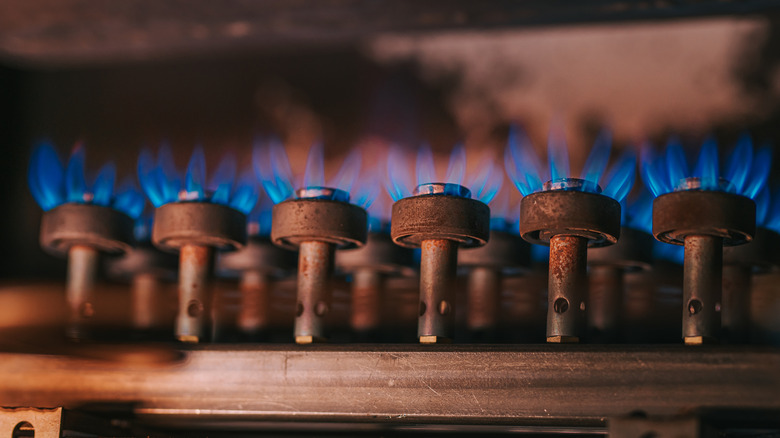
A dirty grill is not only a bit gross to cook on, but it can also be unsafe, leading to flare-ups or an increase in foodborne illnesses. Blackstones, however, add another problem to the list and if you don't know how to clean a griddle, then you might find yourself unable to use it entirely. Even if you do everything right and keep your Blackstone griddle pristine, burner ports are delicate bits of machinery that can clog. This is especially prevalent if you go a season or two without using your appliance, as everything from rust to dirt to dead bugs may build up, closing up the holes. The reduced gas flow can mess with your heat distribution or even trigger the gas regulator if the problem is severe enough.
Fortunately, this is a fairly easy problem to fix. After removing the burner tubes, use a bottle brush or can of compressed air to clear out the holes. Since these devices spit out fire and have no contact with your food, you shouldn't have to worry about sanitizing them with soap or water. As long as they're clear and the flames come out consistently, you should be good to go.