

Without McDonald's Iconic Egg McMuffin, This Kitchen Tool Wouldn't Exist
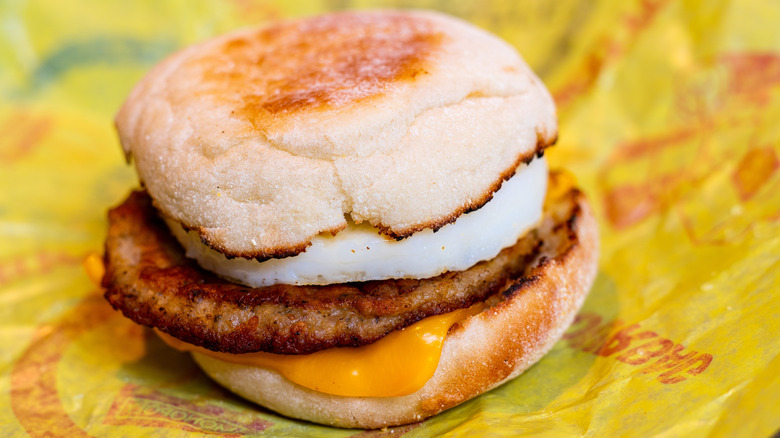
The McDonald's Egg McMuffin is a prime example of how even the simplest dishes can be delicious. Featuring just an egg, Canadian bacon, and American cheese, all sandwiched into a toasted, buttered English muffin, it's the ideal thing to grab in a pinch. But have you ever wondered how McDonald's gets its eggs so perfectly round every single time? Well, we have, and the reason for this comes down to one simple tool invented by a McDonald's franchisee: the Teflon-coated ring.
The story of the Egg McMuffin starts, like many of McDonald's most popular menu items, with one innovative franchisee. In 1971, looking to create a unique breakfast product, Herb Peterson started experimenting with his own take on eggs Benedict. Sound familiar? The classic brunch dish combines a toasted English muffin with Canadian bacon, a soft poached egg, and a creamy Hollandaise sauce. However, Peterson quickly ran into a problem — packaged Hollandaise sauce just didn't work, so he scrapped that idea. He swapped it for a slice of cheese, then decided the egg itself should match the exact circumference of the muffin. This prompted him to invent the Teflon-coated ring. Crack an egg inside, and it cooks to the perfect size and shape for the sandwich. The rest is history, and the Egg McMuffin rolled out nationwide in 1975, becoming the MVP in the story of McDonald's breakfast menu.
Contrary to popular belief, the eggs are neither fried, poached, nor frozen. Instead, the rings go straight onto a flat-top griddle, the eggs are cracked inside and lightly whisked, and a splash of water is added before the eggs are covered and steam-cooked for about two minutes.
The Teflon ring is a multi-purpose kitchen essential
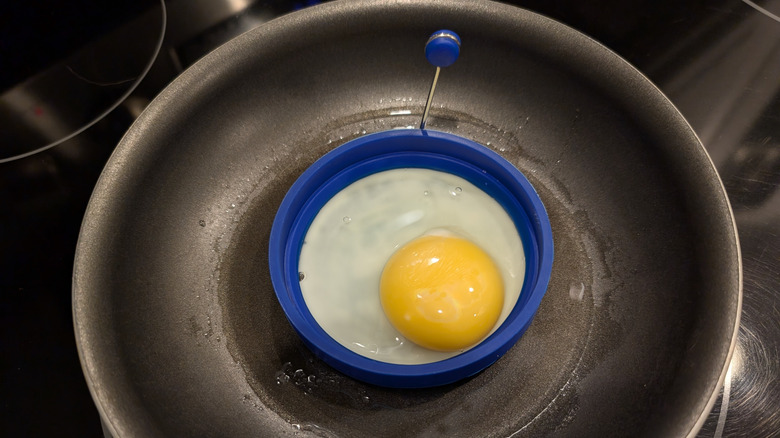
Any video of McDonald's staff using the Teflon-coated ring to prepare their eggs makes it look easy, but the internet is full of people struggling with this handy gadget. On Reddit, one home cook complained, "I've been trying to learn to cook perfect little eggs and bought an egg ring ... First attempt was messy — egg ran out from under the ring."
Several others reported the same issue, and the main culprit is usually the shape of your pan. Since the egg conforms to the shape of the ring, it's essential that the pan is completely flat and already hot when you crack the eggs in. A flat surface ensures there are no gaps between the ring and the pan, while the heat will set the base of the egg before it has a chance to slip away. If you want to use McDonald's steam-cooking method, a simple DIY approach involves pouring a tablespoon or two of water next to the eggs and quickly covering the pan with a lid or heatproof bowl.
But beyond eggs, many creative home cooks have found other uses for Teflon-coated rings. If you're looking to make the perfect copycat Egg McMuffin at home, place your premade muffin dough into the rings — which come in multiple fun shapes — then follow with the egg once it's baked. If you've got hungry kids asking for McDonald's breakfast, this is a fantastic way to make one just as good.
Another delicious use is whipping up pancakes. Pour a small amount of batter into the rings to get perfectly uniform shapes every time. This trick is especially handy if you're making Japanese-inspired dorayaki, which sandwiches ingredients like red bean paste, whipped cream, and custard between two identically sized pancakes.