

The 1979 Cookbook That Belongs In Every Kitchen, According To Alton Brown

We may receive a commission on purchases made from links.
There are so many cookbooks on the market at the moment that knowing which ones are actually worth your money can be a challenge. But sometimes, nothing really does beat the classics: TV personality and chef Alton Brown recommends that every kitchen keep a copy of "The Joy of Cooking," specifically the 1979 version.
The recommendation — which is shared by many — makes particular sense once you crack the spine. The 1975 "Joy" was not merely a stack of dinner ideas — it contained a whopping 4,500 recipes alongside reference material on ingredients and techniques. Want to know how to do everything from the basics, like baking bread, to fiddlier things, like making tahini or dealing with game? The book has your back.
Such breadth feels suited to Brown, who has always favored home cooking — one of the reasons he has never owned a restaurant — and whose "Good Eats" mixed cooking with science, history, and technique. It also explains why "Joy" appears on our list of collection-worthy vintage cookbooks. A trendy cookbook might teach you this year's dinner fad, while "Joy" gets you through decades of tried-and-tested classics.
The Joy of Cooking remains an indispensable guide
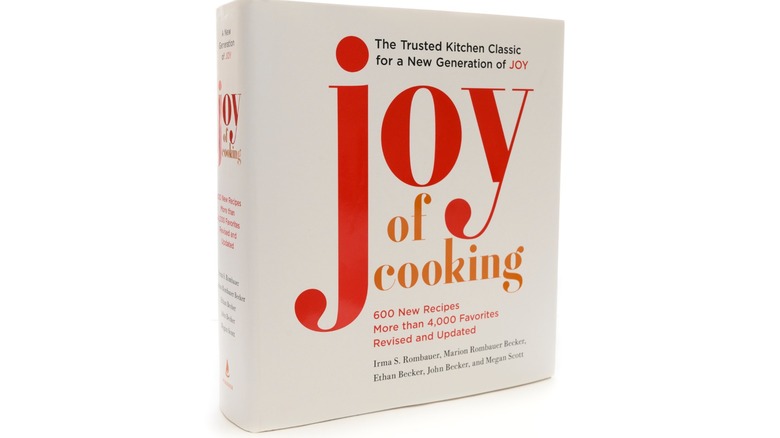
Alton Brown's 1979 copy is particularly interesting — it refers to a later printing of the 1975 classic, which is one of the many updates of the 1931 original. The 1975 edition was the book's bestselling version, according to the "Joy of Cooking" website, expanding well beyond the basics. Marion Rombauer Becker, daughter of original author Irma S. Rombauer, used her final revision to address subjects including soil health, factory farming, and sustainable eating, all of which are increasingly relevant to our current society, especially as the world tackles the effects of climate change and its impact on food production.
Its recipes were exhaustive and extensive, to say the least — a culinary United Nations, with dishes from South America, the Mediterranean, and East Asia. Its "Know Your Ingredients" material grew as well, including instructions for making tofu, tahini, and hard cheeses from scratch. Over 1,000 drawings helped visualize the recipes, so even the most inexperienced home cooks could be guided through what, for many, can be a frustratingly confusing process.
All this helps explain why an older "Joy" offers a glimpse into the history of American home cooking, especially in the postwar period, all while providing a timeless collection of dishes that we can still enjoy today. While we might look to Google now for cooking advice (or accidentally stumble upon AI-generated recipes), the advantage of having a hard-copy book — like Brown's — with time-honed advice is incomparable. That said, nobody needs to rummage through estate sales for Brown's printing: the current edition from 2019 carries the same reference-book mission into a modern kitchen, with more than 600 new recipes and a swath of updated material.