

Why Are McDonald's Happy Meals Served In A Box?
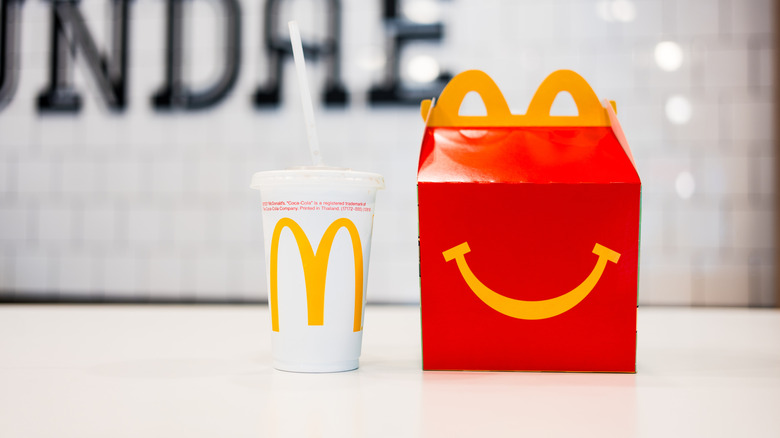
As a kid, there was no greater thrill than spotting a Happy Meal box swinging from your parent's hand. That bright cardboard box has been one of the defining symbols of the Golden Arches for just shy of 50 years. Contained inside is either a hamburger or nuggets, with kids' fries and apple slices, plus a kids' drink. But what came first, the Happy Meal or the box? The answer is neither, as they were developed side by side, with the box serving as a vessel to grab kids' attention.
McDonald's was founded in 1940, but it took several decades for a kids' menu to follow. The Happy Meal's origins can be traced in part to Guatemala, where franchisee Yolanda Fernández de Cofiño drew up the "Menu Ronald," which featured a hamburger, small fries, and a sundae built just for kids. It was a hit, and word of it eventually made its way back to U.S. executives, who wanted to expand upon her concept. Enter Robert Bernstein, an advertising executive whose agency worked with McDonald's and who developed the concept that became the Happy Meal.
Bernstein's pitch was simple yet genius: a meal just for kids. For the box, he landed on the classic lunch-pail shape, and the resulting design — known as the Circus Wagon Happy Meal — came covered in puzzles, corny riddles, and illustrations of McDonaldland mascots on every side. It was nothing like the minimalist red box we know today, but this was the '70s we're talking about. Inside, kids found a hamburger or cheeseburger with fries and a drink, plus a surprise toy. It was rolled out nationwide in 1979, and the rest, as they say, is history.
A Happy Meal isn't complete without a toy
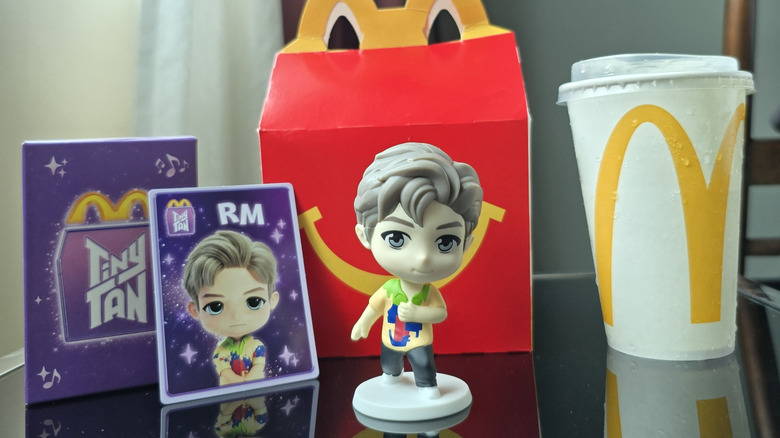
The toy has always been one of the most important parts of the Happy Meal. When drawing up the original concept, Robert Bernstein was inspired by cereal boxes, which often included a little plastic toy stuffed inside. Having kids of his own, Bernstein knew that toys were like catnip to them, and they became one of the box's most important marketing ploys.
At first, the toys were a simple affair, with the Circus Wagon Happy Meal containing either a ruler, a puzzle lock, or a plastic bracelet. But as the meal grew in popularity, so did the mini-prizes tucked inside. They were always a major selling point, and if we're being completely honest, they were the reason some of us wanted a Happy Meal in the first place. Today, many of McDonald's vintage toys, such as its hugely popular Teenie Beanie Babies and Hot Wheels, have become genuine collectors' items that can be worth considerably more than their original cost.
But the popularity of Happy Meals comes with a price. McDonald's has over 40,000 locations, and the enormous number of toys it has distributed over the decades has led to claims that McDonald's is one of the world's largest toy distributors. While the toys put a smile on countless kids' faces, they've also left behind an undeniable environmental footprint. The backlash was loud enough that, in 2021, the chain announced it would transition away from plastics toward more sustainable materials by the end of 2025.