

5 Budget-Friendly Alternatives For Granite Kitchen Countertops
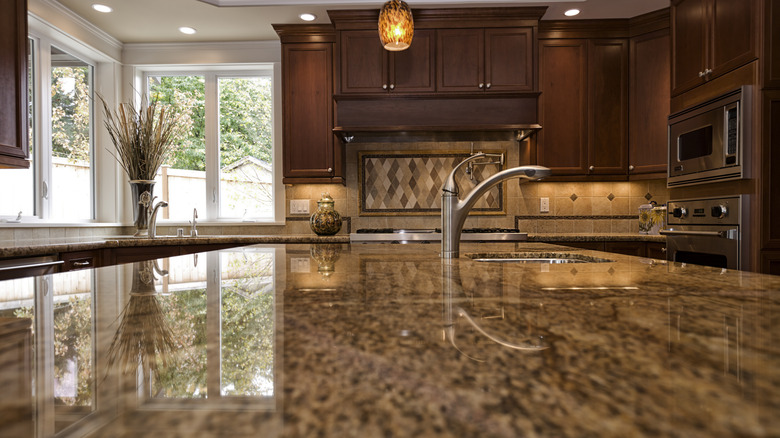
Do you want the look of a high-end kitchen remodel without the hefty price tag? Granite countertops were once the hallmark of luxury, but they aren't as popular as they used to be — which is good news for the budget-conscious. As of 2026, granite counters can surpass $200 per square foot installed, with an average product landing somewhere in the $120 range. This means, all told, a homeowner typically pays more than $10,000 for granite countertops, depending on factors like kitchen size and the grade of granite.
Fortunately, plenty of alternatives cost less and can look just as good. In fact, what's considered "luxury" in kitchens is more loosely defined than it used to be. You can pull off a chic, expensive-looking space using much more affordable countertops. And, believe it or not, some options are more damage-resistant than granite with just as long a lifespan.
Thanks to technological advances, cheaper materials can even be manufactured to convincingly imitate natural stone if you still want that granite look — and they can dupe literally any other material, too. You can get any color or pattern you want — there are virtually no limits.
Without further ado, on we plod to explore five budget-friendly granite alternatives that offer a surprising amount of design flex. You may just find you like them better than the costly O.G.
Laminate countertops have grown up since the midcentury
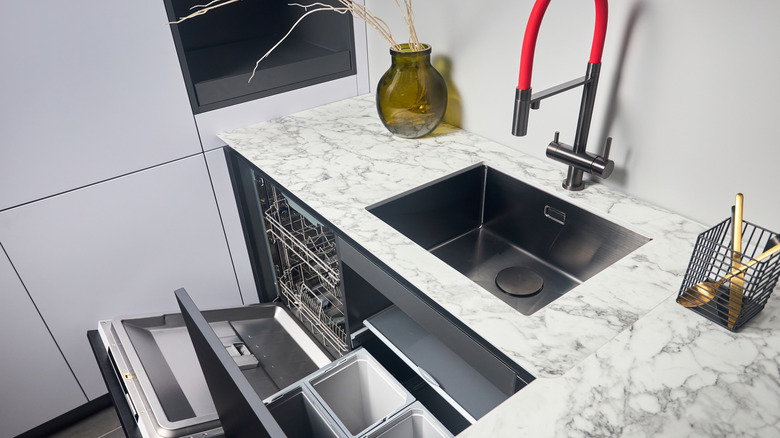
We know what you're thinking: Laminates are those awful kitchen countertops that kids in the '70s grew up with, in muted colors like burnt orange and avocado green, right? Admittedly, the post-World War II years were when laminate countertops gained prominence, but this material has grown up significantly since the days of disco. Today, laminate makers like Formica are delving into cutting-edge tech to create counters that can resemble wood, natural stone, and virtually anything else. High-definition laminates are also hitting the market with three-dimensional textures, making them feel more like real stone. You can even have a laminate surface printed with a photo or artwork.
Laminate is one of the least expensive countertop products. Even at the high end, it's significantly cheaper than granite, averaging $14 to $38 per square foot installed, with some quotes dipping as low as $10 per square foot. Today's laminates are also durable and resistant to scratching, staining, and water damage. They're a low-maintenance option, especially compared to granite, which has to be regularly re-sealed and requires special cleaning methods and products. Laminate can also be fairly easily DIYed if you're handy and want to save money on installation.
A modern laminate's average lifespan is around 20 to 30 years, meaning it may need replacement two to three times before a granite countertop will, as granite can last between 50 and 100 years. That's only if it's properly maintained, though; if not, longevity greatly diminishes in even the toughest counters. The grade of granite factors in, too — a lower-grade product won't last as long.
Solid surface countertops are an upgrade from laminate and, in some ways, from granite
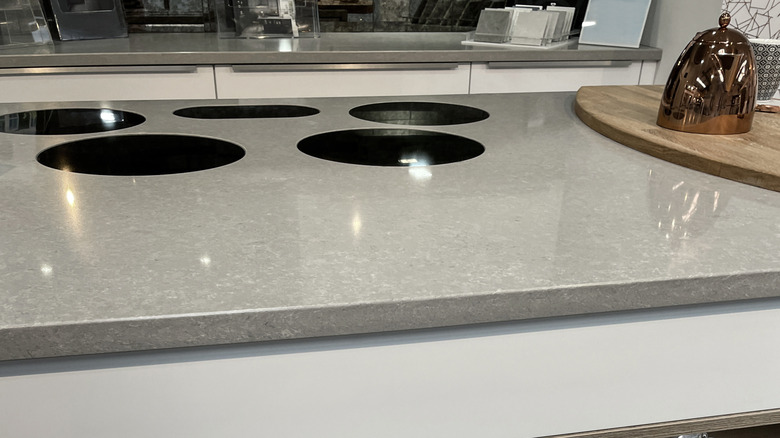
Solid surface countertops are manufactured from natural minerals and high-performance acrylic resin. The product was actually developed as a better alternative to laminate. Like laminate, solid surface countertops can be made to mimic natural stone, and they do so with greater longevity. Like granite, solid surface counters are built to last a lifetime, but unlike granite, they require minimal upkeep.
The cost for solid surface counters ranges between $50 and $150 per square foot, installed. While you may not end up with a huge savings compared to granite, it's enough to make them a contender.
A unique attribute of solid surface countertops is that they can be easily repaired, which greatly extends their lifespan and, thereby, saves you money. If the material is scratched, scorched, or otherwise damaged, you can gently sand it down to remove the impairment. This is possible because the colors and patterns run through the full thickness of the material.
Unlike real stone, a solid surface counter can be molded into specific shapes and formed to create curves and customized edges. This gives you a lot of design freedom and the ability to fit odd spaces more easily. The fabrication process also results in hidden joints and seams for a uniform look.
As with laminate, solid surface counters are a candidate for DIY installation to save even more. They also have great customizability since they're an engineered product, giving you a wide array of colors and patterns to choose from.
The design versatility of tile can make it a beautiful, budget-friendly option
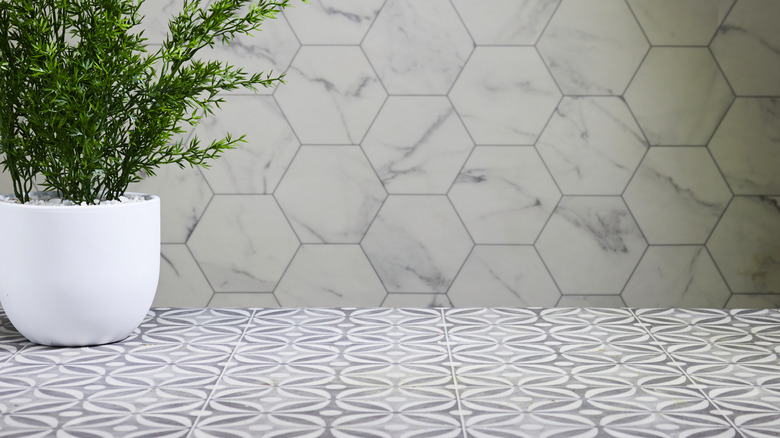
Tile countertops, popular in decades past, are another budget-friendly option that is making a comeback. Some of the reasons they went out of use still exist as potential issues today, like the inherent difficulty of keeping grout clean on a high-traffic culinary surface and the unevenness tile creates, like a cobblestone road across your kitchen. But the benefits can outweigh those drawbacks.
First, there's pricing. Cost varies depending on material, but budget options like ceramic tile can ring up as low as $10 to $15 per square foot, installed, with prices going up from there for higher-end tile and custom projects requiring more intricate work. Ease of repair is another bonus, as you can replace just one affected tile rather than the whole countertop if damage occurs.
As with some others, tile offers great design flexibility. There's the visual interest of mosaic patterns, the light-bouncing properties of reflective tiles, and hundreds of styles. Like laminate, a porcelain tile can be printed to mimic natural stone and other higher-cost surface materials – if your heart is set on granite but that doesn't fit your budget, there's always the option of natural stone tile. It's pricier than other tiles but is still significantly less expensive than a full granite slab and still gives you the luxury and benefits of stone. Designed well, a natural stone tile can be a gorgeous addition to a kitchen, lending unique visual interest that can look more luxurious than a slab counter.
Wood requires higher maintenance but is an attractive option
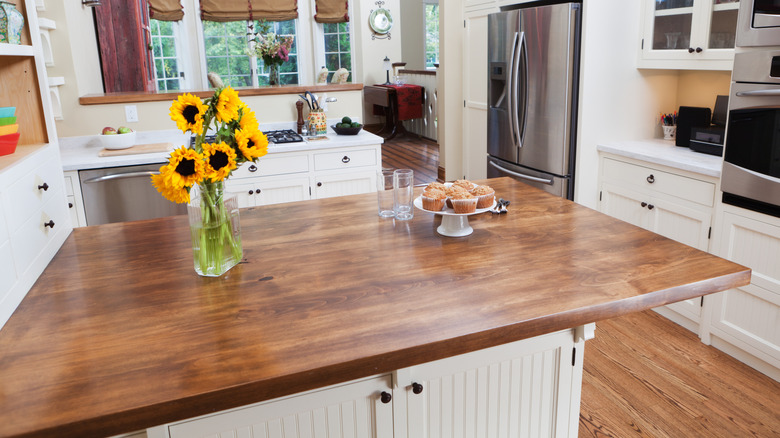
Wood isn't a common countertop surface, but it has plenty going for it. Wood counters can bring a beautiful, organic aesthetic to your kitchen, lending a touch of warmth. Budget-wise, you can DIY a wooden counter fairly easily and cheaply using a pre-cut butcher block slab from a retailer like Ikea or Home Depot. Professionally installed wood counters can also still be a budget saver, averaging $50 to $150 per square foot, depending on factors like wood type. Some of the least expensive woods commonly used in countertop application include red oak, birch, and maple.
While butcher block is a popular choice, it isn't the only option. Many have effectively DIYed gorgeous countertops using salvaged wood, bringing antique, rustic qualities. Wide planks and the unique, organic aesthetic of live edge wood are also finding their way into kitchen design, boasting the natural beauty of knots and more complex wood grains.
Some drawbacks to consider: Wood counters are very susceptible to staining, scratching, denting, scorching, and warping — you need to treat them gently. Much maintenance is needed, and failure to perform proper upkeep will have negative effects – no ifs, ands, or buts. Advancements in wood-finishing products have reduced needed maintenance in some cases, but there is still no such thing as a "maintenance-free" wooden counter. Like solid surface, wood can be restoratively sanded down and refinished, but it's definitely better to take care of it in the first place. Properly maintained, a hardwood counter can outlive its original owner just like granite, potentially lasting 100 years or more.
Concrete offers unique customizability
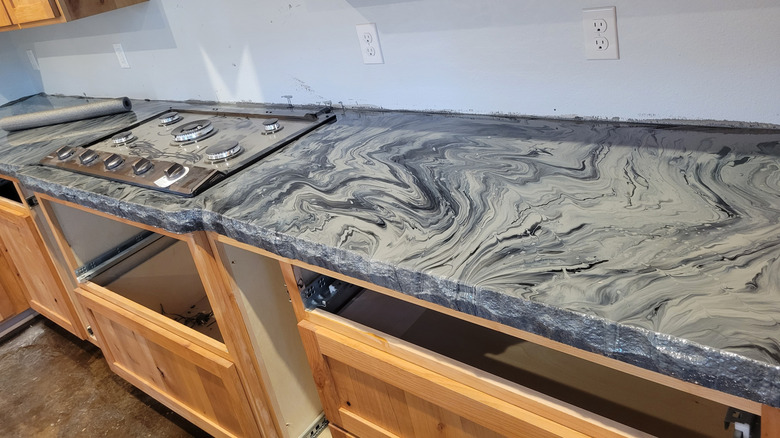
Concrete is another countertop contender people don't always think of, ranging in price from around $65 to $135 per square foot. It can be long-lasting like granite, potentially enduring 50 years or longer if properly cared for.
Like laminate, concrete is a bit of a chameleon. With the addition of pigments, it can be any color, mimic natural stone, or be made to look convincingly like wood. It can also be in virtually any shape. Elements like glass and seashells can be mixed in to create artistic effects — a concept homeowners have taken to the limit, also incorporating things like car gauges and shotgun shells. Beyond its aesthetic, concrete affords some functional customization, as well, such as built-in elements like trivets, cutting boards, and drawers. Your sink can also be built right into the countertop.
As with all types of counters, concrete has its disadvantages. It's another product that requires ongoing maintenance, including regular sealing to prevent staining, as it's porous and easily absorbs liquids and oils. While concrete countertops themselves are robust, their sealants aren't, so it's advisable to use cutting boards, trivets, and nonabrasive cleaners. Concrete can develop cracks, though minor ones can be repaired fairly easily. If cracking is due to poor installation or design, though, you'll need a professional to fix the underlying problems.
Concrete is also extremely heavy and can strain kitchen infrastructure, like cabinets and even the floor, so adding supportive reinforcements is often necessary. Installation is also not a quick process; it can take weeks for a new concrete counter to be ready for use.