

How Bourbon And Rye Whiskey Are Actually Different
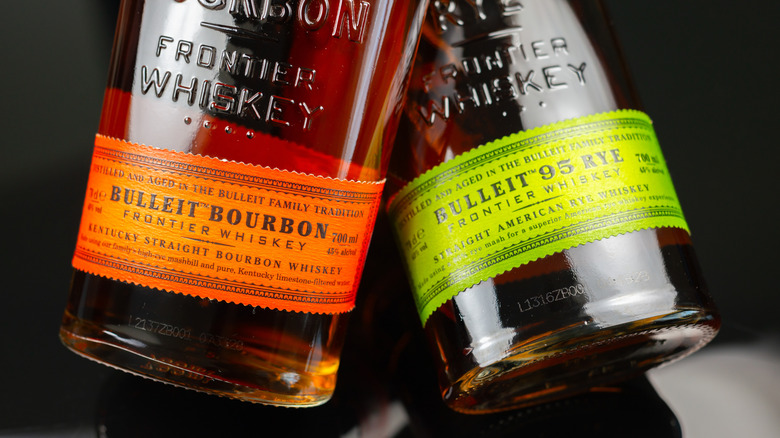
If you're looking to up your whiskey knowledge, knowing the difference between rye and bourbon is undoubtedly the best place to start. Both are classic American spirits with plenty of history, and together, they occupy a huge share of the American whiskey market. At first glance, however, they can be tough to tell apart. Under U.S. law, they share nearly identical production requirements: Both are distilled to no more than 80% alcohol by volume (ABV), entered into new, charred oak barrels at no more than 62.5% ABV, and bottled at a minimum of 40% ABV. Bourbon cannot contain added coloring, flavoring, or blending materials, and neither can straight rye whiskey. But look more closely at one key production requirement, and you'll see that these are actually two very different spirits.
The clearest distinction between rye and bourbon lies in their respective mash bills, aka the specific recipes of grains used to make each spirit. You'll often find a touch of rye in bourbon and a touch of corn in rye, but it's the overall composition that legally defines them. Under U.S. law, rye must be made from a mash containing at least 51% rye grain, while bourbon must be made from a mash containing at least 51% corn. It's this distinction that shapes the final flavors of the two spirits despite their similar production methods; rye tends to lean toward herbal and spicy flavors, while bourbon leans sweeter and rounder on the palate.
Of course, there's plenty of flavor variation within each category, too. A whole host of factors — such as the balance of grains, time spent aging, and final blend — can make two bourbons taste nothing alike, and the same goes for rye whiskey.
Rye whiskey is produced all over the world
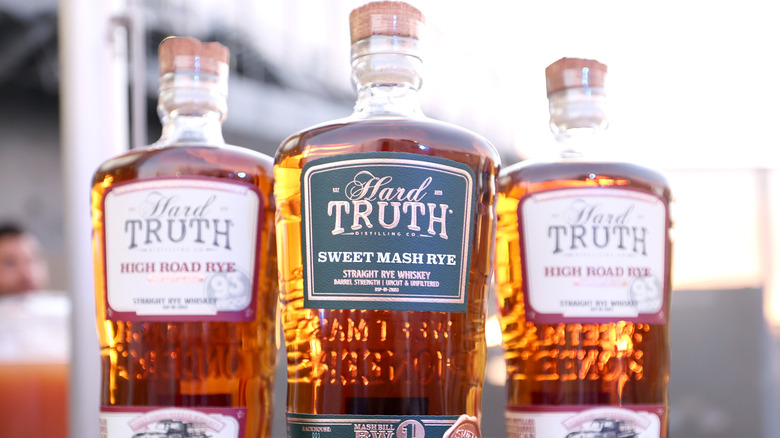
Another striking difference between rye and bourbon is their individual histories. Rye whiskey became established among European settlers in the Northeast and Mid-Atlantic by the mid-18th century; the climate of the area proved agreeable to the grain long before corn-based bourbon came to dominate Southern whiskey production. As a result, rye is often described as one of the earliest grain whiskeys produced in America. Yet, despite its American roots, rye whiskey is produced all over the world, and nations such as Canada, Germany, and the Netherlands also bottle and label their own distinct expressions. This is in stark contrast to bourbon, which can only be produced within the United States, where all distillation and barrel aging must take place.
As the name suggests, American rye whiskey must be made with a minimum of 51% rye grain and aged in new, charred oak barrels. Up north in Canada, however, local laws don't mandate any minimum percentage of actual rye, and many distilleries use mostly corn, which, under U.S. standards, would make the mash more similar to bourbon's. Under U.S. standards, however, rye's rye-dominant mash gives it a considerably drier and spicier profile than the sweeter corn base used for bourbon.
These differing grain percentages also influence how the spirits interact with charred oak barrels while aging. While this is by no means a strict rule, rye whiskey is often bottled younger than bourbon, as producers may find that its assertive spice and herbal flavors reach their desired balance with oak at a younger age.
Bourbon is the most popular American whiskey
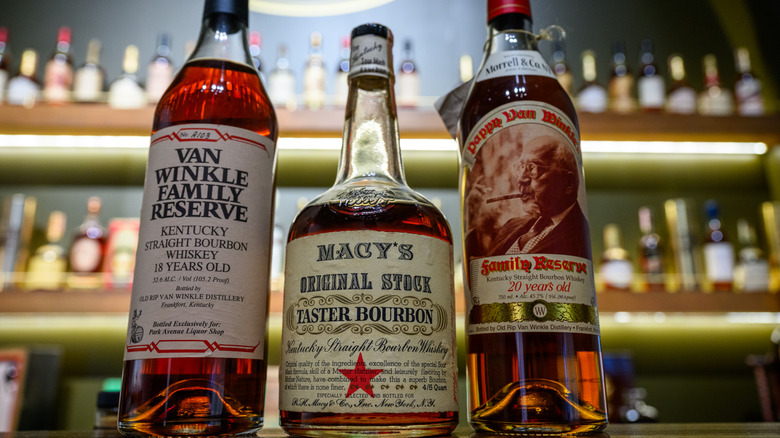
Bourbon's roots are generally traced to the late 18th-century American frontier, where early Kentucky settlers found that the region's abundant corn made for an excellent mash. Its name is commonly linked to Bourbon County, itself named for the French House of Bourbon in gratitude for France's support during the American Revolution. However, the exact link between the county and the whiskey's name remains a point of contention among historians, with some scholars linking the name instead to Bourbon Street in New Orleans, where Kentucky whiskey was once sold as a cheaper alternative to French cognac.
Popularity also sets bourbon apart — it vastly outperforms rye, commanding 49% of the U.S. whiskey market in 2025 and over 65% of domestic production, compared to rye's 16% market share (per 360 Research Reports). However, rye is presently experiencing a massive resurgence following a steady decline that began during Prohibition and lasted into the 2010s.
Legally, bourbon must use at least 51% corn — typically, though not exclusively, hard, dry yellow dent corn. That corn provides bourbon's foundational sweet, full-bodied profile. The remaining portion of the mash bill is filled out with flavoring grains such as malted barley, rye, or wheat.
You might also be surprised to learn that Tennessee whiskey generally meets the same production standards as bourbon, although it is legally and commercially recognized as a distinct product. Following industry lobbying led by Jack Daniel's, Tennessee enacted a legal definition for the category in 2013. Under Tennessee law, the whiskey must be produced exclusively within the state and, with one narrow statutory exception, filtered through maple charcoal before aging.