

Cortado Vs Macchiato: How The Coffee Drinks Differ

If you're popping into a speciality coffee shop and want to look like you know your stuff, the first order of business is being able to distinguish different styles of espresso-based drinks. Sure, everybody knows the difference between a latte and cappuccino, but things get a little more complex when niche styles like the cortado or macchiato come into play. At a glance, they don't seem too different; both are small, espresso-forward beverages that are great for a quick pick-me-up. But that's pretty much where the similarities end, and once you get into the nitty-gritty, you'll never mix them up again.
Before unpacking the differences, let's clear some things up: all espresso-based drinks follow the same formula of espresso and milk. But it's the ratio of these components, the serving size, and the texture of the milk that create distinct styles. The milk-to-espresso ratio is perhaps the most important variation. In a cortado, it always follows an equal ratio, whereas a macchiato can take a broader interpretation, with some versions using very little milk while others lean heavily on it.
Another important distinguisher is how the milk is steamed. When steaming milk, baristas carefully control how much air is introduced; a little air gives the milk a smooth, glossy texture, whereas a lot gives it a drier, foamier consistency. When it comes to the cortado and macchiato, they sit on opposite ends of the spectrum. We like to think of a cortado as a mini-latte, whereas a macchiato has the spirit of a (very, very small) cappuccino.
The Cortado is a Spanish staple

You might know the cortado is a staple of third-wave coffee shops, but the iconic beverage traces its roots back to the working-class communities of Spain's Basque Country. Born in the early 20th-century, the purpose of the drink is hinted at in the name: Taken from the verb cortar, meaning to cut, it refers to how the splash of warm milk cuts through the bitter, acidic punch of the straight espresso. Its well-balanced flavor carried it far and wide, but it's still most at home in Spain, as well as its neighbor Portugal and cousin, Latin America.
The golden ratio for a cortado is a simple 1:1 balance of espresso to milk, served in a small glass. It's important to stick to this ratio, as the espresso should still be doing all the heavy lifting here. Add too much milk, and you'll be veering into mini-latte territory. However, like a latte, the milk's texture should still feel silky, so make sure to steam it with only a small amount of air to keep it glossy and lightly textured rather than foamy and bubbly.
The name of the drink might also change depending on where in the world you order it. Over in San Francisco, a cortado has become indistinguishable from a "Gibraltar," referring to the city's coffee shops, which typically serve it in a 4.5-ounce Libbey Gibraltar glass. There are also several regional spins on the classic. In Cuba, you'll find the cortadito, an espresso whipped with sugar to create a sweet foam, which is then topped with an equal ratio of evaporated milk. Spaniards are also known to enjoy a cortado condensada, which substitutes steamed milk for condensed milk for a richer and sweeter texture.
A macchiato serves a unique purpose
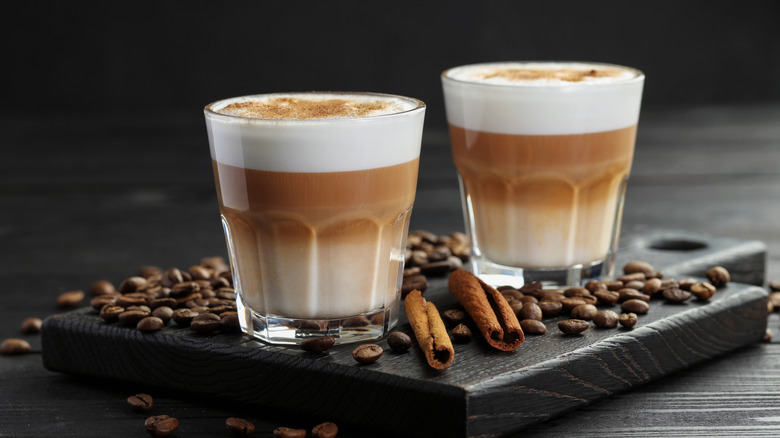
While the cortado has been around for some time, the macchiato hit the coffee scene relatively recently. Originating in Italy during the 1980s, the name means "marked" or "stained," referring to the tiny splash of milky foam added to the espresso shot. Allegedly, baristas invented the drink to help waiters tell apart a classic plain espresso from those ordered with milk. When topped with a dollop of foam, it's something of a mini-cappuccino, but unlike the strictly pre-11 a.m. drink, Italians prefer to enjoy a macchiato later in the day.
While a cortado adheres to a strict ratio, the macchiato is more open to interpretation. Two of the most common types are espresso and latte. For an espresso macchiato, a single or double shot is topped with a teaspoon or two of steamed foam. Typically, the milk is steamed with a lot of air to give it a frothy texture that floats on top of the shot. There's no right or wrong way to serve it, and you'll most often find it served in an espresso glass or a short glass. For a latte macchiato, the script is flipped, and a shot of espresso is poured into a tall glass of steamed milk to show off its distinctive layers — you're marking the milk with the coffee, here.
With the number of macchiato variations, we'd forgive you if you weren't exactly sure how the drink is made. It's only been made more confusing by several major chains who've taken their own creative liberties with the beverage. Take Starbucks' caramel macchiato, a less-than-traditional interpretation that features a large volume of sweetened milk topped with a shot of espresso and a drizzle of caramel. While it's certainly delicious, we'd recommend not telling any Italians about this one!