

How Southern France Makes Pesto
We may receive a commission on purchases made from links.
Italy may have given us pesto, the deliciously fragrant green sauce that can turn any pasta — as well as many other dishes, including chicken salad — into a Mediterranean-flavored delight. Few know, however, that a mere few hundred miles across the border from pesto's birthplace — Genoa, on the Italian Riviera — southern France has its very own form of pesto, "pistou," which is lighter, easier to make, and just as exquisite.
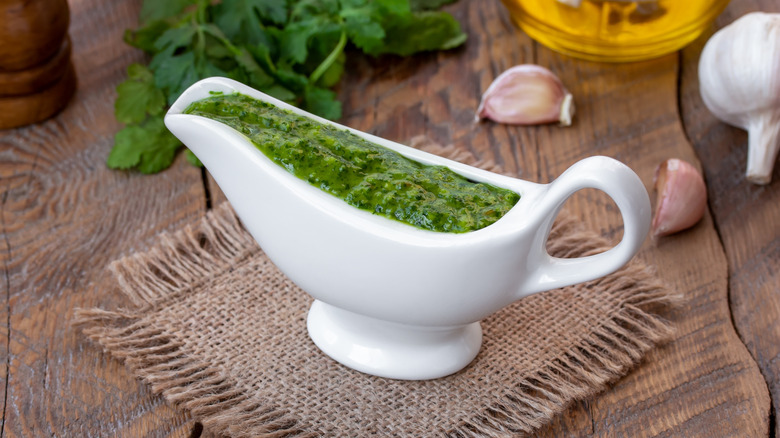
At a glance, the two sauces look — and sound — remarkably similar. Both vivid green, basil-forward, garlicky, and thick in texture. This isn't a huge surprise, as southeastern France — especially Provence and its Côte d'Azur — and northern Italy's Liguria (better known as the Italian Riviera) share deep cultural, linguistic, and geographical similarities. Indeed, southern France has its very own version of pizza and focaccia: pissaladière and fougasse, respectively. But while both pesto and pistou share similar core ingredients and etymology — from the word to "crush" or "pound," referring to the original preparation method with a mortar and pestle — this does not mean the recipes are exactly the same.
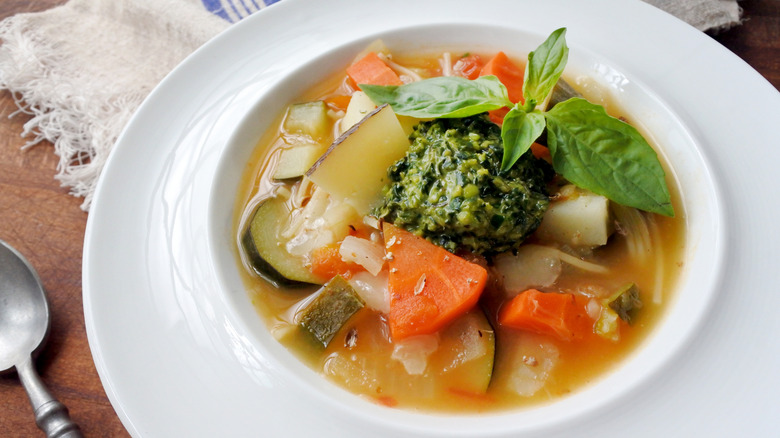
Pistou, like pesto, has basil, garlic, and olive oil, but lacks two of the latter's key ingredients: parmesan and pine nuts. Lacking the cheese and nuts makes pistou leaner, more delicate, and simpler overall — as well as vegan-friendly — which also explains its traditional use in Provençal summer soup dishes with vegetables and beans, where it's added to a bowl right before it's eaten.
Pistou is lighter, cheaper, and easier to make
Originating in Provence and especially prevalent in the Nice area of the French Riviera — a territory which culturally and historically overlaps with Italy — there's a back-and-forth debate on whether pistou or pesto came first. But, as Jacques Médecin, one former mayor of the glamorous city — known for its jet-set appeal and lush seafront Promenade des Anglais — noted in his book "Cuisine Niçoise: Recipes from a Mediterranean Kitchen," what we can say for sure is the French keep things simpler. "I will make no attempt to settle the question of whether pistou migrated from Nice to Genoa, or vice versa, but let me simply say that the Ligurians like to add 100 [grams] of pine nuts to the ingredients pounded in the mortar," he remarked.
And that's pistou's main asset: You can get all the herbaceous deliciousness of pesto, without needing the more expensive, and often harder to find, ingredients like pine nuts and Parmigiano-Reggiano. All you need to do is crush the garlic with a pinch of sea salt, then gradually work in the basil, and incorporate the oil until appropriately spoonable and thick in texture. Unlike pesto, which is harder to produce well in a blender as the blade can flatten the freshness of the sauce, pistou can be whipped up perfectly in any regular food processor. It works amazingly in a myriad of recipes — from pasta to salads or poured over grilled meats and vegetables — and is a quick, inexpensive way of bringing a hint of the French Riviera to even the most basic of dishes. If you want to further elevate your pistou, you can try some Provençal variations: adding finely diced tomato for freshness, anchovies for umami depth, or chilli flakes for an extra kick.