

Grilling Vs Poaching Salmon: Which Cooking Method Is Easier?
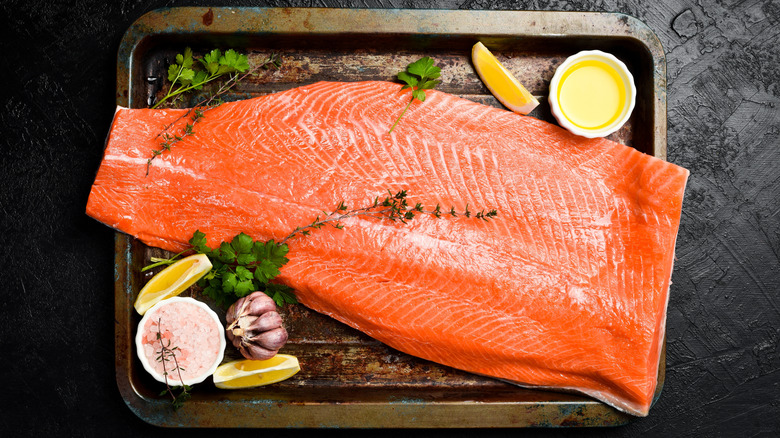
Of all the species of fish that are consumed in the USA, none are more popular than salmon. It has a firm flesh distinguished by its pinky-orange hue, which can range in vibrancy to look like anything from pastel peach to tomato red, and is found in cold waters in the Pacific and Atlantic oceans. There is more species variety on the West Coast, and the only species on the East Coast almost became extinct and is almost exclusively farm-raised today, giving it a different character from wild-caught salmon. Regardless of species, it's an oily fish with a rich flavor and can be cooked using many techniques, including grilling and poaching.
Grilling is a pretty straightforward method that involves cooking over direct heat (i.e. not in a pan or other cooking vessel) at very high temperatures, usually between 500 and 550 degrees Fahrenheit. This cooking style usually involves an open flame, and most home cooks in the U.S. will use either a gas or charcoal grill. Poaching, on the other hand, is a little more variable and includes several sub-techniques but generally consists of cooking things inside a liquid over very low heat, between 160 and 184 degrees Fahrenheit. Poaching salmon is easier for a home cook, overall, since you can do it on your stovetop with equipment you may already have, while grilling requires special equipment and the space to use it. However, there's a little more nuance to each method that may help you decide which is easier for you.
Grilling salmon produces flavorful results but requires outdoor space and can be finicky to master
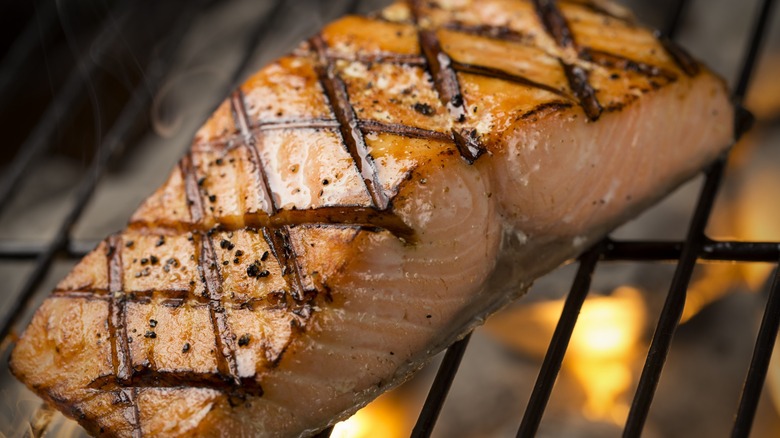
Most home kitchens don't have an exhaust system that is powerful enough to suck up all the smoke that a grill produces, so you generally need an outdoor area where you can set up your equipment. If you live in a single-family home with a yard, you can probably grill, although some neighborhoods may place certain restrictions. If you live in an apartment — even one with an outdoor patio — building management may prohibit it altogether. Community grills do exist in public parks, beaches, and building common areas, but they can often be poorly maintained and ruin delicate proteins, like salmon.
The equipment is also finicky to work with. Charcoal grills can be inexpensive, but getting a fire started on one can take a long time, and weather conditions can seriously impact it. It's also very difficult to control the temperature and prevent overcooking, and it requires near constant attention. Gas grills can be exponentially more expensive, but they are quicker and easier to use while also giving you more temperature control.
If you already have the necessary setup and equipment, though, grilling can be a breeze if you are experienced in this technique. Cooking over an open flame — even one that you can adjust with a dial — is still not as precise as cooking on a stove; each grill is different, and only consistent use will help you determine how well and how fast your grill cooks food. Despite all of this, the high heat involved in this cooking method does yield crisp skin and flavorful browning, and this technique also lets you add bold seasonings to your salmon. And there are certain ways you can prepare your fish, like rolling it, that can help achieve more even cooking without breaking apart or flaking into pieces.
Poaching salmon is feasible for most home cooks, but the flavors can be muted
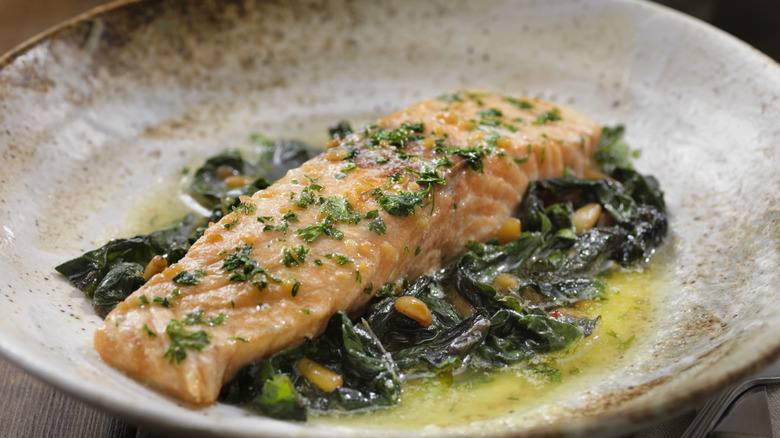
If you have a heat source that you can control precisely, some sort of heat-proof container, and some type of liquid, you can poach. So, even if you're in a college dorm and only have a hotplate, a leftover 2-liter of Sprite, and a foil pan, you can make a salmon dinner. And you don't even need an exhaust hood or to crack a window because the cooking temperature is so low — below a simmer — that it produces no smoke or heavy steam.
You also have a few more specific technical options within the broader poaching method. You can fully submerge your salmon in liquid, submerge it half way and cover it, or poach it halfway and then remove it from the burner to finish cooking in the residual heat. Because you need a liquid for poaching, you're almost pushed towards being creative with your approach. Besides citrus-flavored soda, you can use broth, wine, butter, or even milk for a more flavorful poached fish, along with as many aromatics and seasonings as you'd like.
There are a couple of drawbacks, though. For starters, not all heat sources are created equally, and trying to maintain such a low temperature without your liquid making a single bubble can be difficult for many standard stoves, especially older electric models. A portable butane burner can be a solution, or you can use a diffuser plate under your pan. And despite all the ingredients you add to your poaching liquid, this technique yields salmon with a milder flavor than grilling. Nevertheless, you can remove the poached fish before it has fully cooked and brown it on a hot pan, or you can use a grill pan to get the best of both poaching and grilling.