

Thousand Island Vs Russian Vs French Dressing: What's The Real Difference?
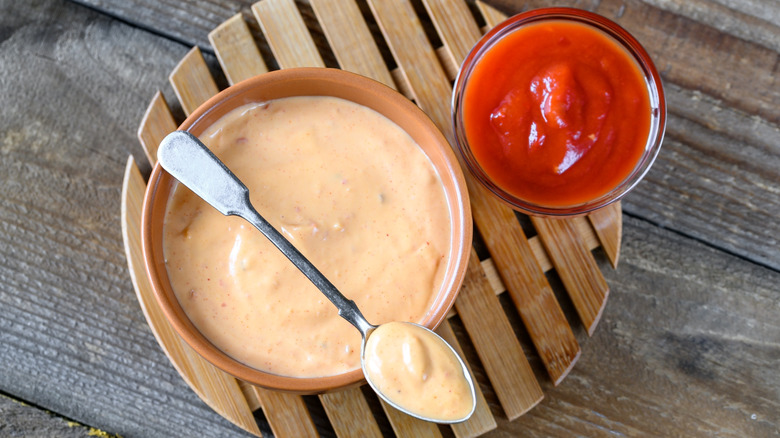
Ketchup is more than just a condiment in American cuisine. It's also an ingredient that forms the foundational flavor of many dishes, from sloppy joes and meatloaf to barbecue sauce and shrimp cocktail. It even features in cuisines influenced by U.S. military occupation, especially in many pasta dishes from countries like the Philippines, Japan, and Haiti. But it's also the backbone of three popular condiments that may sound like they immigrated from the far corners of the earth but were actually developed right here in the USA. If you've tucked into a Reuben sandwich at a deli, ordered a Big Mac at a drive-thru, or reached for a ladle of orange sauce to drizzle onto your plate at a salad bar, you've likely encountered some version of one of these dressings: Thousand Island, Russian, and French.
Since all three are made with the sweet, tangy, tomato-based building block of flavor, they often get confused, and even the recipes get blurred to the point where you may sometimes feel like you're having the exact same thing under different names. But the truth is that while each has a similar flavor base from ketchup, they have different origin stories, ingredients, and unique personalities. If you know the difference, not only will you be able to tell them apart, but you'll also know whether a restaurant is using the right name. At the very least, you'll be able to show off your culinary savvy!
Thousand Island dressing is built on three core ingredients
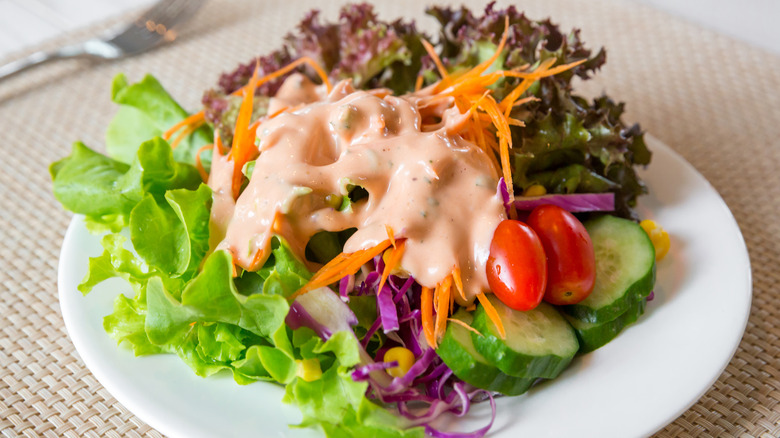
Thousand Island dressing may have a name that conjures up images of tropical destinations, but its origin stories (there is more than one) actually take place in New York. One legend attributes it to Oscar Tschirky, the personal chef of George Boldt, who opened the luxurious Waldorf Astoria hotel in New York City. At the turn of the 20th century, many wealthy people from the city would spend their vacations in a chain of islands located in the St. Lawrence River called the Thousand Islands because there are nearly 2,000 of these land masses in the area. Tschirky presented a salad to Boldt and his love interest that combined ketchup, mayonnaise, pickle relish, Worcestershire sauce, and a hard-boiled egg.
Another story credits the sauce to Sophia Lelonde, who ran the Herald Hotel during the late 1800s in Clayton, New York, a small riverside town near the Thousand Islands. She served a version of the dressing at her establishment, the wealthy vacationers loved it, and they brought bottles of the stuff back to the city.
The modern recipe for Thousand Island dressing is said to be an amalgamation of many historic versions, and it can still vary from cook to cook. Some variations call for vinegar or lemon juice. Others call for a spicy kick from hot sauce or other fiery spices, while still others include mustard. But what they all have in common is a combination of mayonnaise, ketchup, and pickles.
American-born Russian dressing is defined by its spicy flavor
While Thousand Island dressing is attributed to the place it's named after, the same cannot be said about Russian dressing. It was invented by James Colburn in New Hampshire within the first decade of the 20th century. The original recipe was a very luxurious and involved preparation that called for ground lobster shells for color, along with caviar, which is probably how it got its name. The recipe gradually became more accessible, replacing the crustacean exoskeletons with ketchup and omitting the fish eggs altogether.
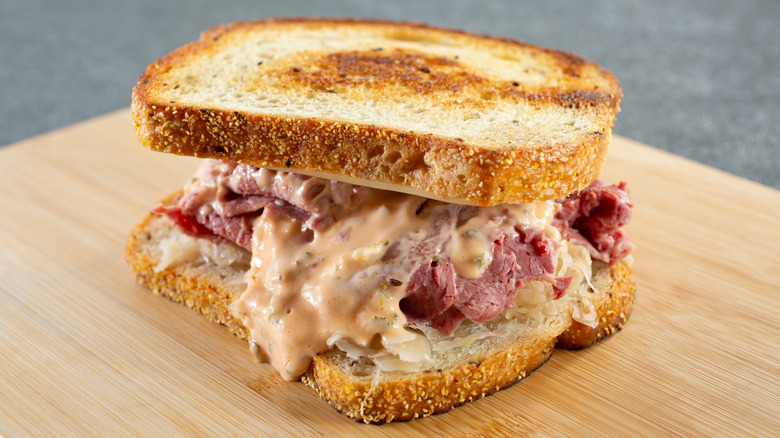
Some recipes also included pickles, conflating it with Thousand Island dressing. Nevertheless, the true difference between the two sauces is that Russian dressing tends to have a sharper, sometimes spicy kick. This often comes from horseradish, although other recipes call for hot sauce. However, recipes for both sauces can overlap, and even though a Reuben sandwich is supposed to include Russian dressing, some restaurants' creamy pink condiment may just be Thousand Island dressing in disguise.
French dressing is a uniquely sweet vinaigrette
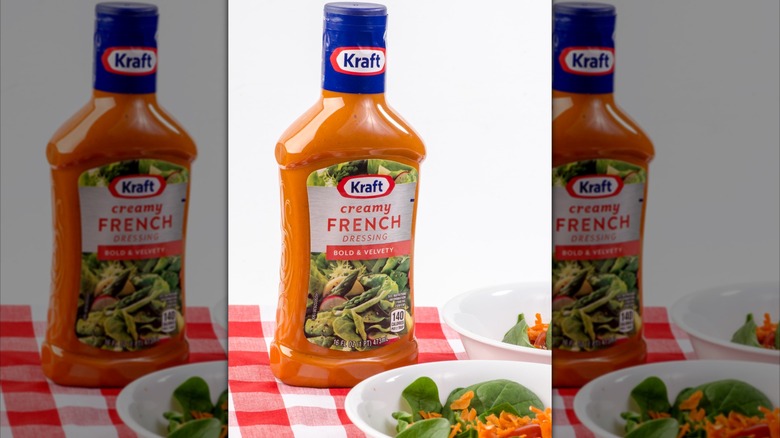
French dressing stands apart from Russian and Thousand Island dressings in that it's a vinaigrette and contains no mayonnaise. French dressing actually used to refer to any vinaigrette, as the French were well-known for dressing salads in this tangy mixture of oil and vinegar. Around the early 1900s, ketchup, chili sauce, or paprika began to be added to the basic vinaigrette, giving the emulsion an orange or reddish hue and a creamier mouthfeel. By the mid-20th century, mass-marketed versions of the French dressing we know today also acquired a much sweeter flavor profile than the classic European recipe from which it took inspiration, and most modern preparations include a significant amount of sugar.
Many recipes also call for paprika for added color, along with onions, garlic, and other seasonings to give it a bit more nuance. And while the other two ketchup-based dressings can be made simply by combining a few condiments, French dressing sometimes requires just a little more work. To achieve its velvety consistency, many recipes require you to blitz all the ingredients in a blender while adding a steady stream of oil, creating an emulsion similar to, but thinner than, mayonnaise. Today, this sweet and tangy dressing is a staple for crisp garden salads and crunchy slaws, but it also doubles beautifully as a vibrant glaze or flavor booster for homemade meatloaf.