

The Companies Behind McDonald's Burger Patties
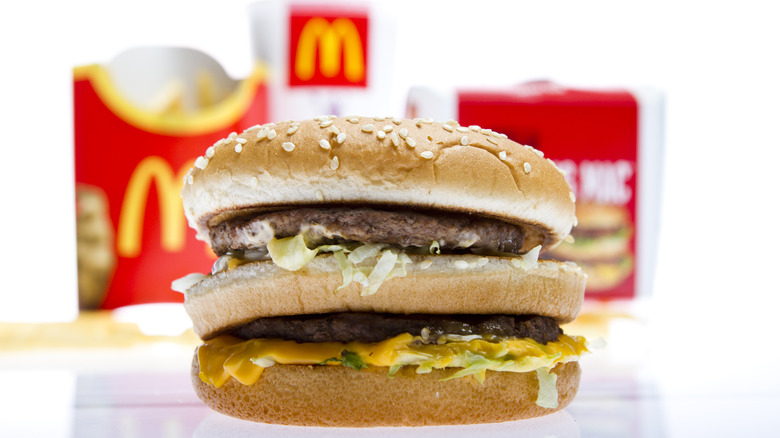
The beauty of a McDonald's burger is that it tastes exactly the way you want it to, every single time. The fast food chain built a reputation for itself based on speedy service, affordable prices, and most importantly, consistency. But with over 38,000 global locations, it would be near-impossible for just a single company to supply each and every burger patty. Instead, it sources its delicious beef patties from a wide network of international meat-packing and processing companies, and in the States, two of its biggest suppliers are Lopez Foods and Keystone Foods, whose respective relationships with the chain go back decades.
Aside from being the chain's biggest suppliers, both companies have played an important part in the history of the company. McDonald's is known for primarily using frozen patties, which helps preserve the flavor and moisture of the meat while simultaneously streamlining operations. This flash-freezing method — also known as Individual Quick Freezing (IQF) — was pioneered by Keystone Foods in the 1960s, revolutionizing how fast food chains operate. Today, the company continues to supply McDonald's with its beef patties, contributing over 150 million pounds of beef, as well as chicken and fish for its McNuggets and Filet-O-Fish.
But while the McDonald's Big Macs and Hamburgers patties are made using frozen beef, the Quarter Pounder stands out as the chain's only non-frozen burger, which was only made possible by Lopez Foods. Founded by John C. and Pat Lopez, who were among McDonald's first Hispanic franchisees, the company went on to work with the chain to pilot the fresh beef Quarter Pounder, which proved hugely popular. Following the success of this test, they became a key supplier responsible for producing and distributing beef patties.
McDonald's claims to put quality and sustainability at the forefront of its operations
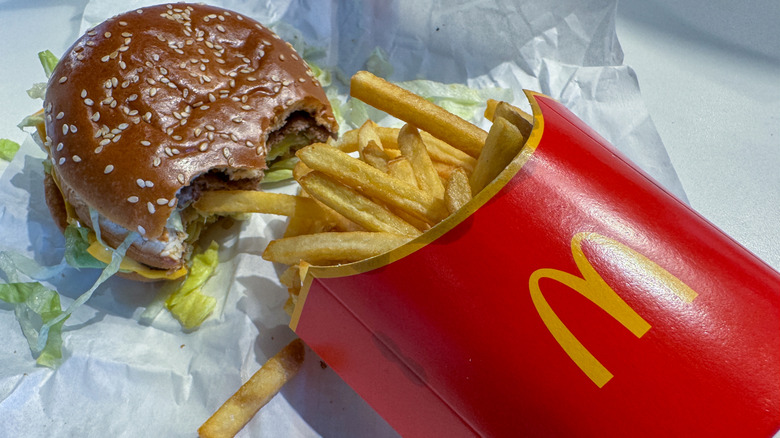
Despite its goals, McDonald's doesn't have the strongest reputation when it comes to food quality. That skepticism certainly hasn't been helped by viral videos showing McDonald's burgers appearing almost unchanged even after sitting out for days. However, the chain has frequently pushed back against those claims, and the company maintains that its standard burger patties are made from 100% beef with no fillers, additives, or preservatives, and are simply seasoned with salt and pepper during cooking.
These claims are also backed by McDonald's beef suppliers. According to Lopez Foods, the company supplies McDonald's with 100% USDA-inspected beef patties containing no additives or preservatives. The same is true of McDonald's other major suppliers, and the chain has praised Keystone Foods for maintaining strict production standards, stating that the supplier goes "above and beyond USDA regulations to meet McDonald's strict animal welfare, product safety[,] and quality requirements."
Beyond quality, sustainability has become one of the biggest talking points in the fast food industry. With growing scrutiny around animal welfare, emissions, and environmental impact, chains like McDonald's are under increasing pressure to ensure their suppliers are adopting more sustainable practices. In 2024, Lopez Foods partnered with Syngenta and McDonald's on a new initiative aimed at improving cattle feed efficiency using Enogen corn, an innovation designed to help cattle convert feed more efficiently to reduce methane emissions. However, it's not all positive. Like many major meat suppliers, Keystone Foods operates within the industrial farming system, which has faced intense criticism over greenhouse gas emissions and animal welfare concerns. So if McDonald's wants to ensure its entire supply chain is truly sustainable, it still has work to do.