

How To Grow A Watermelon Plant From Your Leftover Seeds
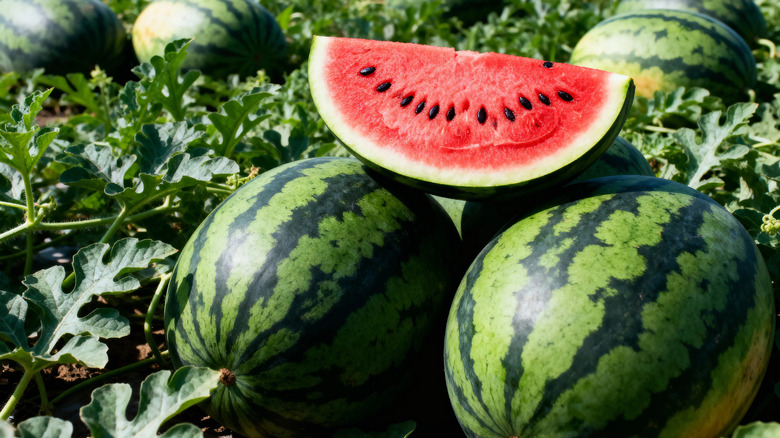
When summer comes around, a slice of watermelon is never a bad idea. No one is complaining about the juicy red flesh, but the seeds and rinds rarely get the same love. Most of the time, they end up in the trash, and (kinda) seedless watermelon varieties have been developed to avoid them altogether. They're perfectly safe to eat, but if they're not your thing, you should still think twice before tossing them out. On average, a watermelon contains hundreds of seeds, the majority of which can be used to grow a whole new fruit!
Seeds are super easy to remove. Slice your melon into quarters or wedges, and use the tip of a knife to gently scrape out the seeds. Once you've gathered a healthy amount, you'll want to rinse off any residual sugary pulp and dry them, which prevents mold growth and bacterial rot from taking hold. Now for the important part: Not all seeds will be viable, and to test which ones are capable of producing fruit, all you've gotta do is place them in a cup of water. The ones that sink are good to go — whereas those that float should be discarded. You could also wrap a test batch of seeds in a damp paper towel, place them inside a plastic zip-lock bag, and leave them in a warm location for 10 days. If the majority of the seeds have sprouted, chances are the rest will too.
To jumpstart germination and wake your seeds up, soak them in a cup of water for roughly 12 hours tops. Then, plant the seeds about one inch deep in a pre-watered seed-starting mix. The root grows from the pointed end of the seed, so make sure that part is facing downwards.
The conditions your watermelon plants need to thrive
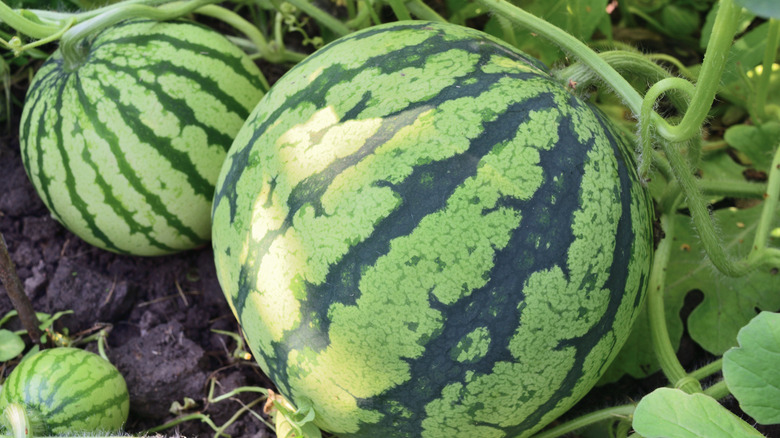
Watermelons are a sun-loving fruit. That's why the vast majority of melons are grown in Florida, Georgia, California, and Texas, which provide adequate heat and sun needed for them to thrive. In winter, we get the majority of our watermelons from South and Central America. Cold can lead to a whole host of issues, including weaker growth, and in serious cases, death. So if you live in a frost-prone region, start your seeds indoors around four weeks before your last spring frost.
Once the outdoor nighttime temperature becomes agreeable (consistently above 50 degrees Fahrenheit), they'll be ready to be transported outside. Like any plant that's been started indoors, you'll want to slowly harden them off to outside conditions to avoid shock. Over a fortnight, move the seedlings outside for increasing increments of time. When they're ready to make the big move, pick a spot in your garden that gets ample amounts of daily sunlight.
We recommend planting watermelon seedlings in a dedicated garden bed or planter, as this gives you greater control over growing conditions. Watermelons thrive in acidic, well-draining sandy loam soil enriched with plenty of organic compost — which is one of the many ways to reuse your kitchen scraps. This is the golden combo; the loose soil helps excess water drain away, reducing the risk of root rot, while the added organic matter supplies the nutrients required for large, juicy fruit. The light, non-compacted soil also makes it easier for watermelon roots to establish themselves as the plant grows. Watermelons are thirsty plants, and, once planted and established, require generous watering once a week.