

Olive Garden Servers Aren't Sprinkling Parmesan Cheese On Your Meal
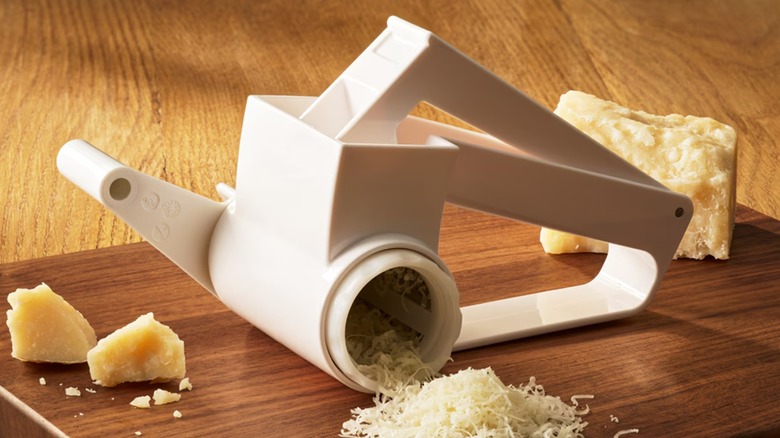
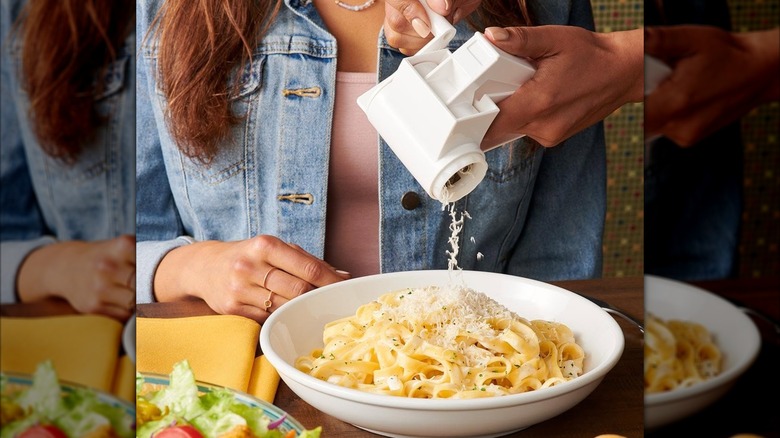
One of the joys of eating at Olive Garden happens right after your server sets your food in front of you and comes around with a chunk of cheese. There's a certain drama as the server turns the crank on the rotary grater and lets a shower of dairy rain over your dish. But what many of us assume to be parmesan cheese is actually something else entirely: Romano. How do we know this? It's simple: Just ask any Olive Garden employee, and they'll tell you. The cheese sachets you get with your to-go order also say it on the label. The Italian-American restaurant chain's website further states that it includes a wedge of Romano cheese when you purchase one of its signature graters.
This isn't some modern cost-saving invention, though, even if Romano is less expensive for Olive Garden to serve. In fact, the cheese has been around since at least the first century B.C. While it doesn't offer the exact same flavors as parmesan, it's similar enough in taste and texture to go largely unnoticed, as it's salty, creamy, just a little nutty, and adds a nice hit of umami to your freshly made soup, salad, or pasta. However, unlike parmesan, Romano cheese isn't as straightforward to define.
Mild, domestic Romano cheese mirrors traditional parmesan flavor
Parmigiano Reggiano, as it's called in Italy, is actually a government-protected style of cheese in the European country, meaning it must be made in specific regions of Italy using legally specified techniques. It must also be made with three ingredients: cow's milk, salt, and rennet. An Italian cheese that meets all these requirements receives an official PDO label, which stands for Protected Designation of Origin. Cheeses made in a similar style outside these regions, or without following the official recipe, cannot be sold in the European Union as Parmigiano Reggiano. In English-speaking countries, they are often marketed as parmesan instead.
Romano is a more general name for an array of cheeses that can be made from cow, sheep, goat, or a combination of milks. There are specific types of Romano cheese, such as the super-salty Pecorino Romano — famous for anchoring classic Roman pastas like cacio e pepe — that may have PDO status and must be made in a specific way. However, the term Romano can apply to many cheeses without involving the Italian government. Italian Romano cheeses, especially those made with goat's or sheep's milk, tend to be saltier and sharper than parmesan. However, varieties made with cow's milk are much milder and taste quite similar to the celebrated cheese we thought we were getting at Olive Garden.
In the U.S., especially in Wisconsin, Romano cheese is typically made with cow's milk. According to various Reddit users, Olive Garden serves is made by Lotito, a New Jersey-based company founded by Italian immigrants in 1952.