

Andrew Zimmern Compares This Seafood To Butter

Andrew Zimmern is the guy to go to for foodies looking to delve into underrepresented cuisines and learn some handy home cooking tips. Through his hit show "Bizarre Foods with Andrew Zimmern," the James Beard Award-winning chef traveled around the world, eating foods that many viewers had never heard of before, like the Samoan delicacy palolo and hárkal — one food that Anthony Bourdain couldn't even stomach. In one episode titled "Alaska's Inside Passage," which aired in 2013, Zimmern notably ate fresh sea cucumber, an ingredient he later went on to champion.
Zimmern shared his thoughts on the seafood dish on his website, detailing its unique texture and the best ways to prepare it. "Sea cucumber, when cooked correctly, is extraordinary. All it needs is a few minutes in a wok, with a little soy sauce seasoning. The squishy creatures taste like lettuce-y sea vegetables with a bit of crunch, but a mostly yielding buttery texture. The trick is splitting them open, scraping the innards out, and then using a spatula to peel the 'meat' off."
Sea cucumbers are elongated, soft-bodied marine animals belonging to the echinoderm group, which also includes starfish and sea urchins. Found in virtually every marine habitat worldwide and represented by more than 1,000 species, these alien-like creatures spend their lives crawling across the seafloor, consuming dead organic matter and algae. Yet despite their abundance, sea cucumbers generally remain a rarity on U.S. seafood menus.
Though harvested globally, sea cucumbers are prized in Asia
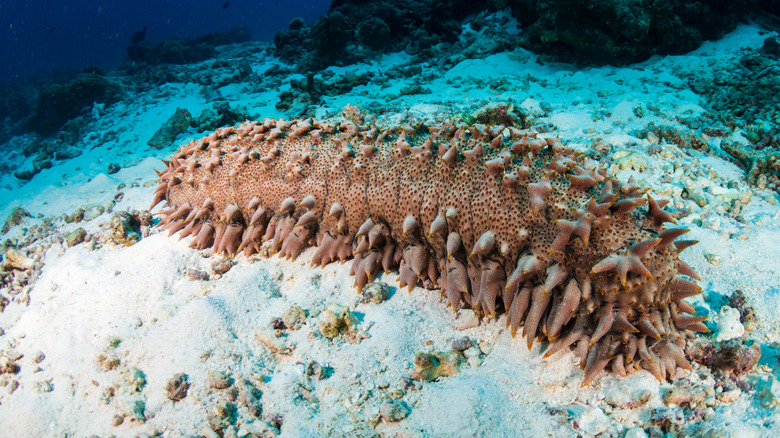
Although Andrew Zimmern first developed his love for sea cucumbers in Alaska — one of America's primary producers — they're far from an everyday food for most Alaskans. While the creature rarely appears on local dinner tables, the state supports a thriving commercial dive fishery centered around the giant red sea cucumber. Much of that harvest never stays in Alaska and is instead exported to Asia.
Compared to Alaska's and California's modest production, the Asia-Pacific region accounts for roughly 72% of global consumption and 64% of global production (via Market Reports World). In Cantonese cooking, sea cucumbers are considered one of the "Four Treasures of the Sea," a group of highly prized dried seafood delicacies that have long been associated with luck and special occasions.
Aside from its reputation as a delicacy, sea cucumber is also associated with a range of health benefits in many Asian cultures. Its name in Chinese literally translates to "sea ginseng," a nod to the highly prized medicinal root that has long been used in traditional medicine. As a result, sea cucumber is often promoted as a food that boosts vitality and, in some cases, is even used as an aphrodisiac. However, its popularity as both a luxury ingredient and a traditional health food has come at a cost. Strong demand has contributed to overfishing in some regions, prompting tighter regulations and conservation efforts aimed at protecting vulnerable populations from depletion.