

Are There Food Dyes In Aldi Products? Here's What To Know
Food dyes remain one of the most controversial ingredients still lining grocery store shelves. While the vast majority approved for public consumption are considered safe under strict U.S. Food and Drug Administration regulations, that hasn't done much to quell public skepticism. As consumer pressure mounts, many grocery chains are phasing artificial dyes out of their products. Although Aldi has rolled out plenty of major changes in 2026, it actually eliminated standard synthetic food dyes from its shelves over a decade ago. However, the discount grocer has announced plans to remove an additional 44 ingredients — including certain remaining artificial pigments, preservatives, flavorings, and sweeteners — from its private-label products by the end of 2027.
Looking at the list released by Aldi, it appears that the grocer already eliminated many artificial dyes from its products years ago. Back in 2015, Aldi removed 13 synthetic color additives from its private-label range, including some of the most controversial dyes on the market, such as Red 40 and Yellow 5. These particular additives have faced years of scrutiny, and for Aldi, the decision to remove them likely had more to do with shifting shopper preferences than a "health-based" motivation. As of 2026, of all the dyes Aldi previously removed, only Red No. 3 has since been formally banned by the FDA.
But while the vast majority of artificial colors have already been phased out by Aldi, some other technical colorants, like titanium dioxide — which has been banned in the European Union since 2022 — and canthaxanthin can still be found in some of the chain's private-label products. These remaining whitening agents and pigments are what Aldi is targeting in its new phase-out ending in 2027.
Removing artificial dyes will reshape how Aldi colors its products
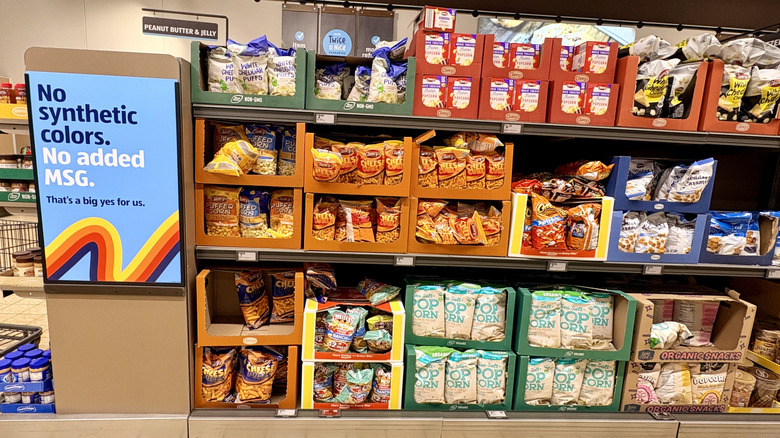
More than 90% of Aldi's products fall under its private-label brands, so the decision to phase out artificial colorings will inevitably have an enormous impact on how the chain produces its groceries. Aldi was one of the first brands to phase out artificial colorings, but this shift is beginning to spread across the industry, with natural colorings becoming increasingly prevalent. The movement has largely been fueled by support from the FDA, which has strongly encouraged companies to move away from petroleum-based dyes.
In an official press release, the FDA outlined new labeling guidance designed to make the change easier — and therefore more appealing — for brands: "Companies will now have flexibility to claim products contain 'no artificial colors' when the products do not contain petroleum-based colors. In the past, companies were generally only able to make such claims when their products had no added color whatsoever — whether derived from natural sources or otherwise."
Throughout 2025 and 2026, the FDA fast-tracked approvals for several plant-based food colorings as manufacturers began transitioning away from synthetic dyes. At Aldi, natural colorings like turmeric, paprika, and annatto — a reddish coloring derived from the seeds of the achiote tree — are already popping up across several private-label products, like cheese crackers and candy. By the end of 2027, shoppers should expect to see many more natural dyes appearing on product ingredient lists. However, don't expect the same for Aldi's non-private-label products.