

McDonald's And Burger King Use The Same Fish For Sandwiches, Yet Customers Say They Taste Way Different
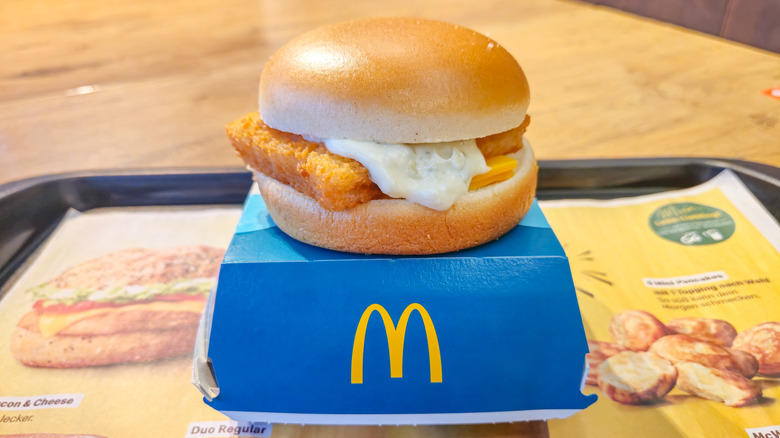
For various reasons, restaurant fish sandwiches just taste better than homemade. Fortunately, options abound for getting a quick takeout fish sammie when a craving strikes. Two leading fast-food chains, McDonald's and Burger King, each offer their own take. Though both restaurants use the same type of fish — Alaskan pollock — customers say the resulting sandwiches are wildly different.
"It tastes like fish sticks that I ate growing up, which is always just like a sentimental kick in the gut," one TikToker observed of Mickey D's Filet-O-Fish, a sentiment echoed by various others reminded of childhood fish fingers by the sandwich. Eaters compare the taste of Burger King's Big Fish to a more grown-up grocery store frozen fish product. "The patties actually taste like the yellow bag Gorton's fisherman ones that I get at home," another TikTok poster declared.
FoF fans describe the sandwich as having a sweet quality, which makes sense; the sauce has sugar, and sugar and dextrose are added to the patty. On the other fin, BK's sammie is commonly described as salty (with some complaining it's too salty). Some have pointed to BK's inclusion of pickles as a possible reason.
Speaking of toppings, that's one big taste differentiator between FoF and BF. Filet-O-Fish eschews veggie toppings, offering just the fish patty, cheese, tartar sauce, and nothing more. "No lettuce, tomato, onions, or pickles to distract from the star of the show — the fish," one Reddit poster declared. BK's sammie, on the other hand, comes standard with lettuce and pickles, along with the tartar sauce, and the brand's "have it your way" policy lets customers easily add even more veg.
A deeper dive into Filet-O-Fish and Big Fish flavor differences
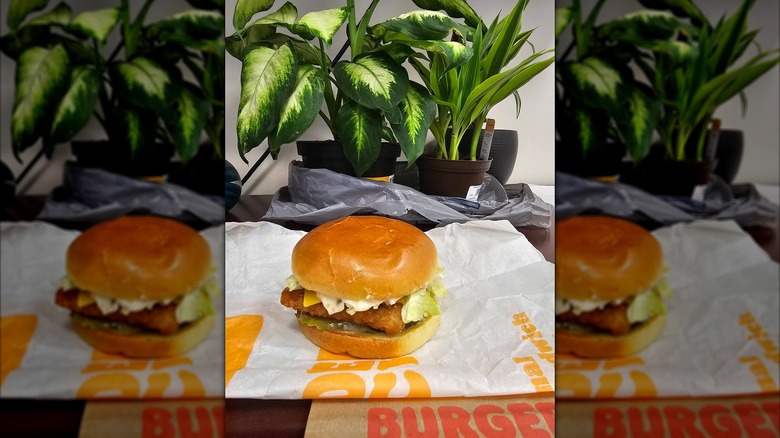
The ingredient and preparation approaches are very different for Big Fish and Filet-O-Fish, shedding further light on their flavor variances. Sauce amounts are one differentiator. Burger King workers spread generous portions of tartar sauce on both sides of the Big Fish's bun, while McD's workers use a device to place portioned, more moderate dollops of sauce on just one half. This gives the Big Fish a much stronger tartar sauce taste.
The American cheese on the Filet-O-Fish brings another flavor difference — albeit it's a very skinny half-strip, as McD's doesn't place a full slice on the sandwich. Customers can, of course, customize their Big Fish to include cheese. BK also uses American cheese on its burgers — incorporating the full slice, though, not just half — but it's not standard on the Big Fish.
At the nucleus of each sandwich, that Alaskan pollock patty, some taste differences could be further owing to the fish itself. While McDonald's proudly proclaims that its pollock is wild-caught, Burger King only identifies its fish as "white Alaskan pollock." BK has come under fire for not openly disclosing its ingredients, but restaurants generally boast about offering wild-caught fish, as it's commonly perceived as superior to farmed fish. BK's failure to identify its pollock as "wild-caught" strongly suggests that it isn't, and wild-caught and farmed fish can have vastly different flavor profiles.
Wild-caught fish is often distinguished as being stronger, more complex, and more oceanic in taste, due to the diversity of a natural diet in open waters. Farm-raised fish have a controlled diet, resulting in more consistent, predictable flavors that are also considerably milder and less complex.
Mouth feel variances between McDonald's and Burger King
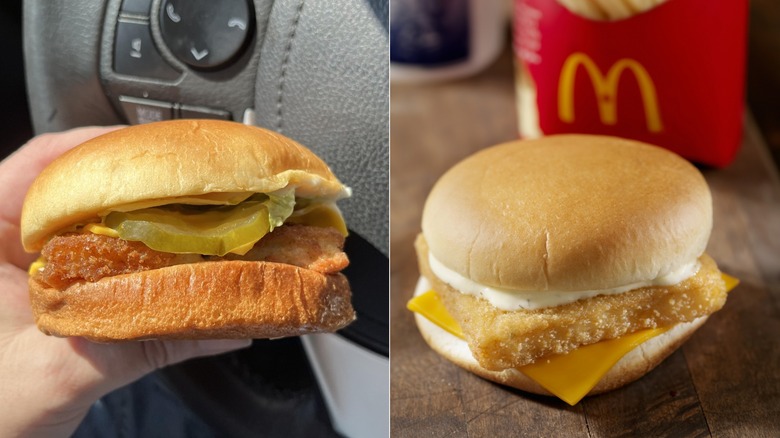
In addition to flavor specifically, the two sandwiches also invoke very different mouth feels and overall eating experiences. McD's Filet-O-Fish is ranked as one of the best fast-food fish sandwiches by customers. But many diners who have a beef with the FoF say its texture is mushy compared to the crispier patty on Burger King's Big Fish. Breading differences on the fish contribute to this distinction. While BK doesn't disclose its full ingredient list for the Big Fish, the chain's website specifies the pollock patty is panko-breaded, which explains the superior crunch factor. While McDonald's doesn't identify what coating is used for Filet-O-Fish, the patty's ingredients include wheat flour and yellow corn flour, suggesting a mix of corn and wheat flour, a coating commonly used for fish. This can at least partially explain why FoF reminds fans of the taste and texture of frozen fish sticks, which have much softer breading when cooked.
Another differentiator is found in the sammies' buns. Burger King uses potato buns (hailed as the absolute best bread for burgers), which are known for having subtle sweetness, a lighter crumb, and a moister texture, while Filet-O-Fish features a standard wheat bun. Burger King's bun is toasted, while McD's is steamed, giving each one a completely different mouth feel. In addition to crisping up the Big Fish's bread, toasting alters its flavor, thanks to the Maillard reaction, deepening the taste and bringing added nutty and savory notes. McD's restaurants have a special steamer used especially for FoF, which makes its bun soft and fluffy.