

How To Give Food Container Lids New Life In Your Kitchen
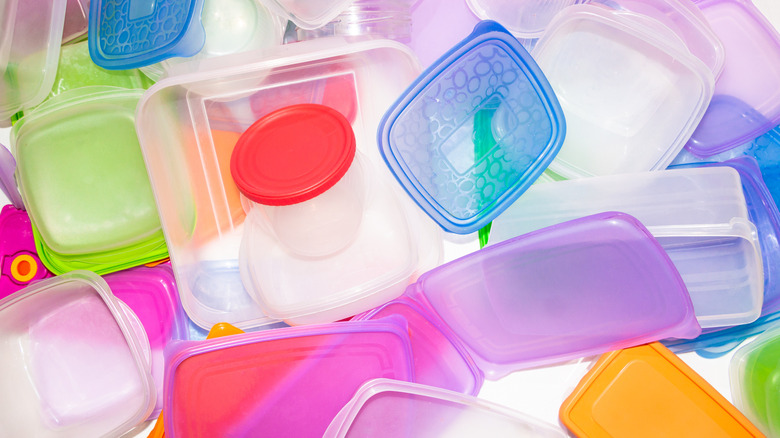
Discarding a single-use lid can feel upsetting, yet accumulating containers isn't a much better solution — especially if the containers themselves are cracked, stained, or otherwise unusable; organizing your plastic lids needs a dedicated technique, and too many can get overwhelming, fast. So instead, give your food container lids a new life with a more profound transformation.
With a little know-how, the plastic lids can play a surprisingly versatile role, whether as the backbone of a cute craft or as a way to reduce a kitchen mess. Lids come in varying shapes and dimensions, with each type offering distinct advantages. In fact, the item's disposable nature is advantageous, letting you trial various options without fear.
Small and circular-sized lids lend wide-ranging capabilities for small tasks. "I use them as mise-en-place dishes," noted a Reddit user; the item's flat dimensions yet raised edges ideally contain prepped ingredients. You could also employ them to prop utensils amidst cooking (no more saucy spoons leaving marks on the counters), as a makeshift sink caddy, or as a temporary container for kitchen scraps.
Larger lids lend themselves to more serious reworking. Cover in a fabric — ideally secured with glue — and the topper can serve as a foundation for a new container. Glue on popsicle sticks with a string along the perimeter, and it's a cute DIY basket. Attach some vertical cardboard dividers, and it transforms into a charming tray. You could even cover the entire container in fabric, making a storage vessel that doesn't look disposable at all.
Carefully prep plastic food containers for reuse
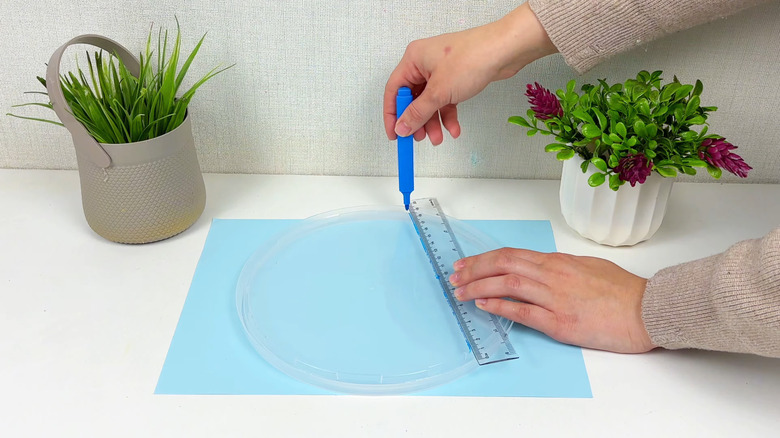
Whether using a plastic lid to perfectly shape burger patties or as a fuss-free coaster, you'll want to prep the object first. Precise plastic composition varies, but just like how deli containers aren't microwave safe, you won't want to place the item in the dishwasher, either. Such an extended time in hot water will likely distort the lid, rendering it completely useless. Not to mention, there are possible health concerns regarding BPA and microplastics upon heat exposure.
Instead, keep it a light, warm-water rinse accompanied by a scrub. If there's an odor or food speck that's hard to eliminate, toss the container — it's not worth the effort. Furthermore, if you notice a large crack, scratch, an off-putting plastic smell, or discoloration, that's even more reason to throw the vessel into the trash. After all, you'll get longer reuse from a textile-covered plastic, shielded from heat and food particles altogether — but you should only cover a plastic lid that's totally clean and in good repair. Plastic lids can be a canvas for exciting new projects, but make sure to keep the downsides in mind.