

Why Cereal Prices Have Skyrocketed Over The Years
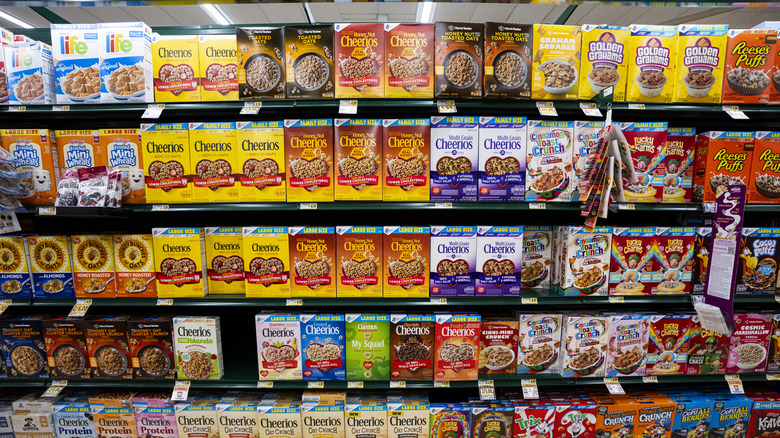
Since packaged breakfast cereal was invented in 1863, the offerings on the shelves of any given supermarket have changed substantially in every possible respect: content, variety, and price. It's theoretically a good thing to have more options, but the continuous price increases over the past four decades are certainly not a positive development.
Though the Consumer Price Index (CPI) is the common way to measure price increases over a certain period of time, comparing the buying power better illustrates how much prices have gone up. The cereal that you spent $20 on in 1977 would cost more than three times that much, $65.66 in 1997, and more than five times as much, $100.15 in 2026.
This staggering increase can be attributed to a couple of factors. Firstly, while cereals still hold the largest share in the breakfast market pie today, there is more competition from other breakfast options such as breakfast bars. As a result, the overall consumption has been dropping in the last 25 years. Consumers abandoning products with high-sugar or artificial dyes (Fruit Loops anyone?) is also a factor . As the prices of raw ingredients such as wheat and oats increase, together with energy and transportation costs, manufacturers pass the increased prices on to the consumers — and generously round it off.
The price increase may not always be obvious. When you buy a box of cereal and it looks smaller or feels lighter, you can trust your senses. Manufacturers have also stealthily been increasing prices by selling the product at the same price but in smaller boxes, just a couple of ounces less, a phenomenon called shrinkflation (other famous examples for this phenomenon include Cheesecake Factory's portions).
Consider skipping boxed cereal and making your own to save money
If you are unwilling to keep up with the price hikes, you have a few alternative options. One is to buy store brands, also called private labels, instead of brand names, which can result in savings of 30% or more. For example, the cost per ounce of Kellogg's Frosted Flakes at Walmart is 22.9 cents while it's 14.3 cents per ounce for the store brand Great Value (prices may vary based on location, but the pattern is the same). Another option to save money is to use coupons, which offer discounts of 60% or more.
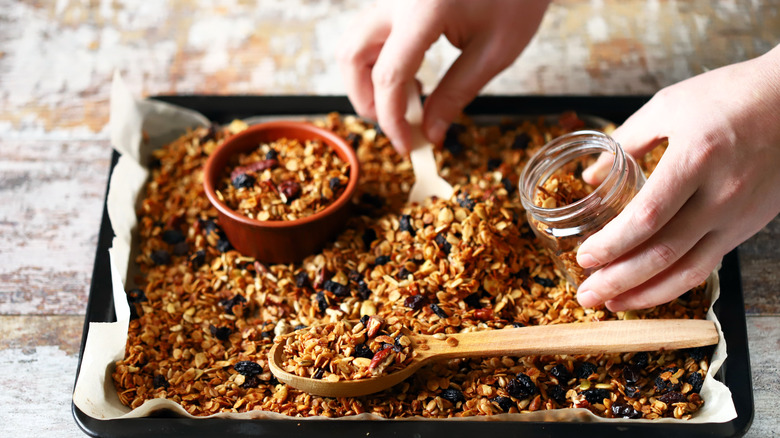
Making your own cereal is another budget-friendly possibility if you are ready to put in a bit more time and effort. One of the easiest to whip up is granola, which can cost $8 or more for a 12-ounce bag at the grocery store if you go for premium brands with organic oats. Meanwhile, you can buy 42 ounces of organic oats at Whole Foods for $6.38, which can make five 12-ounce batches if you follow our perfect granola ratio. All other ingredients combined (nuts, seeds, butter or oil, sweetener, spices, possibly an egg white to boost protein and crunch, dried fruit) are used in small amounts and won't cost you more than $2 to $3 — even if you use high-quality products such as maple syrup as a sweetener. In the end, 12 ounces of homemade granola will cost you less than $5. That's not only a great way to save money; it also lets you cut down on sugar and fully customize your breakfast to your taste with your favorite ingredients.