

Why Red M&M's Disappeared For Over A Decade
When famous foods are taken off the market, it's usually because of economics — languishing sales or high production costs — or the company itself disappears, as it happened when Twinkies (the ones without the irresistible retro ingredient) temporarily disappeared following the bankruptcy of Hostess Brands in 2012. The vanishing of red M&M's in 1976, however, is a different story. The beloved sugar-coated candy was taken off the market because of health concerns that turned out to be unfounded, and, to the delight of M&M's fans around the world, came back 11 years later.
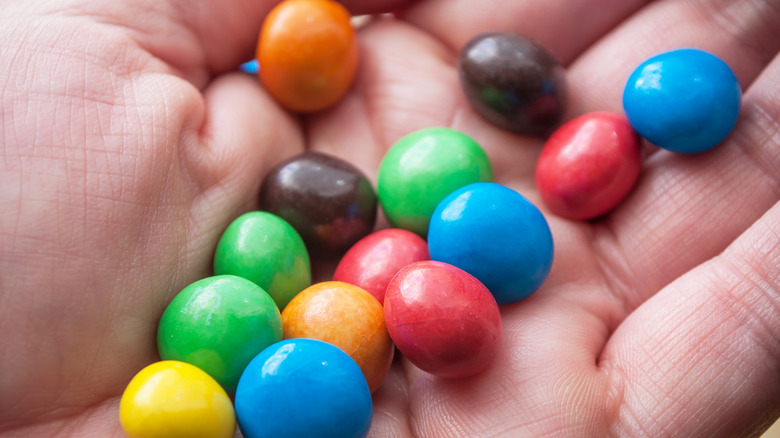
It all started in 1970 when officials at the Federal Drug Administration (FDA) learned about studies undertaken in Russia that found Red Dye No. 2, also known as amaranth, was possibly causing cancer in rats. The FDA rang the alarm bell, and as a result, the dye was banned in the U.S. in January 1976. Although the dye used in M&M's was not Red Dye No. 2, the public scare prompted Mars, the manufacturer of the famous candy, to stop producing it. For the next several years, a bag of M&M's only contained orange, brown, green, and yellow.
When the panic subsided almost a decade later, Mars tentatively tested the waters by including red M&M's in its Holiday candy packages in 1985. It did not take long for red M&M's to rejoin the other candies. In January 1987, they were back in every bag of M&M's. And history thankfully did not repeat itself. In 2025, when another food dye, Red Dye No. 3, was banned in the U.S. due to its potential cancer risk, red M&M's, which are dyed with Red No. 40 (which is different from Red Dye No. 3), here in the U.S., stayed put.
M&M's colors are more than just eye candy
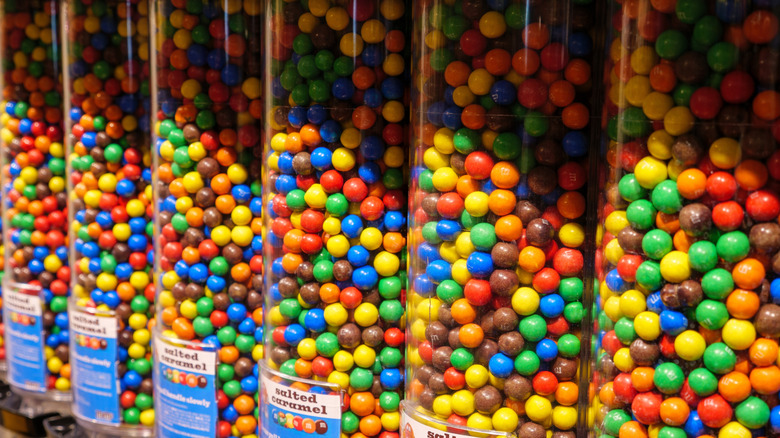
Sure, the main purpose of M&M's is to pop them in your mouth, but the candy, which was first introduced in 1941, has also developed a life of its own as a teaching tool. Every bag contains a certain percentage of each color, which, according to Mars, is the most attractive ratio to the general population, per the Phillips Exeter Academy (via the Wayback Machine). Since the 1990s, the color distribution in the bags has been used to teach students about probability, population proportions, data collection, analytics, and statistics.
The colors of M&M's are not only material for mathematics buffs. Although all the M&M's candy colors taste the same (if you want a different taste, go for the limited edition flavors), whether you are reaching for red, orange, yellow, green, blue, or brown M&M's is also interesting for psychologists. Your favorite color may give insight into your character or current mood. And because of their distinct color differences, M&M's are also used to teach children about differences and promote inclusion of those who may look different.