

Velveeta Has Been Blessing Our Cheese Dips For 100+ Years. What Was The Original Like?
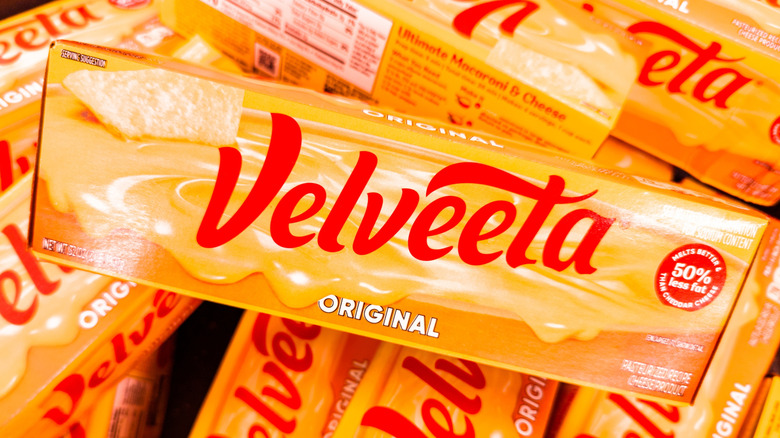
There are few things better than Velveeta. This smooth, meltable "cheese" product has become a pantry fixture. It's super versatile and can be used in everything from creamy cheese dips and mac and cheese to homemade Tostitos-style queso. Vevleeta has also been around for quite some time, celebrating its 100th anniversary in 2018. However, the product we know today is very different from the Velveeta that first appeared all the way back in 1918.
Initially, Velveeta was the product of strategic waste management. In the early 20th century, cheese titan Jacob Weisl set out to find a way to repurpose his broken Swiss cheese wheels. Enter Emil Frey in 1918, who combined those cheese scraps with emulsifiers and whey to create the original Velveeta. Although the ingredients have changed over time, the purpose of the product remains largely the same. It was — and still is — known for its smooth, melty texture, so much so that the name Velveeta was originally chosen to honor its velvety texture.
After its acquisition by Kraft in 1927 — who advertised it as a healthy dairy product – Velveeta gradually became very different. It was promoted as a sliceable cheese, perfect for charcuterie boards or to be enjoyed on its own. Back then, Velveeta only had eight ingredients compared to 25 today. A big difference is the removal of American cheese, which has been replaced by milk protein concentrates, canola oil, whey protein concentrate, and a long list of stabilizers, emulsifiers, and preservatives. While this means that modern Velveeta is now shelf-stable, in 2002, the Food and Drug Administration (FDA) informed Kraft Foods that Velveeta could no longer be marketed as a "cheese spread."
What exactly is the difference between Velveeta and real cheese?
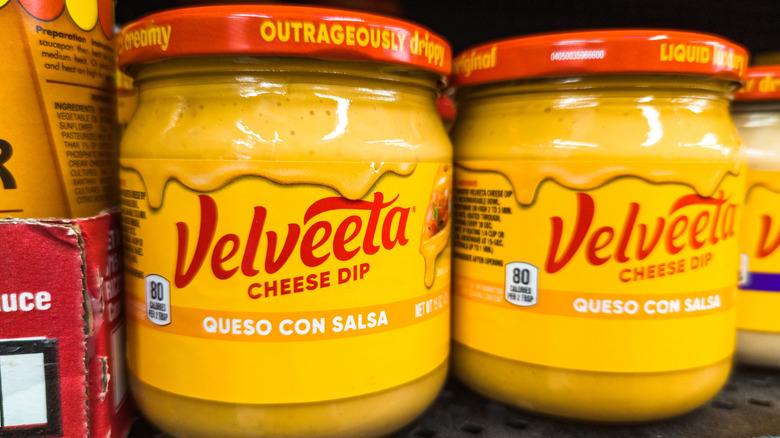
There are several big differences between processed and unprocessed cheese. Most unprocessed cheeses follow a similar production process. Bacteria and enzymes like rennet are added to milk, which causes it to curdle and separate into solid curds and liquid whey. These curds are then cut, heated, and drained before being pressed into shape and salted. The FDA maintains strict regulations on what can meet the legal definition of cheese, and one ingredient it does not permit in any processed cheese product is milk protein concentrate.
Even when compared to American cheese, which is regulated by unique FDA standards as a "pasteurized process cheese food," Velveeta still doesn't meet the criteria to be classified as a processed cheese. Because it contains milk protein concentrate, it was forced to be reclassified as a "pasteurized prepared cheese product," a label that does not have the same strict compositional requirements as processed or unprocessed cheese. Other well-known "cheese" products that fall under this loosely defined category include Cheez Whiz and Easy Cheese.
But there are several reasons why Velveeta can be more convenient than your standard cheese products. For starters, it has a much longer shelf life and can sit unopened in your pantry for many months without going off. Even when opened, it'll last much longer than most soft cheeses. Its emulsifiers also prevent the cheese from separating as it melts, making it ideal for heating into dips, grilled cheese, or even as an indulgent burger topping.