

Do The Tiny Handles On Maple Syrup Bottles Serve Any Purpose?
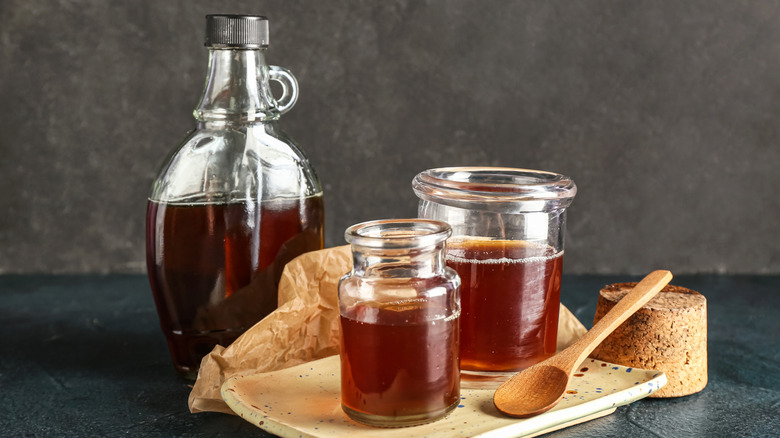
If you're anything like us, you probably have nostalgic ties to the foods you enjoyed as a child — gooey boxed mac and cheese, dino-shaped nuggets, and, of course, fluffy stacks of diner-style pancakes crowned with a glaze of sweet maple syrup. While it's likely a parent or guardian prepared the meal, you may have caught a glimpse of the packaging — namely, that bottle of maple syrup equipped with a handle so itsy-bitsy you can barely fit a single finger through it. It begs the question: Why include it at all? Were they designed, perhaps, for a colony of helpful kitchen rodents (Remy from "Ratatouille," is that you?)? Seriously ... what's the deal?
As it happens, those tiny handles are actually a clever bit of marketing. While some believe they're merely shrunken versions of the handles found on large-scale stoneware crocks from the 1800s, historians note syrup was more commonly stored in simple tins and cans. In reality, when glass bottles became the industry standard in the 1930s, designers likely added the miniature handles to mimic vintage molasses and liquor jugs in a targeted attempt to make a mass-produced product feel more rustic and special — sort of similar to how the gingham pattern on a jar of Bonne Maman preserves evokes a French farmhouse kitchen.
As the industry transitioned to plastic containers, the handles were scaled down even further. By the time 12- and 24-ounce bottles became de rigueur, the handles were far too small to be functional. However, they remained because they had become synonymous with "authentic" maple syrup in consumers' minds, acting as a visual shorthand for quality. In essence, they serve as a tiny link to the syrup's history.
Modern maple syrup bottles balance practical design with historical aesthetics
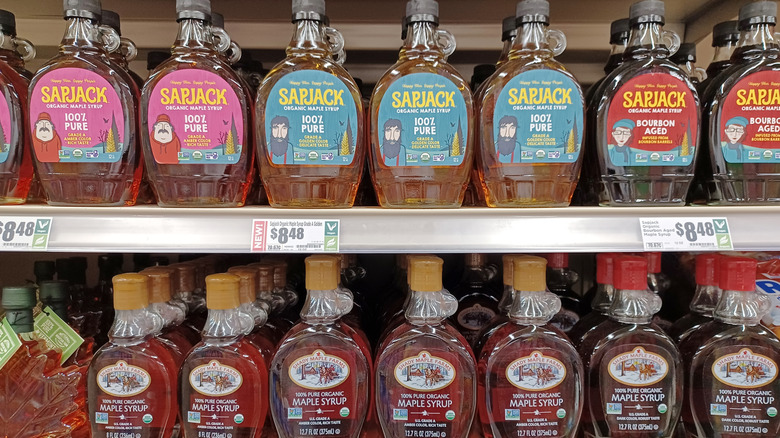
Look, we know the itty-bitty handle attracts a lot of chatter, but while it's basically only there for decorative purposes, there was actually a lot of thought put into the rest of your maple syrup bottle's design, too — some of which is pretty darn practical. For instance, because the syrup itself is so viscous — thick, slow-moving, and prone to sticking — most bottles come with a narrow neck to help mitigate the dreaded "glug" factor (we all know the pain of turning over a jar of, say, homemade ranch dressing, only for far too much of the good stuff to spill out). Additionally, most modern bottles are designed with a notably wide, flat base. This provides a low center of gravity that makes the bottle much harder to tip over, serving as a sort of insurance policy against a sticky countertop disaster.
What's more, some design elements that have persisted aren't exactly useful, like the handle, but still presumably harken back to frontier times. For instance, while there are a few exceptions — like Costco's hard-to-use maple syrup bottles, which come in beige plastic jugs — many brands are packaged in clear containers. This is likely because the shift to glass allowed buyers in the early 20th century to visually verify their maple syrup's purity and color at a glance, and ensure it hadn't been adulterated or spoiled.