

What Are The Coca-Cola Machine Cameras Actually Recording?
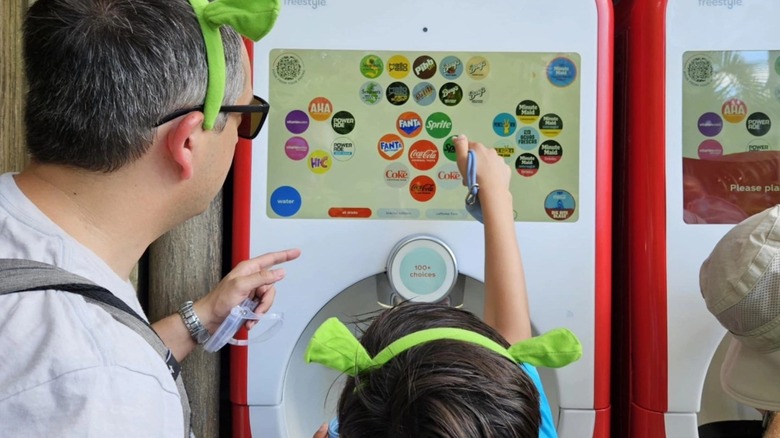
These days, seemingly everything includes a camera — your doorbell, your phone, your tablet. And they're out there in the world among us, too, whether it's in the drive-thru speaker box at your favorite fast food restaurant (yet another reason to turn off your wipers on rainy days), or traffic monitors that show you live feeds of busy thoroughfares in your city. One place you might not expect to find a camera is in a soda fountain, yet that is exactly where they have shown up, on some models of the Coca-Cola Freestyle machines, which came to market in 2009. The little dot where the camera points out appears centered near the top of the touchscreen, and it has people wondering what they're recording. As it turns out, while the cameras were tested in the late 2010s, public Freestyle cameras are recording nothing — yet.
Still, one must imagine that nothing that gets built into these machines, by this absolutely enormous corporation that owns the most popular brand of soda in the U.S., is an accident. And so an application for the patent for the Freestyle, which revealed that one possible function for the cameras might be to help gauge the user's feelings about the beverage they had dispensed. Since this patent was sought in 2018, it might be that the AI necessary to interpret human emotions in a meaningful way hadn't been developed at that time; it still isn't, quite. But as the years march on, and we grow closer to this achievement, Coca-Cola may end up putting those cameras to use yet.
There's a whole lot of tech contained inside the Freestyle machines
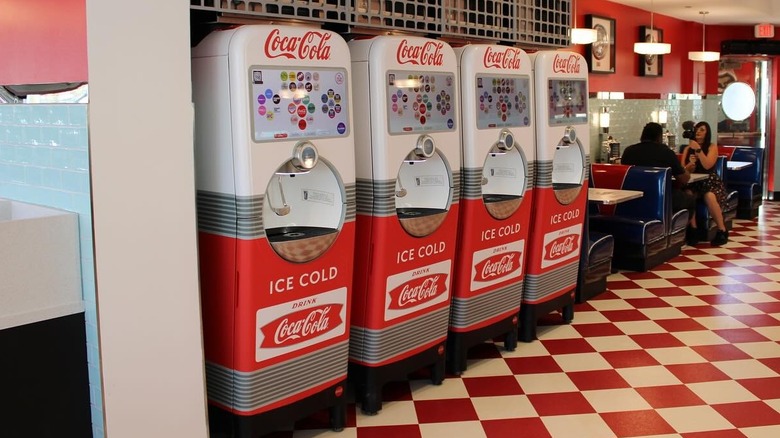
Other than cameras that may, one day, be used to assess how much you enjoy your beverage mix from its soda dispenser, the Freestyle machines actually contain a lot of technology that might surprise you. For example, every single dispenser — all 50,000-plus across the country — is linked to the same network, which Coca-Cola can use to oversee individually in real time if the company wants. Significantly, the machines also send their customer data back to the headquarters. This is how Coke spots trending beverage mixes as they're happening, and responds with lightning-quick reflexes, bringing some of these combinations to market in bottle and can form (perhaps the January 2025 release of Coke Orange Cream can be traced to Freestyle popularity).
The Freestyle machines are also a huge step forward in the practical management of supplies. Because everything is digitized, the machine itself can recognize when syrup is low — it definitely knows the difference between Zero Sugar and Diet Coke — and prepare a reorder submission all on its own, saving the operator a lot of time over the long run.
Further, Freestyle technology was able to help the machines, and therefore the owners of the establishments in which they can be found, adapt in the midst of a public health crisis. In response to the COVID-19 pandemic, the dispensers were able to go touch-free by offering customers a QR code to scan, which took them to a site where they could place their beverage order without having to touch the screen of the machine.