

15 Foods From Costco Japan You Won't Find In The US
We may receive a commission on purchases made from links.
This might come as no surprise, but the food offerings from Costco locations in Japan are quite different than those at the warehouse's locations in the United States. In fact, since members are familiar with the treasure hunt feel of browsing through a warehouse, it might be worth taking a trip to Japan just to experience the variety and uniqueness of what's available in the Costco warehouses there.
Okay, so maybe that's a stretch — planning international travel around wholesale grocery shopping feels like a bit much. But if you do make the trek, once you're inside, you'll find entire sections unique to Japan that are reflective of local cuisines and palates. These include sushi and a variety of snacks, as well as scores of unique options that may appeal to many Americans — and others that likely won't. Beyond the culture shock, the food court is considerably more tourist-friendly with just enough variety to make visitors wish their home Costco may one day have a menu refresh. Let's take a closer look at what Costco Japan has to offer behind its warehouse walls.
Jumbo Bulgogi Bake
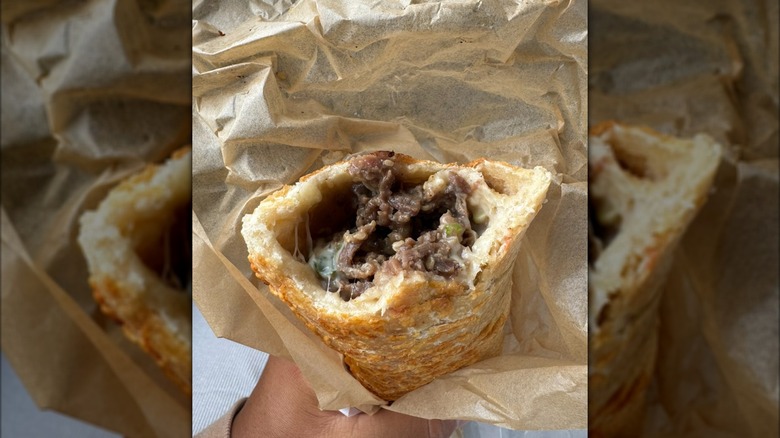
Like stepping into an alternate universe, the food court menu at a Costco Japan is at once dramatically different and similar enough to give one pause. This is particularly true when you notice that, between the hot dog combo and the pizza, the available bake isn't chicken, but rather a Jumbo Bulgogi Bake. Gone are the familiar flavors of smoky bacon with chicken breast strips and green onions in a Caesar dressing. Instead, members will find Korean-inspired barbecue beef wrapped within the cheesy crust.
Among the initial takeaways from those who've tried both is the fact that the Costco Japan offering is a bit larger than its American alternative. Beyond that, the bulgogi is described as having a sweetness that some consider far superior to the saltiness of the Chicken Bake. All told, between those who've had one and those seemingly willing to travel around the globe to get their hands on one, Costco fans remain flummoxed as to why the warehouse chain has yet to make this beefy option available in the states.
Food court soup
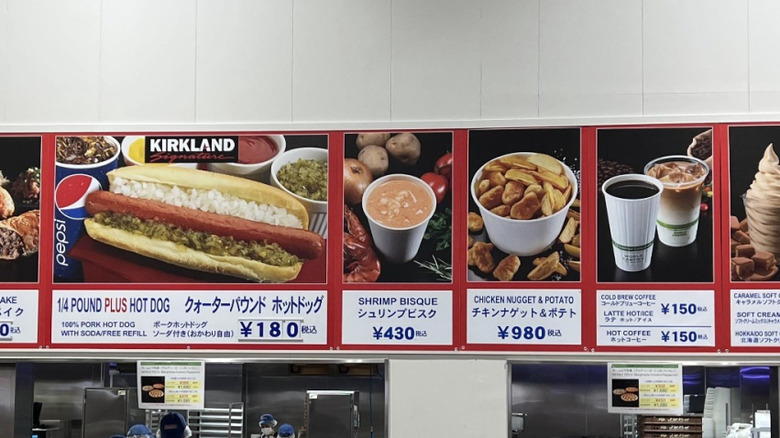
Despite the prevalence of restaurants offering options of a bowl or cup of soup as an appetizer alongside soup and sandwich combo entrees, the liquid supper is not something found at American Costco food courts. To the contrary, Costco Japan not only offers bowls for you to sip or spoon at your leisure, but it's also run through numerous different types over the years.
Going back to 2021 and 2022, a Chicken Tomato Bisque was listed beside several other international exclusives that included a Falafel Salad and a Quinoa Chicken Sandwich. The following year, a shift to seafood came with the addition of a Shrimp Bisque. 2024's follow up was a Clam Chowder that stuck around through 2025. In addition to boasting a good many pieces of the mollusk, this one could be enjoyed with soup crackers. By the beginning of 2026, the menu saw another update with a Mushroom Chicken Soup.
Dorayaki
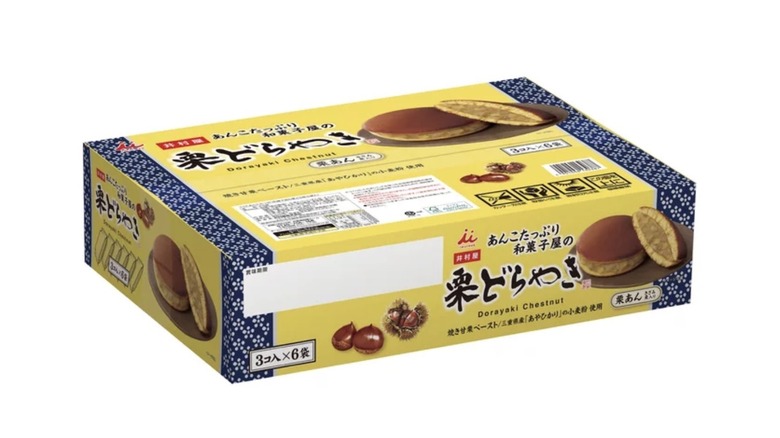
Translated from the native tongue, wagashi — or Japanese confectionery — are a category of primarily plant-based treats hailing from at least as far back as the Edo Period, which began at the onset of the 17th century. Counted among these artisanal desserts is a kind of pancake sandwich known as dorayaki. While it's no surprise that the limited space of stateside Costcos prohibit carrying all kinds of goods, Costco Japan makes a point of stocking multiple versions of this special sweet.
Browsing the shelves, one iteration of dorayaki is available at a price of a little over $14 for a case of 18. Marketed with "plenty of anko" — the red bean paste that comprises the filling — this version of the treat has an added chestnut flavor. Over in the bakery, another version of sweet-filled pancakes comes with a maple and margarine combination sandwiching them together. A dozen of these is available for little more than $4.
Salmon Poke Roll
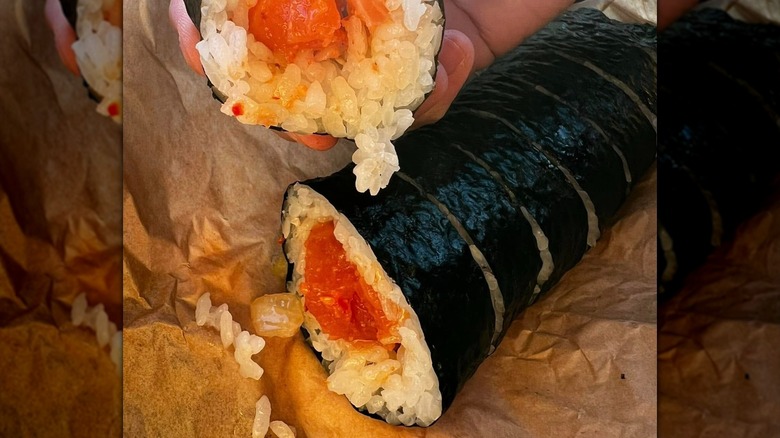
Thoughts of Japanese cuisine undoubtedly call to mind images of noodles, soups, and sushi. While Costco Japan has plenty of the latter packaged fresh alongside other prepared foods — more on that later — it should come as no surprise that the food court menu also has a sushi option. Appearing beside more American options like the hot dog and chicken sticks, locals and visitors alike can share, or hog, a Salmon Poke Roll for under $5.
Proving that a dish doesn't need to be overcomplicated to be satisfying, the sushi keeps things simple with salmon surrounded by rice enrobed in a seaweed wrap. The result earns high marks from those trying it out, both for the freshness of the fish and the expertly prepared rice. Fellow Pacific Islanders from Hawaii recognize the similarities to their own poke while some add surprise that their local Costcos, which includes arguably the busiest in the world in Iwilei, don't serve up the salmon roll at the food court.
Turkey leg
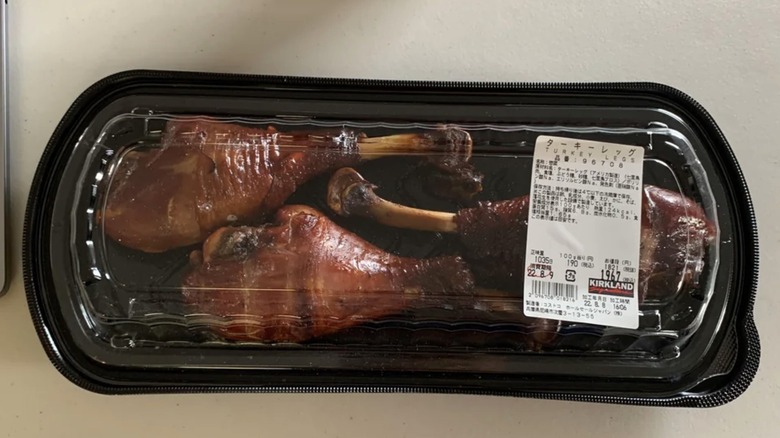
Aside from Thanksgiving — where a few people may be left clamoring over who gets to dig in caveman style on the limited supply — turkey legs are typically only seen at street festivals and Renaissance fairs. By contrast, the legs of the large bird indigenous to North America can be found for sale at Costco Japan where the traditional accompanying feast isn't even celebrated.
Whether marking the fourth Thursday in November or pulling out all the stops for Christmas weeks later, Costco is one of the few places in Japan where celebrants can purchase the preferred poultry. Meanwhile, thanks to clever marketing, American fast food chain KFC has been surprisingly popular in Japan dating back to the '70s. That's when Kentucky Fried Chicken launched its Kentucky for Christmas campaign. Despite a meager percentage of Christians in the heavily Buddhist nation, KFC was sold as the ideal American Christmas feast resulting in millions placing their orders, sometimes weeks in advance.
Strawberry milk mix
Japan has a long history with — and love for — strawberries. The Dutch were the first to establish trade with Japan in the year 1600, and more than two centuries later (some time in the 1840s), Dutch strawberries were introduced to the country. Another century or so later, a post-WWII Japan allowed for broad production of the fruit and greater access to Ichigo milk — literally strawberry milk.
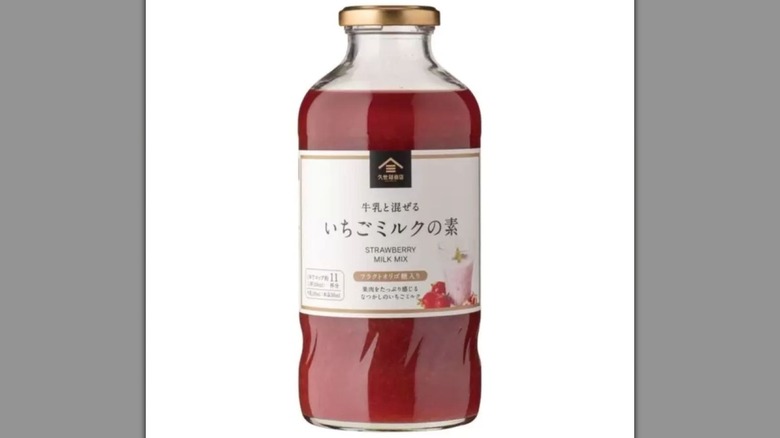
The extent to which the Japanese appreciate the fruit is clear — while it's among the top 10 nations for strawberry production, the majority never venture beyond Japan's coast. So it's no wonder that in addition to the array of strawberries and strawberry-topped products available at Costco Japan, the warehouse also keeps a stock of strawberry milk mix on hand. Made by Kuze Fuku & Sons, the mix has limited ingredients that include water, cane sugar, a vanilla bean paste, as well as chunks of strawberries.
Wagyu beef
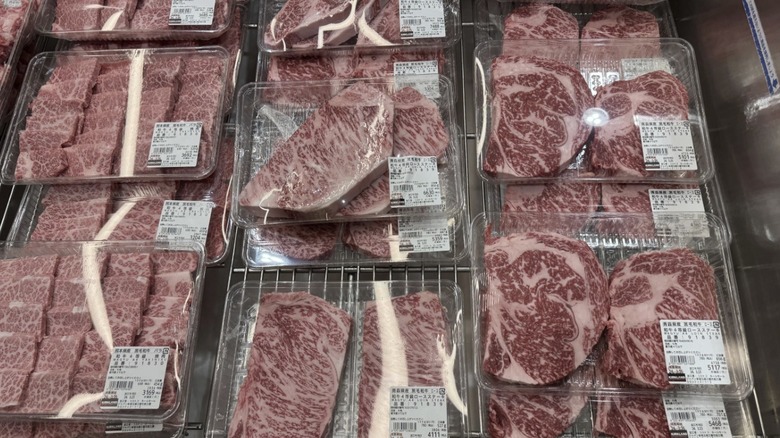
Some foods speak to decadence. Mention of beluga caviar, shaved truffle, and saffron evoke thoughts of formal dining or exclusive supper clubs. Counted among these prized ingredients is Wagyu, Japan's beef cattle known as producing some of the most expensive cuts of meat on the market. That pricing is reflected stateside where Costco makes the meat available as an online exclusive. A few pounds of the prized marbled meat can go for hundreds of dollars.
As to why Wagyu beef is so expensive, Destination Wagyu founder and CEO Golan Haiem told Food Republic that the cattle are raised an extended period of time compared to typical cattle, and their diet is meticulously managed. Adding to the cost are the extensive certifications and import costs that are passed on to the consumer. Since the latter is removed for Costco Japan members, as well as the expense of shipping the beef around the world, various cuts of Wagyu can be found in the cooler chests at prices that won't break the bank.
Actual Japanese Kewpie Mayo
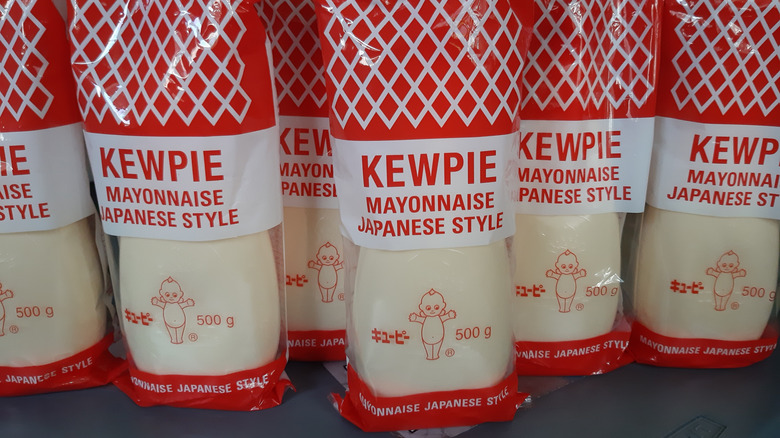
Okay, we're counting this one on technicality. The truth is, you can fine Kewpie Mayonnaise at American Costco warehouse locations. But much like the warehouse itself, the product you're buying there is the distinctly American version. Go ahead and check the back — you'll see that it says "Product of USA." That's not necessarily a bad thing — we've got it ranked as the very best store-bought mayo. But it doesn't have quite the same flavor as its Japanese antecedent.
So what makes them different? In crafting the combination of oil, acid, and emulsifier, the Kewpie brand relies on strictly egg yolks for the final and key ingredient. Critically, though, the Japanese version dishes out umami with the inclusion of MSG. By contrast, the American version, which includes the addition of water, uses yeast extract to mimic the MSG. You might not be able to tell the difference if you've never had the former, but enough of those who love it say it's not as flavor-packed, and thus, not quite the same.
Sashimi horse meat
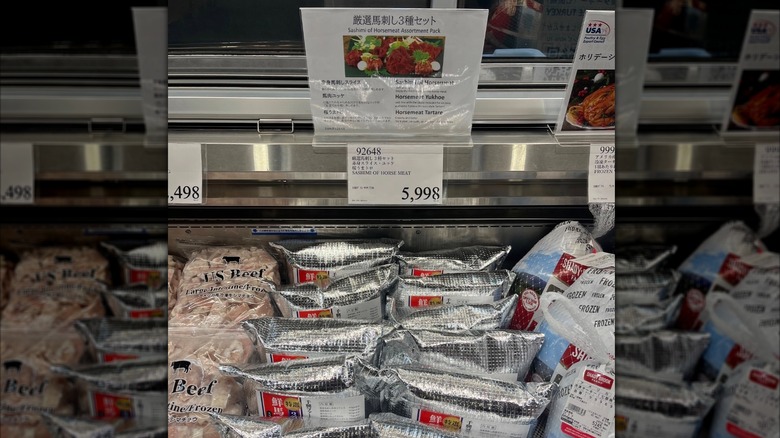
Depending on where you go, there are different taboos when it comes to eating different animals. While Jews and Muslims alike are prohibited from consuming pork, and Hindus consider cows sacred, many American appetites view eating certain domesticated animals as untenable. Imagine then the surprise a visitor to a Costco Japan may have, especially if they are averse to sushi, to discover the warehouse has sashimi horse meat available in the freezer. You read that right — raw horse meat.
Priced at around $40, Senko Farm of the Kumamoto Prefecture offers an assortment that includes four packs of three different styles of the raw horse. These include a lean cut, a fatty cut called uma-toro, and a Korean style known as yukhoe that comes with a special sauce. The sashimi isn't even the only horse offering in the store as Costco Japan makes available a number of horse meat products for dogs as well as a meat and potato combo from Comif Deli that is crafted to be suitable for both people and pets. As to why horse is counted among international food you can never taste in the U.S., the taboo remains even after the ban of federal funding for inspections of the meat was lifted in 2011.
Hokkaido soft cream
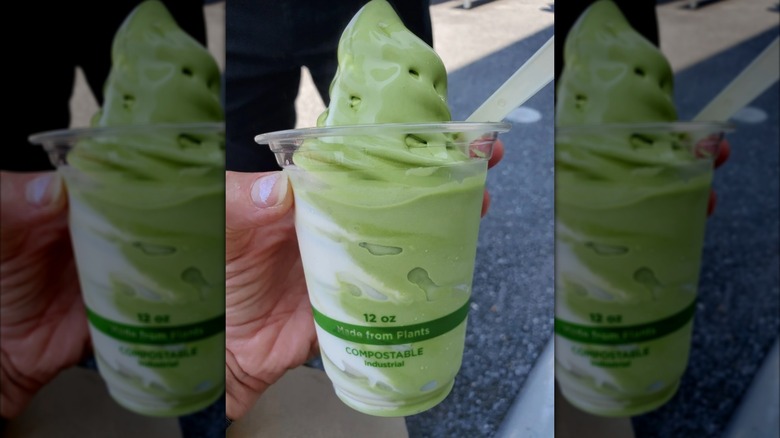
Costco food courts in the United States garner a lot of attention, especially for those craving a sweet treat. While Americans rave about the soft serve at stateside warehouses, the soft cream at Costco Japan has even more renown. Much like the nation's Wagyu beef cattle are praised for delivering high-quality meat, Hokkaido, the northernmost island of Japan, is where dairy reigns supreme.
Hokkaido's ideal conditions and the increasing westernization of Japanese diets finds the nation employing its customary dedicated craftsmanship to the dairy industry. Nearly 60% of Japan's fluid milk is produced by cows on Hokkaido with the nation exceeding 7.3 million metric tons distributed in 2024, according to the United States Department of Agriculture. While American Costcos feature flavor options like chocolate and mint, Costco Japan is similarly unique in expanding the cool treat choices. Vibrantly-colored flavors featured on the menu have included a purple Okinanwan sweet potato and a green Uji matcha iteration.
Chicken sticks
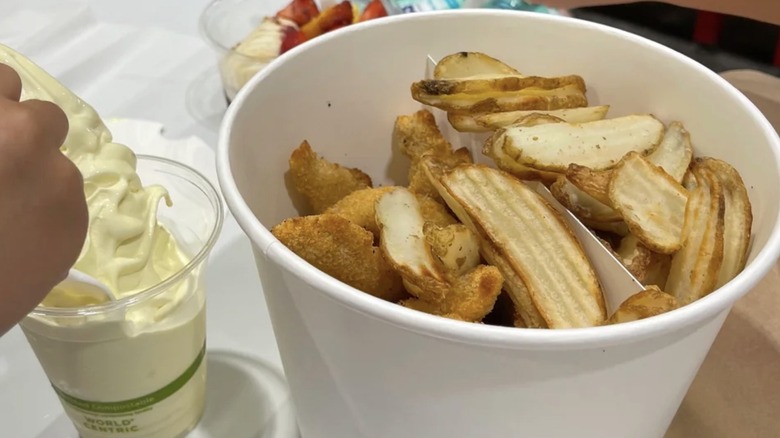
Costco shoppers in the United States are likely accustomed to fast food value meals where the number of pieces in an order of chicken tenders can be counted on two hands or less. So, if it isn't surprise enough to see that Costco Japan offers the unique chicken sticks option at its food court, it certainly blew members away to discover just how much food it includes. The image of an overflowing serving bowl is hardly an embellishment. In fact, exaggeration is against the law in Japan.
In 1962, Japan passed the Act against Unjustifiable Premiums and Misleading Representations (AUPMR) which bans "acts that are likely to interfere with general consumers' voluntary and rational choice-making ..." With that in mind, the surprise that remains is how cheap Costco Japan offers its bucket of both crispy breaded chicken sticks and thick-cut fries. This abundance of food that could readily satisfy a family browsing the aisles costs less than $7 — a fact that leaves many feeling cheated over the options in the States.
Egg Salad Sandwich
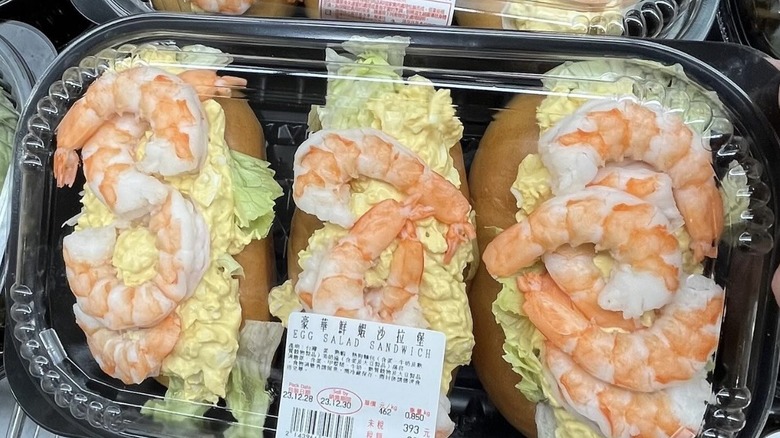
If someone offers you an Egg Salad Sandwich from Costco Japan, it's likely that whatever image you conjure in your mind is missing an unexpected topping. The name itself is at once descriptive and misleading. At its core, the star of the sandwich, stuffed in a hot dog roll, is a creamy mixture of egg and mayonnaise, as you would expect. However, along with the addition of lettuce, the proverbial cherry on top of this savory sundae is the heaping portion of jumbo shrimp.
The three-pack of sandwiches, each arguably large enough to cover multiple servings, have between four and five of the crustaceans set neatly in a row or unceremoniously heaped on to complete the meal. While not available in American Costco warehouses, Costco Japan manages to highlight local cuisine where egg, or tamago, even appears on sushi menus often in the style of tamagoyaki (fluffy omelets).
Cantaloupe Melon Smoothie
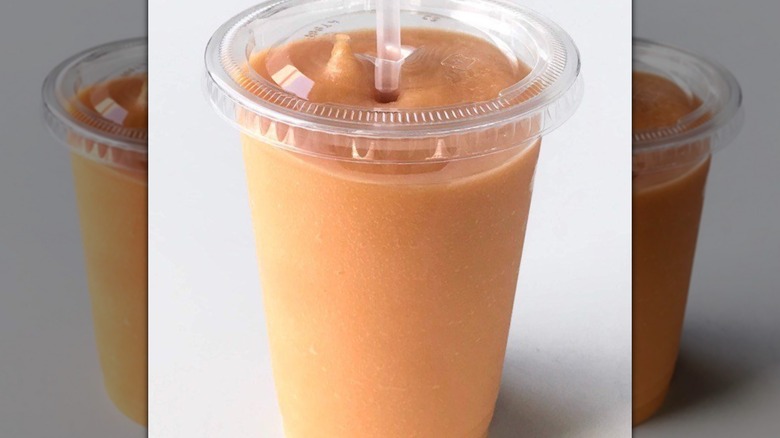
Stateside Costco food court fans are undoubtedly familiar with the cold, refreshing beverage options throughout the years like the Strawberry Banana Smoothie, Mango Smoothie, and Berry Smoothie. However, one flavor not seen this side of the Pacific that gets much fanfare at Costco Japan is the Cantaloupe Melon Smoothie. A vibrant orange color like the sweet flesh of the muskmelon, tasters report this fruit smoothie's consistency is a tad closer to the slushie side of frozen drinks.
Unlike the unchanging price of the hot dog combo, the Cantaloupe Melon Smoothie has seen a slight uptick in price over the better part of a decade. However, at only a 100 yen increase — a little over 60 cents — it's arguably fairly inflation proof. It is also a drop in the bucket in price compared to Japan's $200 cantaloupe lookalike, the crown melon. This "Japanese King of Fruits" is meticulously cultivated over a span of months in a method where each vine is only permitted to bear one fruit to maximize the sweetness.
Sushi
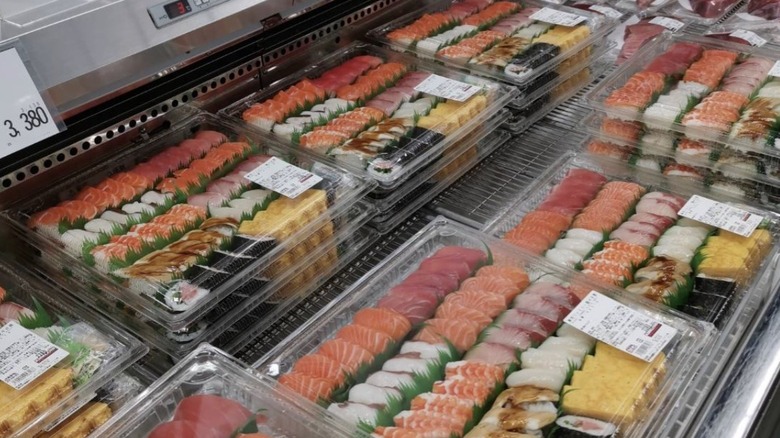
Sure, Costcos in the United States have expanded offerings to include sushi platters in the deli section. But there is no question that Costco Japan blows away its corporate home country's selection with an array of choices reflective of the national cuisine. For starters, unlike in America where imitation crab is used, the California Rolls in Japan have real crab. The variety only picks up from there.
Costco Japan members have access to large platters that include maki, salmon, scallops, shrimp, tamago, and tuna for under $25. For under $15, there are platters with rolls and nigiri. Plus, customers can satisfy a desire for some salty crunch with tempura rolls. In addition to the staggering amount of seafood — like octopus, soft shell crab, and mixed packs of shrimp, squid, and clams — the section offers an array of poke with different sauces, spicy pollack roe, dried young sardines, seaweed salads, and much more.
Konbini snacks
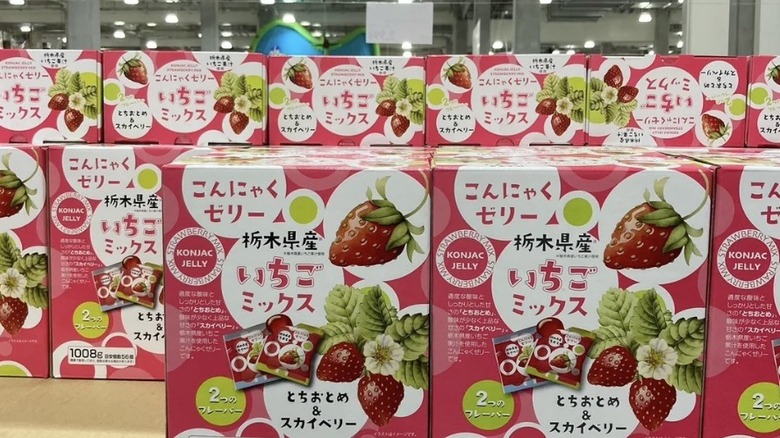
Whether you've had the opportunity to shop one yourself, have seen them in movies or anime, or simply read about them online, you likely know that Japanese convenience stores differ from those in the United States with the foods they offer. As it happens, many of the individually wrapped snacks and treats that are popular at these konbini are also available at Costco Japan — just in bulk.
Some treats like Pocky (stick-shaped biscuits coated in chocolate or other flavors) can be found in in the U.S. at supermarkets or movie theaters. Other snacks are far less common. Among the many offerings from Meiji is the Apollo, a strawberry and chocolate dessert designed to look like the Apollo 11 spacecraft. Then there are strawberries coated with chocolate, vanilla, and strawberry like Neopolitan ice cream. Kit Kats could have their own section given the wide variety, including a lemon version. Plus there are jellies, Wagyu beef-flavored chips, shrimp rice crackers, and many more.