

Air Fryers Vs Toaster Ovens: Which Appliance Is The Bigger Hit To Your Electricity Bill?
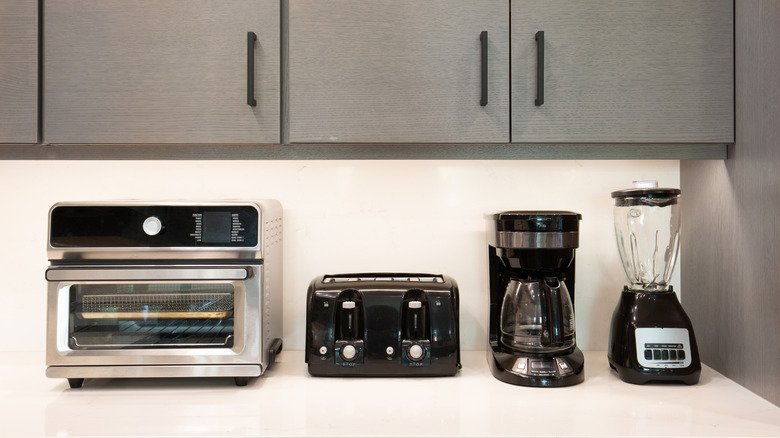
Stocking abundant countertop kitchen appliances is fun and all — until the electricity bill arrives. Aside from heavyweights, such as HVAC and water-heating, kitchen energy expenditure comprises a sizable portion of said bill. Even if you stick to simple dishes, such as avocado toast or a pan of chicken nuggets, it pays off to consider efficiency with a countertop oven. Two go-to candidates are the air fryer and toaster oven, but which one minimizes the electricity bill?
To put it succinctly, it's complicated. A toaster oven and air fryer both certainly beat out a conventional built-in oven, yet certain factors, including the precise model, device capacity, and cooking duration and settings, dictate energy usage more than just the countertop appliance type. So, before broadly contrasting the two devices, consider your intended cooking to optimize energy efficiency.
Do you often prepare several rounds of food for a crowd, or simply speedily brown food for a solo or two-person meal? Estimate the frequency of use, noting how your appliance usage incorporates into day-to-day routines. Not to mention, the precise prepared dish also impacts energy efficiency. You achieve optimal electricity bill savings by buying the most compact appliance, then using it for the shortest duration. That said, in general, air fryers can use a touch more electricity than toaster ovens.
Air fryers benefit from speedy food preparation
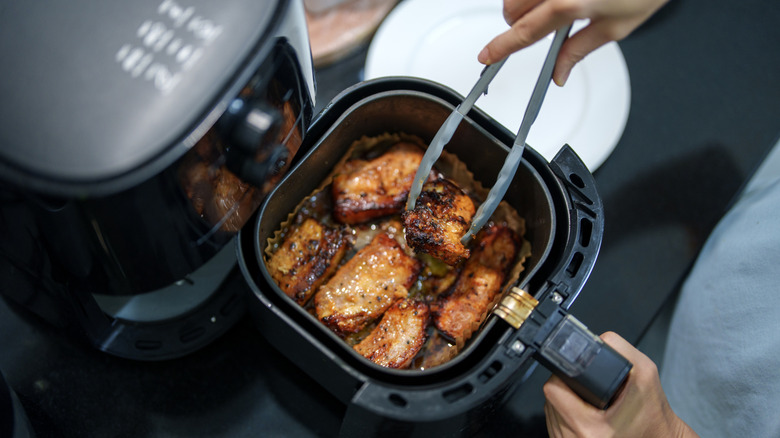
Despite the name, an air fryer operates akin to a typical oven, hitting foods with waves of hyper-heated air in a compact design. The clever cooking mechanism can delectably crisp foods without a bath of oil or lengthy warming time — but what's the entailed energy expenditure?
Depending on the model, you're looking at 800 to 2,000 watts, with the energy usage per second directly correlated to capacity. Buy a spacious model, and the energy expenditure ends up higher than a toaster oven, which occupies a range of 800 to 1,400 watts. But here's the catch: An air fryer cooks food more rapidly than a toaster oven. Whether you're reheating Chinese takeout or crafting some crispy spuds, you can expect a shorter dose of energy usage. Plus, unlike a toaster oven, air fryer models don't always need preheating, further aiding with the duration efficiency.
However, such benefits can be nullified based on intended application. If you're running your air fryer for robust applications, such as preparing raw chicken or a pan of Brussels sprouts, the lengthy cooking times rack up the electricity bill more than a quick toast. Combine with a spacious 8-quart capacity, and you're looking at the most taxing energy scenario between the two appliances. So, when considering the perfect air fryer, remember to assess your energy needs.
Toaster ovens demand less energy for cooking tasks

A classic toaster oven is a straightforward, yet nifty appliance. The design involves at least two heating elements — one each on the top and bottom — which radiate heat to cook contents inside. Some models might add convective heat flow, hence why consumers ask if French door air fryers are just fancy toaster ovens. To better delineate energy usage, this comparison sticks to exclusively electric coil models. Additionally, like with air fryers, toaster oven energy expenditure depends predominantly on the model capacity.
Toaster ovens cover a scope of cooking techniques, such as roasting and baking, in addition to toasting. You could use them to reheat foods, but this would likely use more energy than an air fryer by way of the extended duration. Opposed to an air fryer, a toaster oven can also be employed for baking bread or cooking frozen pizza, plus it has quick-and-easy uses such as toasting bagels, nuts, or spices at a cooler temperature. Some units can go as low as 80 degrees Fahrenheit, letting you slow-roast or keep foods warm. While air fryers may offer low temperatures for dehydration, their design is generally set up for high-heat cooking. If you're looking for fast, low-temperature cooking in a compact design, a toaster oven wins out as the energy saver.