

The Common Vegetable You Should Plant Early For A Strong Summer Harvest
Of all the popular root vegetables, onions are perhaps one of the easiest to grow. Still, it doesn't mean they don't have their own required tricks to maximize your harvest, and the sooner you can get them in the ground in spring, the better.
Growing onions to harvest involves two phases: vegetative and bulbing. During the first, green shoots sprout from the soil to convert sunlight into energy. In the second phase, your plant develops the tastier root, but it still leans on those leaves to develop properly. Once the days start to lengthen and temperatures begin to rise, this triggers the plant to develop its bulb. However, there is a direct correlation between the size of the root and the number of leaves, with each shoot giving it another layer.
You want your plant to develop as many leaves as possible, to a typical maximum of around 12. Guaranteeing this is as simple as transplanting your onion seedlings once temperatures start to hover around 50 degrees Fahrenheit, but as long as there's no danger of a freeze, you should be fine. Just be sure to let them get cold when they're small, rather than large, as cool environments actually trigger full-grown plants to produce flowers. While you can still eat the root from a flowering onion without noticing any major flavor changes, seed production steals energy from the bulb, resulting in a smaller harvest.
Tips for growing the biggest possible onions
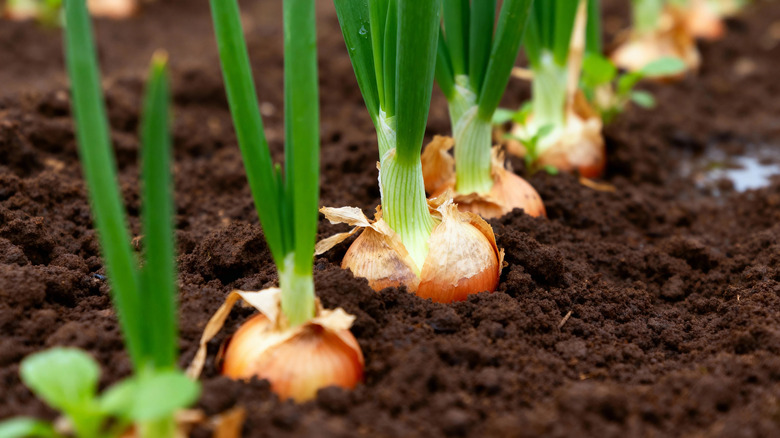
Onions may grow just about anywhere that gets enough water and sun, but they thrive in slightly acidic soils rich in organic compost. Seeds and seedlings are fairly affordable, so be sure to plant more than you need, and then thin out your vegetable garden to guarantee you have enough quantity before turning your attention to quality.
How often you should water your vegetable garden depends on temperature, sun, and how deep your root systems are, but onions are fairly hands-off in this area. As a shallow-rooted plant, you'll want to water more frequently, rather than deeply, but even just once a week when it doesn't rain should do fine. If you live in especially hot climates, you can do this up to twice a week. If you're unsure, stick your finger down to the second knuckle and feel the soil. Provided the tip of your finger isn't bone dry, your onions will thrive.
Well-tilled and composted soil is always your best friend when it comes to gardening, but don't feel the need to go overboard on your onion patch. So long as the dirt has enough nitrogen to encourage leaf production and phosphorus to develop the roots, you should be fine with just about any spot that gets full sun. However, always be sure to remove weeds that may choke out the plant. A bed of pine straw can help with this, plus it adds acidity to the soil when it breaks down, which can only help.