

How Ree Drummond Creates The Perfect Texture For Enchilada Sauce

Ree Drummond, the pioneering Pioneer Woman, has a recipe or two up her sleeve that we can't help but admire. Her super creamy mashed potatoes? Divine. Her trick for super-fast grilled cheese? Brilliant. So when she tells us that she has a way to create the perfect texture for her enchilada sauce, we're taking notes. The key? A quick roux. Traditionally, a roux is made by cooking some fat and flour together before adding liquid — but Drummond sprinkles her flour directly over sautéing onions and peppers. It's quick, easy, and works like a charm.
The role the flour plays is pretty vital in creating a sauce that clings to your enchiladas rather than running off or completely soaking into the tortillas. This comes down to the starch, which forms a gel as it cooks — each little granule soaks up liquid until it pops, releasing starch into the surrounding sauce, thickening it. Just make sure you stir continuously as you add the liquid — in this case, stock. Otherwise, you might get unappetizing clumps rather than a luxuriously silky enchilada sauce. If you don't whisk constantly, you also run the risk of the flour sinking all the way to the bottom of your pan — where it will either burn or become a thick, sludgy mess. Yuck!
Other ways to make a velvety enchilada sauce
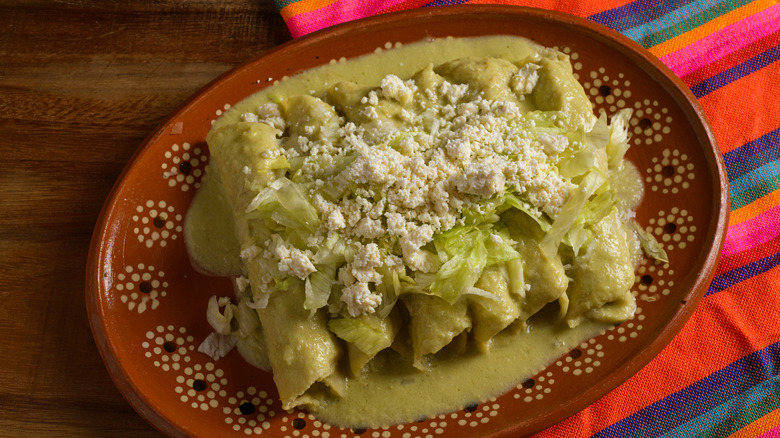
Don't want to use flour to thicken your sauce? No problem — there are lots of other ways you can add body and get that mouth-coating velvetiness. This is especially important if you want to keep your sauce clear — which may be more of a concern with a green sauce, as it can go from vibrant to murky quickly.
Other starches, like corn or potato, become totally clear when cooked, but they will still give you the consistency you're after. Potato starch leaves an especially neutral taste, giving body without weighing things down or making them feel overly starchy. It will be slightly glossy, however, so expect a little extra sparkle in your enchilada. Just be sure you make a slurry to thicken your sauce — don't just dump the starch in, or it will clump up.
Want to get a little science-y? You can do some molecular gastronomy by adding a gelling agent that isn't a starch — think guar gum, xanthan gum, even agar agar. Make sure you make a slurry here, too; agar agar also requires a slurry, but use warm water for this one, not room temperature. You could similarly melt in a little gelatin to give it that vivacious mouthfeel that silkenly slips across the tongue.