

What Happens With McDonald's Leftover Food?
Reducing food waste and addressing global hunger have become big topics. In the United States, 30 to 40% of our total food supply is discarded uneaten (per USDA), but many U.S. companies are making strides to divert usable food from going to landfills when possible. For instance, Costco sends its unsold produce to farms and waste facilities for repurposing and donates edible but unsellable items to food banks for redistribution. It's actually become illegal for commercial retailers to throw away food in some states.
But what does global fast-food giant McDonald's do with its leftovers? Operating more than 44,000 restaurants in over 100 countries gives McDonald's massive potential for discarded ingredients and uneaten menu items.
But the question of how excess food is disposed of among locations doesn't have an entirely clear-cut answer. "There are thousands of McDonald's restaurants in over 100 countries. This means that donating food or supplies isn't always straightforward," the McDonald's corporate website states. The company declares it works with partner organizations, like Food Donation Connection and The Global FoodBanking Network, and, along with franchisees and suppliers, has "taken steps to help reduce food going to waste by redistributing it to people in need" (per McDonald's). Specifically, McDonald's works "with restaurants (both Company and Franchisee owned and operated) and our supply chain to donate meals and excess ingredients to families in need," per the McDonald's corporate website.
The true, bottom-line answer, though, seems to be that food waste disposal varies from one McDonald's location to another. A defined, overarching policy doesn't seem to exist governing the practice, and the ifs and hows of donating seem to be largely left up to individual franchisees.
Leftover food disposal varies among McDonald's locations
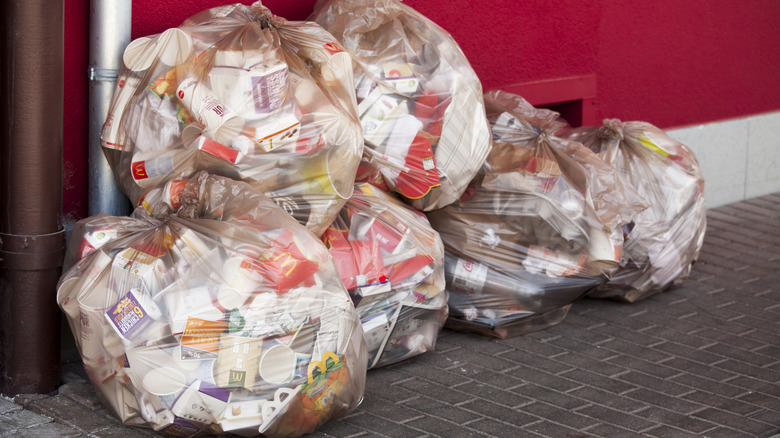
Many self-identified McDonald's employees and former employees report, via online forums like Reddit and Quora, that their restaurants strictly throw out uneaten food, though some say their sites permit employees to consume leftover items. However, the chain tries to ensure it doesn't cook more than it's likely to serve.
Others say their locations give unused food to charitable organizations, though different policies seem to exist from site to site for those that do. One Redditor stated that only certain items can be donated from their facility. "We don't donate completed sandwiches," they posted, "only the ingredients that are allowed to be donated in the system."
The Scott Family McDonald's franchise group, though, which operates McDonald's restaurants across Ohio and Kentucky, seems to be less restrictive in its food waste diversion, actively contributing a variety of uneaten comestibles, including full sandwiches, to food banks, soup kitchens, and other charities. Scott Family McDonald's charitable diversion has amounted to over 100,000 donated food items as of 2025, ranging from burgers, bread products, and hash browns to meat, eggs, and even pancakes. "From breakfast classics to signature sandwiches and sweet treats, these items go straight to organizations working to fight hunger in our communities," the group's website states.
The pandemic spurred changes to McDonald's food waste policies
The COVID-19 pandemic had a big influence on food donation practices and permissibility for McDonald's restaurants. When the pandemic struck, and quarantine kept customers at home and, in some cases, completely shut down McDonald's restaurants, the company was faced with an unprecedented problem of having significantly more food than it had customers to serve it to. "We changed our food donation policy[,] so ingredients like meat, lettuce, milk[,] and cheese that could be donated directly to food banks — reaching communities faster and with far larger quantities than ever before," per the McDonald's website.
While the specific policy McDonald's had in place prior to the pandemic isn't spelled out, a 2018 post on the McDonald's UK website sheds some light. "Unfortunately[,] we can't send cooked food to be eaten elsewhere as this would breach our food safety policies, but we do send all leftover food for composting, rendering or anaerobic digestion," the post stated. More recently published information on the McDonald's UK website, though, now proclaims the brand's local partnership with a food redistribution organization called FareShare. "We are proud partners of FareShare since 2020, helping them with their mission to redistribute surplus food to charities that turn it into meals," the website states. "As one of the first companies to tackle the redistribution of surplus food in lockdown, McDonald's UK has since funded the redistribution of 5 million meals a year through charitable donations."
Other types of food waste repurposing are occurring in nations like Turkey, where McDonald's leftovers are being converted into biopolymer trays, reducing both culinary discard and plastic use, per a corporate-issued McDonald's Purpose & Impact Report for 2024-2025.