

How To Speed Up Strawberry Growth In Your Garden
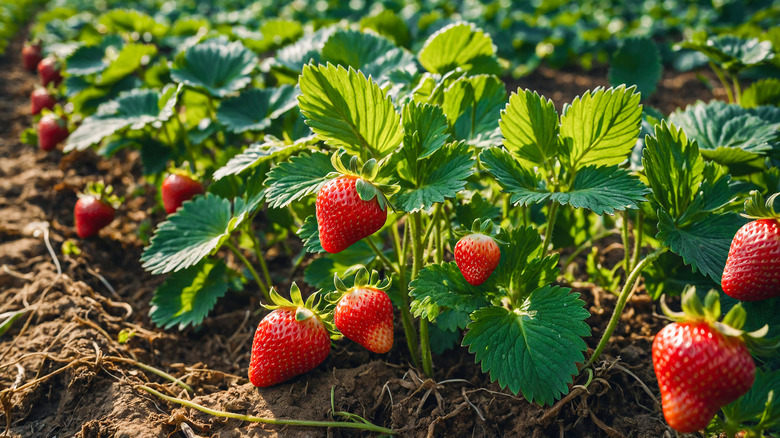
Strawberries are a tasty spring harvest fruit that are fairly easy to grow. Still, according to Angelika Zaber, a lawn care specialist and gardening expert at Online Turf, you can accelerate their fruit production with the right environment.
"Starting off with temperature, strawberries need a cold spell to initiate flowers and fruits," Zaber told Food Republic. "Ideally, a two-week period when the temperatures are consistently below [44.6 degrees Fahrenheit]." Steady exposure to colder temperatures helps them produce larger, healthier fruits. Sunlight works similarly to drive energy production and is especially useful in helping them ripen berries during the higher temperatures of full-sun exposure, which lets them grow even more fruit. If your variety doesn't get enough sun, its leaves can end up pale, and it is less likely to produce any fruit.
"Strawberries are also susceptible to root rot, so to grow well they need a well-draining soil that's rich in humus and organic matter so that it can support their development," Zaber continued. Watering frequently rather than deeply is great for strawberries because it not only supports their shallow root systems, but also gives you the opportunity to apply a weekly high-potassium fertilizer. A bit of yeast can also help you grow the juiciest garden strawberries, since it provides several nutrients that specifically help the plant flower and produce fruit.
Mistakes that inhibit strawberry growth
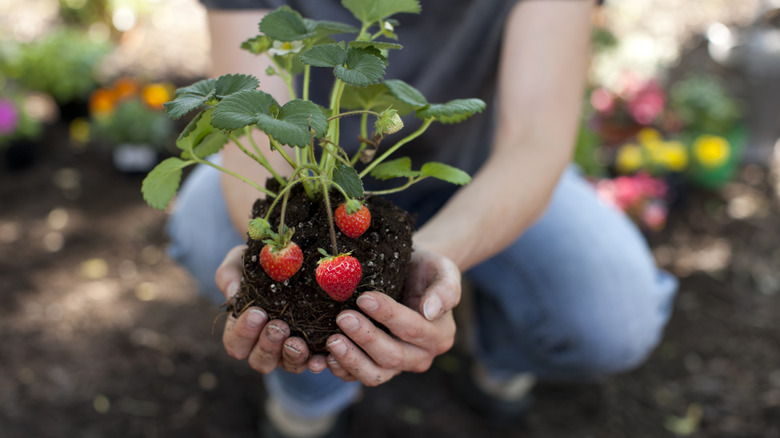
Strawberries like to stretch their legs once planted, sending out little runners that produce even more fruit. A single plant should produce fruit for three to five years, but many people make mistakes on the first day with improper planting techniques.
"The first one includes planting the plants too deeply," Angelika Zaber explained. "Ideally, strawberries should be planted with the crown above the soil." Strawberry roots should enter the ground straight as an arrow, with no bend, but planting them too deeply leaves them prone to root rot. It is far better to plant them a bit too shallow and scoop dirt around the plant in a wide berm, as this allows their roots to stay moist and helps them send out runners later on.
"Mulch is a great way to ensure that the soil does not dry out too quickly while also suppressing weeds, preventing them from competing with your plants," Zaber finished. While you can kill weeds in your garden with baking soda or harsher chemicals, it is difficult to do so around strawberries since they spread so much. Mulch also decomposes slowly, adding nutrients back to the soil year after year. Since strawberries prefer slightly acidic soil, use a pine bark variety that is thick enough to shade your dirt, but fine enough to break down and require refreshing every spring.