

How To Make Delicious Curry Without Coconut Milk
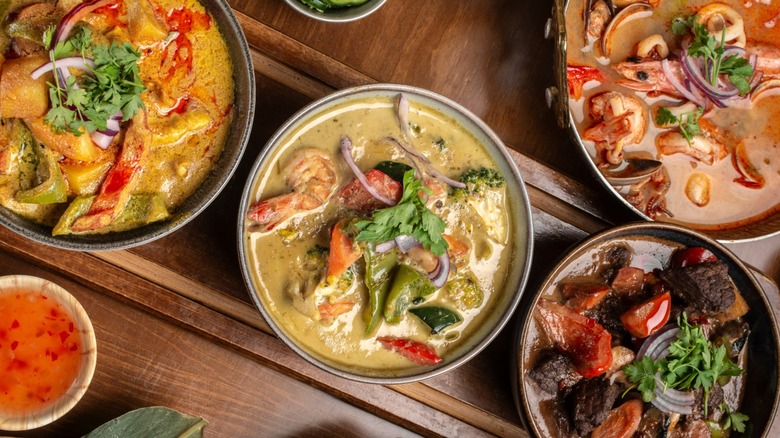
Whether it's a Thai green curry or a rich Malaysian rendang, one of the best ways to use coconut milk is to add it directly into your curry, instantly giving it body and depth. But while it's a staple in many Southeast Asian dishes, it's not the only way to thicken the dish and build richness. To explore other options, Food Republic spoke with Yasmin Henley, head chef, founder, and recipe developer at By The Forkful.
Henley's first recommendation for thickening curry is heavy cream. Its high fat content gives the sauce a rich and indulgent consistency, as well as balancing out the spiciness, which is why it's commonly used in North Indian classics like butter chicken. Another popular dairy-based thickener used in Indian cooking is yogurt, but for the best results, make sure it's full-fat to achieve that silky, velvety texture. Once the sauce has had plenty of time to simmer, stir in a dollop of your chosen ingredient and remove from the heat.
It's not just dairy that can make curries rich and creamy. Henley says a vegan-friendly alternative is cashew cream, which is commonly used in Indian dishes. Like coconut milk and heavy cream, cashews are also high in natural fats, helping to thicken up the sauce. Unlike dairy, however, they add a mild nutty flavor that keeps the dish lighter while adding welcome complexity. "Simply blend about 1 cup cashews and ½ cup water until you have a thick, creamy sauce," Henley advised. Once your cream is ready, you can treat it just like coconut milk or heavy cream in recipes.
Choosing the right fat preserves a curry's flavor profile
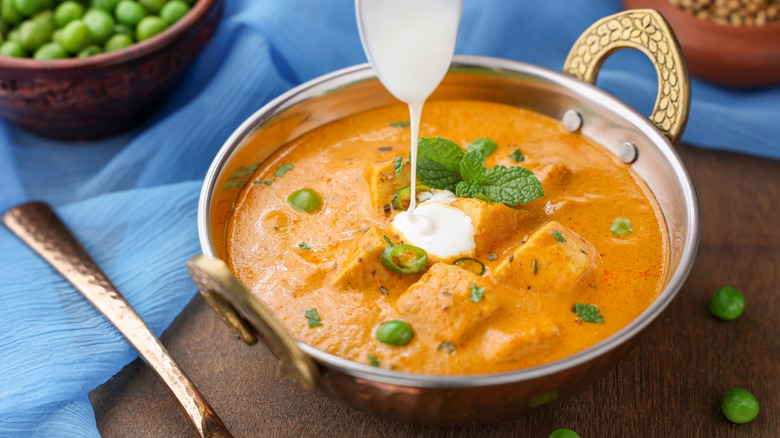
While coconut milk, heavy cream, and cashew cream all contain one key element — fat, which is what adds richness to curries — they are not interchangeable. Each serves a distinct purpose, making certain types of curries better suited to one over the others.
"Curries that benefit most from non-coconut bases tend to be North Indian or Pakistani styles, where the structure comes from yogurt, tomatoes, browned onions, or a reduced masala rather than creaminess," Yasmin Henley noted. "Dishes like rogan josh, bhuna-style curries, or chicken karahi are meant to be intense, spice-forward, and concentrated — coconut milk would soften their edge."
When cream is used in these dishes, it's usually added sparingly at the end of cooking to create a velvety texture without altering the core flavor or intensity. Curries where heavy cream is a central ingredient, like butter chicken, are actually the exception rather than the rule. Historically, cashew cream was the preferred method for adding richness to Indian curries, providing creaminess while also imparting a subtle nuttiness to round out the flavor profile.
In contrast, coconut milk is usually a central part of the curry's body, texture, and flavor. "Many Southeast Asian curries — especially Thai red or green curry — rely on coconut milk to balance heat and aromatics like galangal and lime leaf," Henley explained. It's also widely used in South Indian cooking. Climate can help explain this distinction. Because coconut milk is naturally sweeter and lighter than heavy cream, it creates curries that feel creamy yet lighter, which is ideal for hot and humid regions like South and Southeast Asia.