

The 9 Hottest Peppers In The World, Ranked By Heat
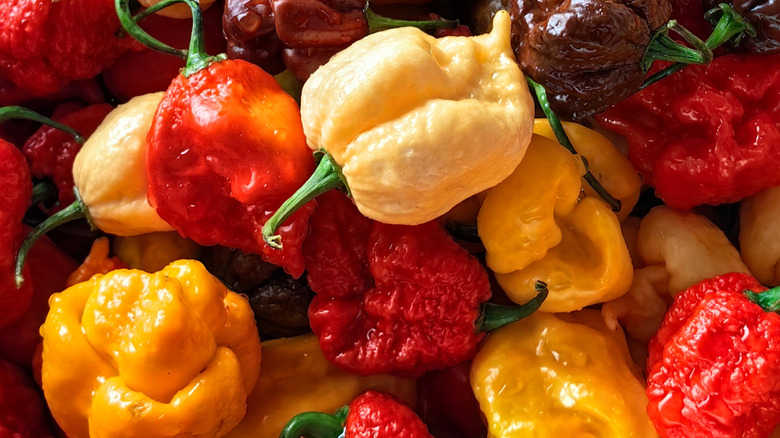
Everyone loves a little spice now and then, whether it's devouring a plate of the blisteringly spicy hot wings or satiating your sweet tooth with candied jalapeños. Afterwards, perhaps you've found yourself with a glass of milk in hand pondering how hot can these gastronomic grenades can actually get. The answer? Extremely hot.
Whether you call them peppers or chiles, both are measured by the Scoville Heat Scale, a rating system devised back in 1912 by Wilbur Scoville to measure the heat of these fleshy fruits. While Scoville administered his tests by placing his samples directly on taste testers' tongues, modern day testing uses High-Performance Liquid Chromatography to determine results.
As anyone who has watched an episode of "Hot Ones" knows, the higher the Scoville Heat Unit (SHU) number, the hotter the pepper. While a standard bell pepper or sweet banana pepper ranks between 0 to 100 SHU, your average jalapeño pepper can often score anywhere between 2,500 SHU and 8,000 SHU. The following chiles, however, make these paltry peppers seem like no more than footnotes in the book of spicy. From the first "superhot" to a pepper about 27 times as hot as a habanero, get ready to meet the hottest peppers known to man.
9. Ghost pepper
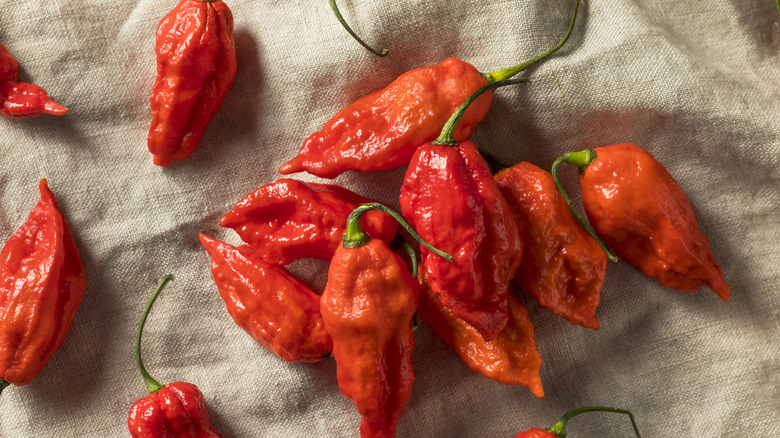
The ghost pepper, also unknown as the bhut jolokia, held the title of hottest pepper in the world from 2007 until 2011, measuring 1 million Scoville Heat Units or more. The ghost pepper became the first to break the 1 million mark on the Scoville scale, becoming among the first to fall in the category of "superhots." The previous record holder, the Red Savina, held a modest 577,000 SHU in comparison.
However, you may be surprised to learn that 1 million SHU is just the average, as this smoldering chile can range from 855,000 to 1.46 million SHU. A chile originally from India, this pepper is so hot it's been used to deter elephants and deployed in pepper spray.
What makes the ghost pepper different from other peppers? Unlike many other chiles, these brutal fruits hold half their capsaicin content in their flesh, rather than mostly in the pith like jalapeños, allowing them to imbue your cooking with plenty of heat. Different varieties of ghost pepper possess different flavor nuances. Some are described as smoky; others, like the chocolate ghost pepper, are detailed as having a sweet and floral flavor.
One never wants to eat a ghost pepper straight. Although some describe the initial flavor as sweet, less than a minute after one tastes this superhot pepper, the burning sensation starts and continues to intensify. Just a teeny nibble can cause your eyes to water and your entire mouth to ignite. Still, gloves and goggles will be necessary to cut these blazing fruits, lest you feel their flame-like sting without even eating them.
8. Infinity Chili
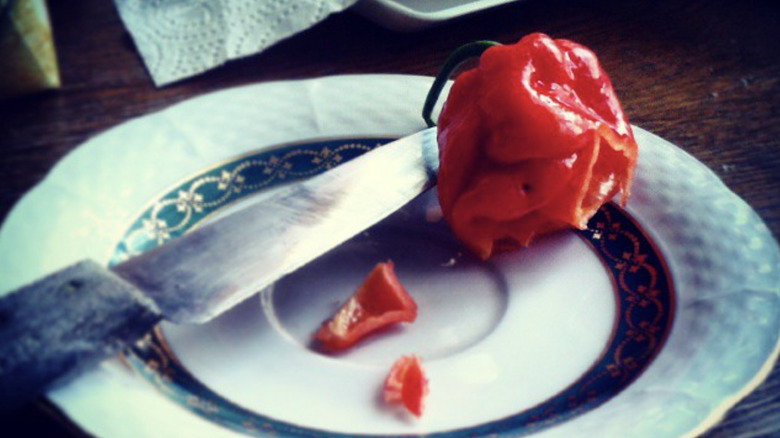
The Infinity Chili's time in the sun may have been short-lived, but it was indeed spicy. Invented by Nick Woods in England, tests at the University of Warwick's Crop Centre showed this pepper to hold 1.17 million Scoville Heat Units, beating out the Ghost Pepper in hotness and holding the Guinness World Records title for world's hottest pepper for two whole weeks. Others estimate the peppers can range from a little over 1 million SHU to 1.25 million SHU, averaging out at something closer to 1.16 million SHU.
Woods started creating hot sauces as a hobby before forming his business Fire Foods and crossbreeding peppers to make the Infinity Chili. But this Brit's aim wasn't to create the world's hottest pepper. An invention of accident, Woods unexpectedly made the Infinity Chili. But even the creator of this scorching pepper is not immune to its incendiary effects.
Woods attempted to eat one of his Infinity Chilis which had been frozen, thinking the storage process might have dampened some of the pepper's strength. The result? Woods experienced burning on his tongue which lasted 30 minutes, and other painful effects strong enough that he considered calling the hospital. Luckily, medical services weren't necessary.
7. Naga Viper
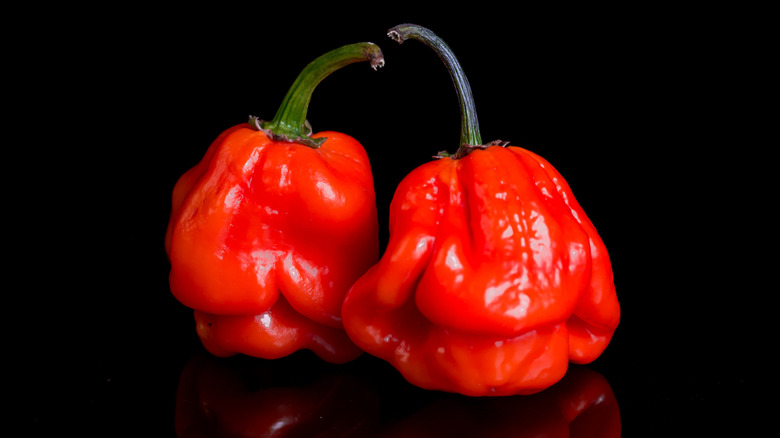
You can thank U.K. resident Gerald Fowler for the existence of the Naga Viper pepper, which measures at about 1.35 million Scoville Heat Units. Claimed by Fowler to be created from three pepper varieties that he cross pollinated (the ghost pepper, Naga Morich, and Trinidad Scorpion), this pepper stole the Guinness World Records title for the hottest pepper, replacing the Infinity Chili, which, as we mentioned, only held the title for a fortnight.
At the time, Fowler had been a full-time chile farmer for five years, and growing peppers for a full decade in Britain. The Naga Viper was created in his heated greenhouse, measuring a modest 16-by-8 feet. Owner of the Chilli Pepper Company, he transformed his creation into a scalding sauce for use in curries, well aware of how hot the paper could be in its raw form.
Per the Daily Mail, Fowler has described the Naga Viper as being "hot enough to strip paint." He claims the pepper's blistering heat to last an hour, numbing the tongue and searing its way through your body — although apparently it comes with a remarkable rush of endorphins as well. With the Naga Viper falling anywhere between 900,000 and a maximum of 1.38 million SHU on the Scoville scale, we'll take his word for it on that.
6. Komodo Dragon Pepper
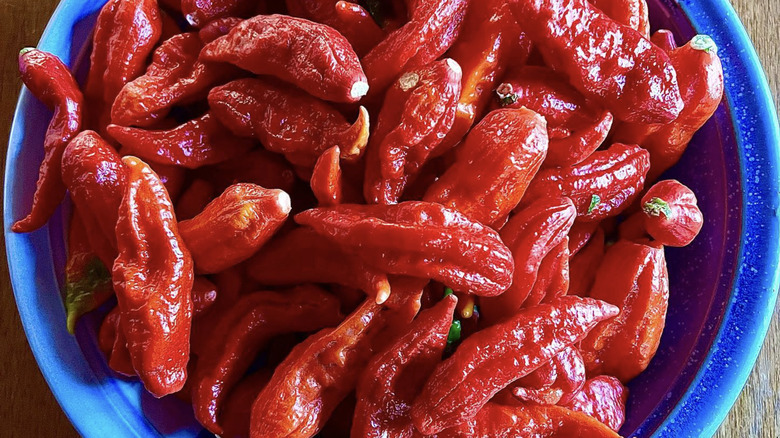
The Komodo Dragon Pepper ranges around 1.4 million Scoville Heat Units (although some sources say it can reach as high as 2.2 million SHU) making it one of the hottest peppers in the world to date. Originating in the United Kingdom, the Komodo Dragon Pepper is a fruit-flavored pepper grown in Bedfordshire by Salvatore Genovese, the man behind the United Kingdom's biggest chile production.
Salvatore began growing chile peppers after assuming his family's cucumber business 15 years before creating his ferocious invention. The Komodo Dragon came out of his seven acre farm in Blunham, Bedfordshire, before making its way into Tesco supermarkets in 2015. Recognizing the popularity of spicy peppers and their increased demand in the U.K., Genovese was always trying to up the heat level on his peppers, aiming to create hotter ones each year. With the Komodo Dragon, he certainly succeeded.
Like many of the world's hottest peppers, the deadliness of the Komodo Dragon comes from its delayed onset. Consumers might think the heat is less than expected at first bite, enjoying the fruity yet fiery taste. But as the seconds tick by the heat builds, leading to a furnace-like spice level. When the Komodo Dragon hit stores, it became the hottest commercially grown chile pepper consumers had ever seen. Consequently, Salvatore warned anyone who wished to try this blistering beast of a pepper to be sure they had some milk or yogurt on hand — just in case.
5. Trinidad Scorpion Butch T
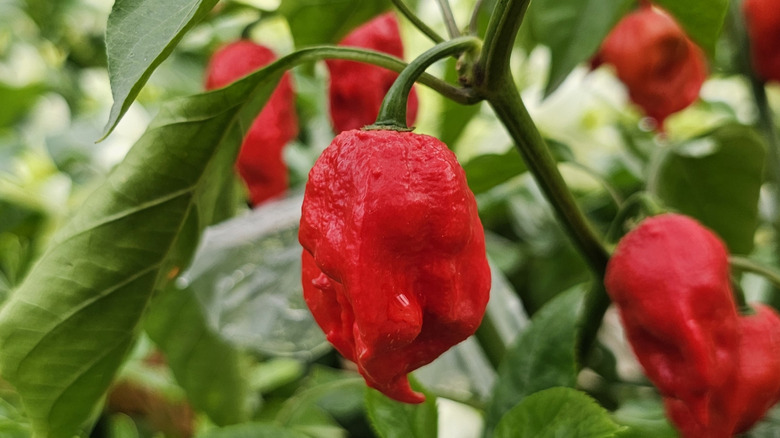
What's in a name? American Butch Taylor is widely accepted as the propagator of this blazing fruit (hence its moniker), though it's officially credited to The Chilli Factory in New South Wales, Australia in 2011.
Regardless of who deserves the credit (or blame) for these little scorchers, they certainly did a job – the Butch T ranges from 800,000 to 1.43 million SHU and boasting an average heat around 1.13 million SHU. The team at The Chilli Factory actually need to equip themselves with gloves, chemical masks, and suits just to cook these peppers. Due to their scalding nature — they can cause a burning sensation that lasts for days on the hands if one forgets to wear gloves — these fearsome fruits are wielded in the form of a hot sauce known as the Scorpion Strike line.
After clocking in slightly above 1.4 million SHU, the Butch T held its position as the world's hottest pepper from 2011 to 2013. Despite being named for an American and being grown in Australia, its roots come from Trinidad as the name implies, where a lengthy tradition of hot peppers continues to thrive. A variety of scorpion pepper (so-named as its pointed bottom mirrors that of a scorpion's stinger), it's just one of many in a group of superhots.
4. 7 Pot Primo and other 7 Pot Peppers
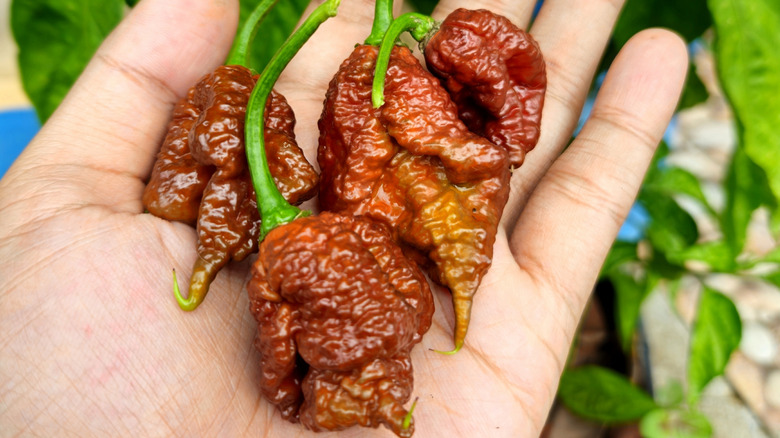
The 7 Pot Primo and other 7 Pot Peppers like the 7 Pot Douglah have been among the hottest peppers in the world, clocking in at around 1.47 million Scoville Heat Units and higher. You'll find different Scoville ratings for the 7 Pot Primo depending where you look. Some sources list the SHU as high as 1.5 million , while more modest calculations place this pepper within a range of 800,000 to 1.27 million SHU. Despite the differing calculations, the 7 Pot Primo is still undoubtedly one of the world's most blistering peppers.
Pioneered by Troy Primeaux of Primos Peppers, the 7 Pot Primo came into being after Primeaux crossbred pepper varieties from Bangladesh and Trinidad. A former musician who turned to horticulture later in life, he now heads Primos Peppers, a Lafayette-based company offering a variety of hot sauces, pepper powders, and hot pepper jelly to the world in addition to 7 Pot Primo seeds.
Allegedly named 7 Pot Peppers because they hold enough heat to flavor seven pots of stew, these fiery fruits all stem from a few strains of peppers hailing from Trinidad and Tobago. The 7 Pot Douglah, also sometimes referred to as a Chocolate 7 Pot, rates even hire on the heat scale, although accounts vary as to its exact SHU. Some give this burgundy-colored fireball a sweeping range of 923,889 to 185 million SHU, while more modest estimates place it at between 1 million and 1.5 million SHU.
3. Trinidad Moruga Scorpion
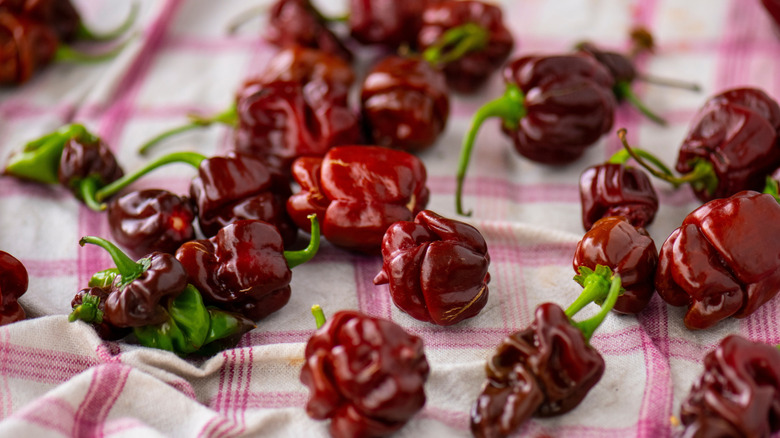
Clocking in at about 2 million Scoville Heat Units, the Trinidad Moruga Scorpion is face-meltingly hot. While some estimates place the average heat level closer to 1.6 million SHU, these peppers can range between a blistering 1.2 million to 2 million. When the New Mexico State University's Chile Pepper Institute tested this chile in 2012, they named it the hottest pepper in the world. (The Trinidad Scorpion Butch T, Chocolate 7 Pot, and ghost pepper were also among the peppers they tested.)
A variety of scorpion pepper believed to have been developed by Wahid Ogeer in the Moruga district of Trinidad and Tobago, it seems this pepper wasn't certified by Guinness World Records despite being the first to break 2 million SHU. (Its cousin, the Trinidad Scorpion Butch T, continued to hold the title until our No. 2 ranked pepper nabbed it, but more on that in a moment.) Perhaps the Trindad Moruga Scorpion's omission is tied to its debated origin story, which remains contested as to who the actual creator might be, with other individuals having since claimed the pepper to be theirs.
A pepper that relishes hot and arid weather, the Trinidad Moruga Scorpion's spice level is directly related to its growing conditions, increasing when the plant experiences dry spells and higher temps. This is why heat temperatures may fluctuate widely between individual peppers. But this extremely spicy grenade is not without its uses. A pair of peppers can be enough to enliven a week's worth of food, with small amounts of these peppers making a more approachable hot sauce.
2. Carolina Reaper
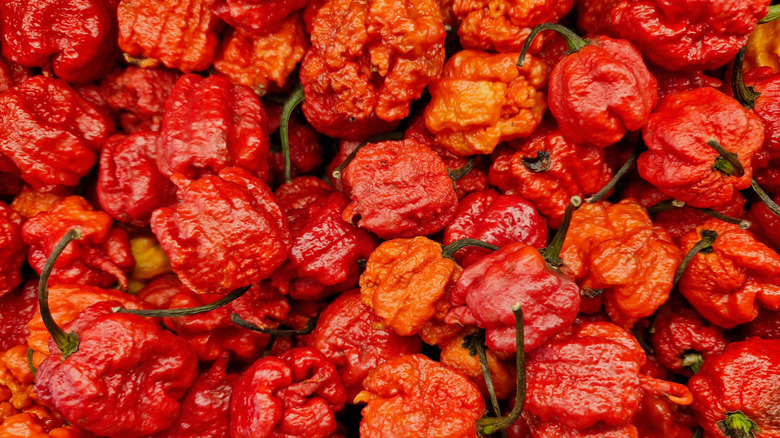
In 2013, a new pepper emerged as the world's hottest, coming in at 2.2 million Scoville Heat Units and taking the Guinness World Records title. A pepper so hot those who cultivate it need to wear two pairs of gloves, this demonic fruit contains oils powerful enough to burn through latex.
While the grimly-named Carolina Reaper can rate as high as 2.2 million on the Scoville heat scale, your average Caroline Reaper actually falls closer to 1.64 million SHU on average. Still, this powerful pepper packs one of the meanest punches, having held the record for the world's hottest pepper for a full decade. It was developed by Ed Currie of PuckerButt Pepper Company, who apparently never intended for the chile to be the world's hottest but found himself at the top of the pepper pyramid, at least initially, by chance.
Currie began growing peppers in his yard after moving to South Carolina in 2001, eventually crossbreeding chiles. However, crossbreeding a stable pepper is a complicated process that can take up to a decade. It seems the Carolina Reaper was well worth the effort, though, with this firebomb still ranking as the second hottest in the world.
1. Pepper X
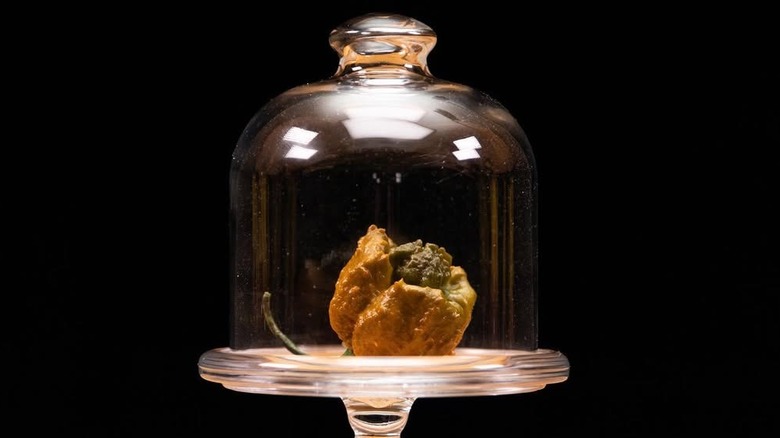
Currently, Pepper X reigns as the hottest pepper in the world, officially ejecting the Carolina Reaper from its decade-long reign as the Guinness World Records holder in October 2023. Also created by previous record holder Ed Currie in South Carolina, it carries 2.69 million Scoville Heat Units to scorch your palate if you dare try this brimstone-like fruit. While lab tests at Winthrop University showed the Carolina Reaper to average an SHU of 1.64 million, Pepper X showed a stupefying 2.69 million SHU.
Just why is this enigmatically named pepper so hot? Pepper X is a chile with lots of ridges and contours, giving the pepper's placenta more space to grow within. Because a chile's heat is held in the placenta or pith (not the seeds), this gives Pepper X all its lava-like potential. A few sources even claim the pepper to reach a broiling 3.18 million SHU.
Still, this volcanic pepper is hard to come by — the seeds have never been released, so you can only sample its molten fire by purchasing official hot sauces. It seems the success of Currie's previous inferno, the Carolina Reaper, made him realize the value of his contribution to the pepper world. Over the years, some 10,000 products have sported the Carolina Reaper name without Currie's permission. For this reason, Currie has kept his latest pepper property heavily protected.