

Why Does Crown Roast Have White Paper Hats On It?
We may receive a commission on purchases made from links.
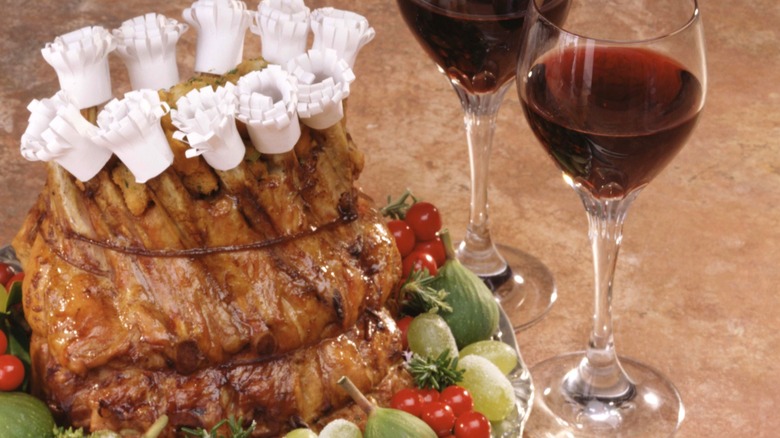
Between their beautiful coloring, crusts of seasonings, and eye-catching size, most roasts are naturally sensational enough to dominate a dinner table. However, while crown roasts are not above a little dressing up, those little white paper hats are just as much for function as they are for form.
A romantic alternative to steak, crown roasts are formed by taking one or two racks of ribs, typically either pork or lamb, and tying them into a circle before roasting. This gives it its characteristic "crown shape," but the true royalty of this dish comes from the manchettes, paper coverings similar to a tiny chef's hat. It rose to popularity during the Victorian era, fell out of vogue for a time, then saw a resurgence in the 1990s, but always with its characteristic trimming. Not only did manchettes impart extra elegance to the main course, but they also allowed diners to hold the bone of an individual chop after carving without dirtying their fingers.
Most cuts for this dish come "frenched," meaning someone removed all the tissue from the thinnest end of the bone, leaving a lollipop of meat at the other. While this already made eating or selecting your portion by hand simple, Victorian-era diners were not known for turning their noses up at a bit of added nobility. Crown roasts are surprisingly easy to make for how beautiful they are, and the only real difficulty is in getting the ribs to form and hold a perfect shape.
How to prepare a crown roast
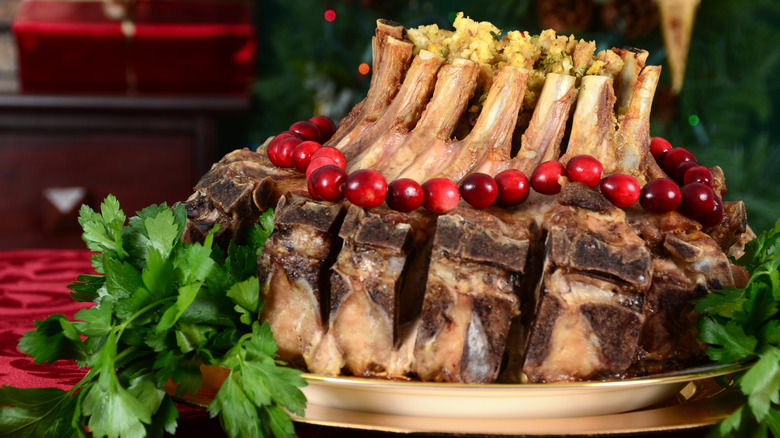
Regardless of whether you use pork, lamb, or veal, each rack of ribs needs some preparation. While you can french the bones yourself, even Ina Garten asks her butcher to do it for her, as it usually ends up far prettier. If using pork ribs, do not forget to trim off the silverskin at the bottom so they will be easier to work with.
Once you have your roast, flip it so the rounded top side is facing up. Make half-inch slits between each bone, or every other bone, whatever your preference is for serving size. This makes it easier to bend the ribs without tearing muscle fibers and to carve it later. For a single rack of ribs, wrap a string of butcher's twine around the circumference of the roast and tie it snugly, ensuring the whole thing stands up on its own. You may need to truss it twice to make things secure, but feel free to use as much twine as you feel is necessary.
If you are making an extra-large roast with two racks of ribs, you can use a meat needle, such as this one from Ofargo, threaded with butcher's twine. Pierce one roast high up between the last two bones, then repeat with the second roast, tying them together. Repeat this step lower down, then do this process again with the other side until they are essentially "one" roast. Truss the roast around the outside to guarantee it will hold its shape, and you have a beautiful crown of meat.