

The 1950s Crab Dish Everyone Should Try At Least Once
Every country's got a dish that's uniquely its own. Italy's got pizza, the U.K. treats fish and chips like a religion, and over in Singapore, it's chili crab — a dish that dates all the way back to the 1950s. Given Singapore's spot on Anthony Bourdain's list of top food cities, skipping this longtime local favorite would be a serious foodie faux pas.
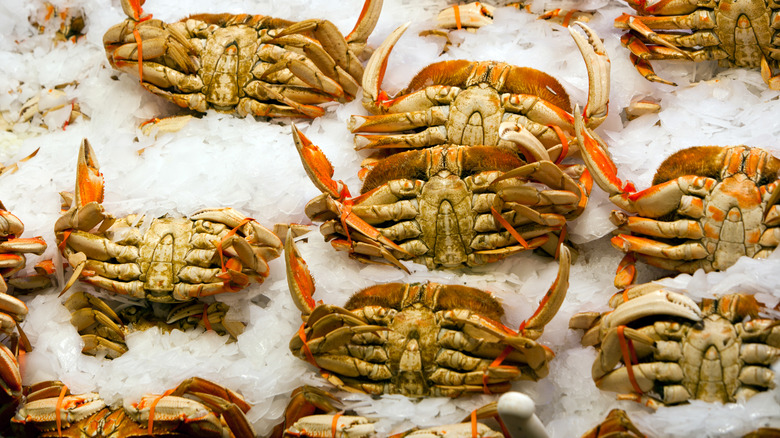
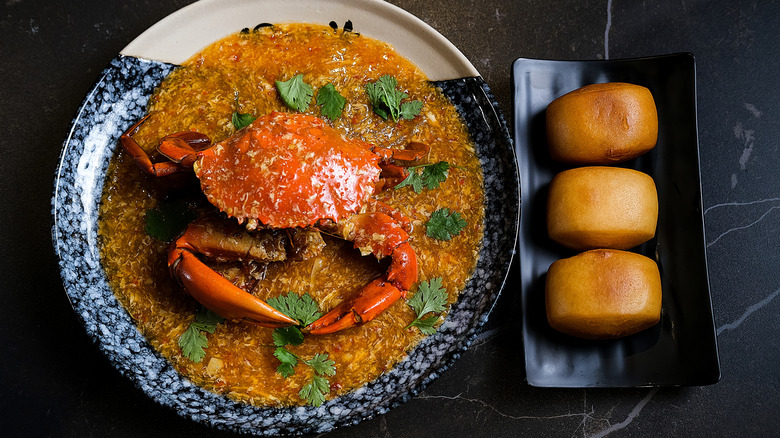
At the heart of this dish are mud crabs, with Singapore remaining one of the world's most significant hubs for the species. The crabs are stir-fried in a rich, spicy tomato-chili sauce and traditionally served with fried or steamed mantou (Chinese-style buns) for dipping. Served whole, shell and all, this dish invites you to dig in with your hands — just make sure to skip white clothing and have plenty of wet wipes on standby!
Locally, the dish is considered nothing short of iconic, but how exactly did it become a favorite in a city filled to the brim with good eats? Chili crab is largely credited to couple Choon Ngee and Cher Yam Tian. Tian developed the dish for her husband, who wanted a spicier twist on steamed crab. Combining chili and tomato, the duo quickly realized that they had whipped up something special and began selling it from a pushcart. Like many beloved Singapore street foods, chili crab soon became a sensation and eventually entered the high-end dining scene. At the now-closed Dragon Phoenix Restaurant, legendary chef Hooi Kok Wah created the modern version, featuring additions like sambal and eggs to add more depth and complexity to its flavor profile.
Chili crab is uniquely Singaporean
Chili crab is a strong representation of Singapore's diverse cultural heritage. The nation is made up of three main ethnic groups — the Chinese, Malays, and Indians — whose unique culinary traditions all influence Singapore's food landscape. In the case of chili crab, the sambal sauce reflects fiery Malaysian flavors, while the tomato adds a Chinese element. Although Malaysia has occasionally claimed credit for chili crab, the consensus remains that it's a distinctively Singaporean creation. Surprisingly, despite its widespread popularity, chili crab isn't Singapore's national dish. While many locals argue it deserves the top spot, that honor is most frequently associated with the equally delicious Hainanese chicken rice.
If you want to try chili crab in Singapore, you won't have any trouble finding it. It's as widely available as other local street food classics like kaya toast or laksa. You could splurge at a restaurant, but you'll get a better (and cheaper) experience at one of Singapore's many bustling hawker centers. These establishments feature numerous independent food stalls serving a variety of Asian cuisines. They're so culturally significant that UNESCO recognizes them as intangible cultural heritage. Despite Singapore's tiny size, you can find over 100 hawker centers scattered across the island.
One of the best things about hawker centers is how affordable they are — it genuinely makes the food taste better! Chili crab, however, is a bit of an exception since it uses the whole crab, so expect to pay a premium compared to other stalls. Depending on the crab's size and the specific hawker center, prices typically range around $80. Fortunately, these crabs are large and meant to be enjoyed communally, so bring along some friends and share both the food and the cost.