

Neither Tyson Nor McDonald's: Here's Who Really Invented Chicken Nuggets
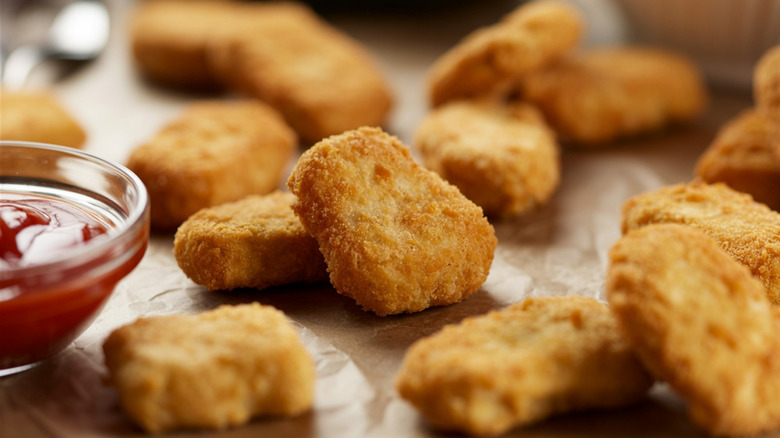
Who doesn't love a juicy, crispy chicken nugget? The truth is, lots and lots of people do, which is why the golden, fried poultry bits are offered in supermarkets and all types of restaurants across the world. Heck, even Taco Bell has had chicken nuggets on its menu. But how did chicken nuggets come to be?
The inventor behind our beloved nuggies wasn't Tyson Foods or McDonald's (though, as Tyson told Food Republic, the company certainly "played a significant role in the category's growth" and subsequent rise to global popularity). As with many food origin stories, there's some dispute about who nuggetized the chicken first. But a professor of poultry science and food science at Cornell University named Robert C. Baker is widely credited with the invention.
Baker was the founder of the university's Institute of Food Science and Marketing. In a Cornell laboratory in 1963, he set out to innovate ways of repurposing chicken. Among his discoveries, Baker pioneered an approach that involved grinding raw poultry — using vinegar and salt to draw moisture out of the meat — and binding the chicken with ground grains and powdered milk. The concoction was then molded into bite-sized "sticks" and coated with a special breading designed to stay attached through the freezing and frying processes. Thus, chicken sticks, the forerunner of today's chicken nuggets, were born. In creating a food invention that would ultimately take the culinary world by storm, Baker was actually just trying to help local New York poultry farmers, who were struggling in a failing post-World War II chicken market.
The post-WWII shift led to the creation of the chicken stick
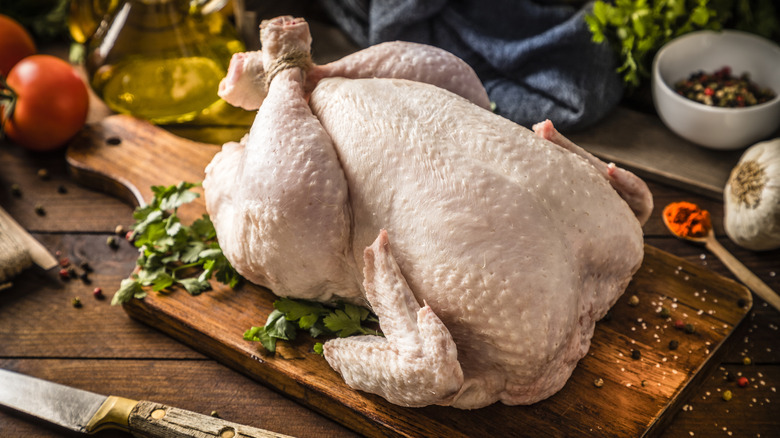
During World War II, high demand for chicken was driven by military requisitioning. After the war, however, there was suddenly an abundance of supply and a drastically diminished demand. Not only was the military need gone, but society had changed, too. Women were increasingly working outside the home, which left them seeking easier, quicker meals to feed their families. Quick-fix foods like boxed macaroni and cheese fit the bill — but chicken did not. At the time, poultry was largely sold only in whole-bird formats, unless a butcher cut it up for you. Either way, preparing and cooking raw chicken was more time-consuming than working folks wanted to deal with (after all, there's a reason most households only cook a whole bird once a year, on Thanksgiving: It's a lot of work).
All of these factors resulted in a struggling poultry industry. Enter Robert C. Baker, who recognized that chicken needed to change with the times if farmers were going to survive. The problem wasn't generating more chicken — farmers had already implemented improvements to both chicken feed and genetics during the war to produce more birds and keep up with military demand. This ultimately backfired, as the resulting postwar oversupply contributed to an upside-down poultry market. What was needed were new ways to move the surplus, use chicken more cheaply and at a larger scale, and make it more convenient to consume. To address these issues, Baker developed new methods of processing poultry, including the advent of his frozen, ready-to-cook chicken sticks.
Robert C. Baker influenced global food processing at large
The chicken nugget is by far Robert C. Baker's most famous contribution to the food world. But in addition to his nuggets, also known as chicken sticks, he developed other chicken processing methods that resulted in more convenient end products for consumers. Among his creations, the food scientist innovated processes behind chicken-based hot dogs, ground chicken "burgers," poultry-based cold cuts, and more. He and a colleague, Joseph Hotchkiss, also developed vacuum packaging and modified-atmosphere packaging to improve the shipping of poultry, both of which are still implemented in modern poultry processing practices.
In short, Baker influenced nearly every type of processed poultry product consumers enjoy today. Ironically, though, he never grew wealthy from his many inventions and innovations. He didn't patent his discoveries or his recipes; he simply shared them. Baker's ideas, including chicken nuggets, were distributed free of charge through Cornell publications in hopes that players in the food industry would implement them. And did they ever. Chicken nuggets, along with Baker's other innovations, eventually took hold in the food market, and the once-floundering poultry industry began to thrive.
Chicken nuggets are now one of the most widely eaten foods among Americans, and they are a top product in the multibillion-dollar frozen processed chicken market. Their popularity isn't just stateside, either. Chicken nuggets have become a global food sensation, and countries outside the U.S. have become major exporters of the chicken invention, including Poland, which exported more than $600 million in chicken nuggets in 2023, according to Tridge.