

What Dining Out Was Like In The 1950s
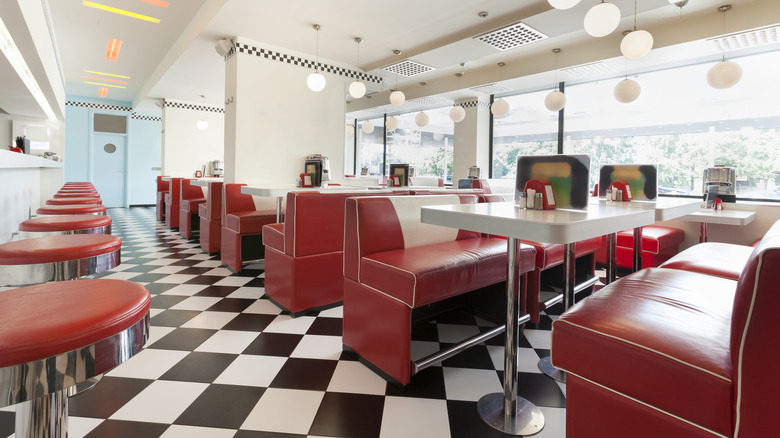
The 1950s were a time of sweeping culinary changes in the American landscape. Returning WWII soldiers brought home a taste for diverse dishes inspired by their travels. Suddenly, herbs and spices like oregano, paprika, and chili peppers used in Italian, French, Indonesian, and other cultures burst onto the wider scene. Coupled with multiple freshly completed highways connecting the country, these newly discovered flavors met convenience in the form of drive-ins, diners, rest stops, and restaurants.
Some of today's best-known fast food chains began in the '50s, with the establishment of brands like KFC, Domino's, and Pizza Hut. While chrome-laced diners have never fully left the dining scene, many 1950s staple dishes, like Jell-O molds and aspic, have. However, inflation is bringing about a revival of old-school recipes and an interest in vintage kitchen trends. So, let's look back at what dining was like in the 1950s and how it's still influencing eating out today.
Diners became shiny and chrome
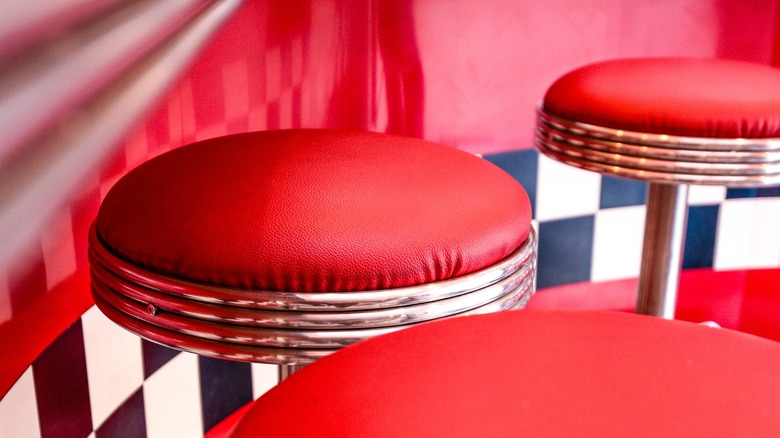
It's hard to hear the word "diner" and not have images of jukeboxes, long lunch counters with low stools, and a grill filled with frying burgers. There's a reason for that, and it's tied into the optimistic interior designs related to the Space Age and represented by gleaming chrome. The U.S. (and most of the Western world) was fascinated by the idea of what outer space held in the 1950s and '60s. Speculative fiction was at its peak, with authors like Ray Bradbury, Isaac Asimov, and Marion Zimmer Bradley creating tales of suspense, danger, and hope.
Those themes carried over into architecture at large, but with diners in particular becoming beacons of futuristic style. The flashy chrome accents on every surface that wasn't actually made of the reflective metal created an aesthetic set firmly in the early atomic age. The image of rocket ships and space was conjured through oversized windows, too, which let customers look out over the scenery and passing cars. Those same cars could see the light reflected from the windows, along with neon signs, to welcome them into the restaurant and repeat the cycle all over again, 24 hours a day.
Diners popularity went beyond their looks
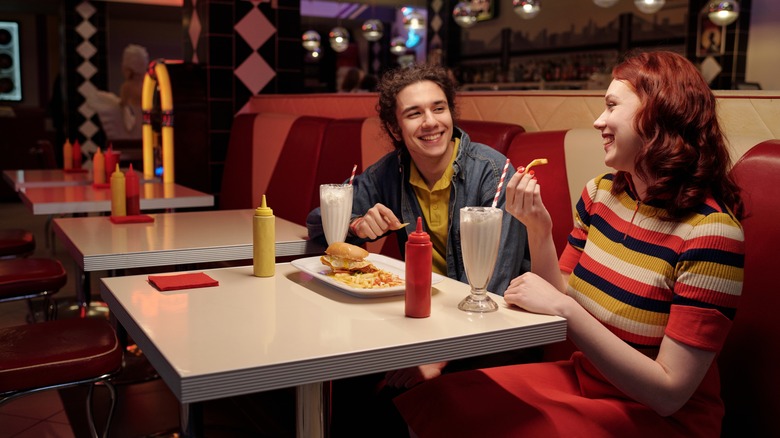
Diners had been around America since the early 1900s, when they started off primarily as converted boxcars. The long shape didn't lend itself to a place with many tables and chairs, but a long counter with barstools would allow multiple people to be served at the same time without the staff having to maneuver across the floor continuously. The lunch counter became synonymous with diners, as did a more extensive menu than other restaurants of the time. Diners were able to deliver dishes like hamburgers, hash, pancakes, and meatloaf at a lower price than other places and at a quicker turn-around time. These former railway cars were the precursors to fast food establishments just a few decades later.
All of that was as true in the 1950s as it was in the 1920s and 1930s, when diners were seen as a low-cost way of taking the family out to dinner. It wasn't until the mid-century, however, that diners were also seen as a primary spot for social interaction. Young people courted each other there. Older couples could grab a bite after running errands. Although not desegregated until the 1960s, people from a variety of wealth and social classes gathered together daily at diners, and they still do now.
Coffee shops took on a California flair
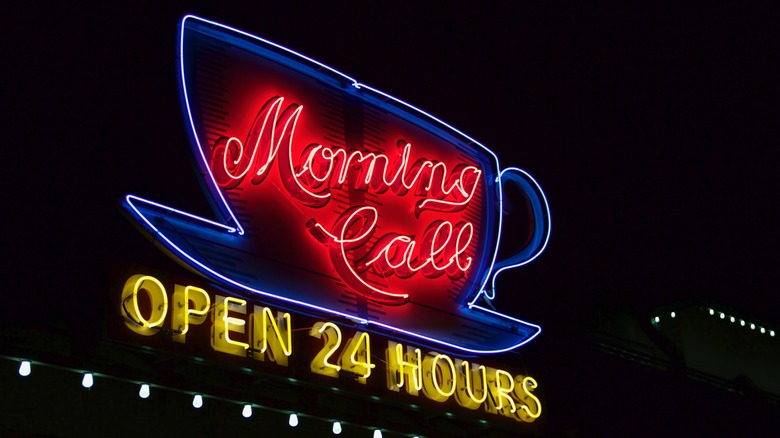
Suburbs were literally on the rise after WWII. As the housing divisions grew, so did the new community's need for social meeting places, and a great cup of joe. Southern California took that challenge and ran with it. Their solution to both was the coffee shop. Coffee shops themselves were nothing new, and indeed, the American diner had been on the rise since the 1920s. But these SoCal establishments were different. From aesthetic to vibe to the food and coffee being served, these spots helped shape the coffee shops we know today.
The forerunner of the California coffee scene was Hollywood's own Googie Coffee Shop, not to be confused with one of today's most popular search engines. Instead, Googie's created artistic and futuristic decor coupled with the asymmetry of mid-century architecture. The designs included amoeba-like shapes, bright colors, art inspired by the atom, and sharp fins that would be mirrored by '50s car makers.
These coffee shops also offered a mid-range option between the cheaper fare of diners and the higher prices of fine dining restaurants. Average families could experience small glimpses of luxury with carpeted sitting areas, interior stone walls, and outdoor patios. Often open 24/7, some of the shops offered cocktails for the late-night crowd, increasing the shops' reputations as social gathering places.
The Diner's Club made paying with a card possible
Have you ever considered when the idea of charging items to a payment card came into use? Here in the U.S., it happened on February 8, 1950, when the first Diner's Club Card purchased a meal at a steak house in NYC. That first credit card became the frontrunner of a nationwide industry that's still booming today. But why exactly was the charge card necessary? The answer, in a word, was taxes. After WWII, companies began using expense accounts for employees to entertain clients for business. Those accounts needed to be itemized at tax time, so an ingenious way of allowing employees access to company funds while making itemization easier was born. The Diner's Club Card was the first of many such credit accounts, including Duncan Hines' Signet Club, American Express, and the Gourmet Guest Club.
And these weren't simply bank cards like we have today. To be a member of many of these organizations, you had to pay an annual fee and clear the debt from the account each month. As such, these slips of paper (plastic credit cards wouldn't come about for another decade), became major status symbols for those lucky enough to have one. By the mid-1950s, the cards were so popular that it's estimated 50% to 80% of purchases at high-priced restaurants were paid on one of these expense accounts. So, if you took part in a mid-century fine dining experience, odds were good you'd hear the words, "charge it," at some point during the meal.
Smoking was allowed everywhere
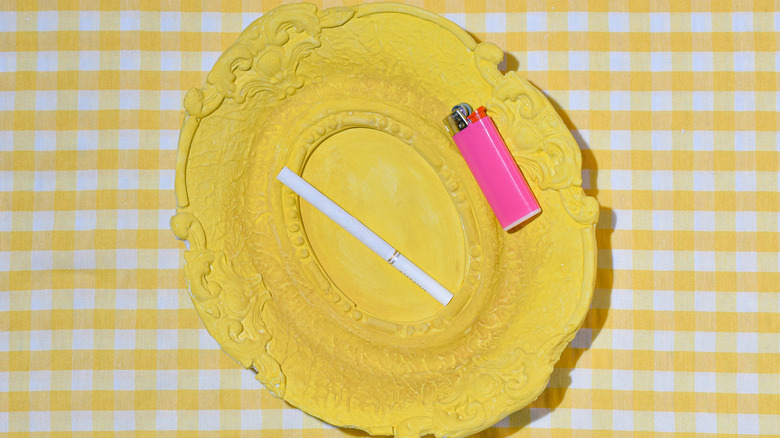
You probably didn't think you'd see a mention of smoking in a food article. However, if we're talking about dining out during the 1950s, cigarettes are going to be part of the conversation. Television was in its infancy, and the popular fad began advertising cigarette manufacturers as the sponsors of shows like "The Flintstones" and "I Love Lucy." Not to mention the fact that many returning soldiers were dedicated smokers, as well. With the country's prevalence for smoking, ashtrays would have been on every table and bar of the era.
Cigarettes were once individually hand-rolled luxury items. But mass manufacturing and the heavy use of them in films of the period made smoking glamorous and accessible for the first time. Just like eating out, cigarettes became a status symbol and an indicator of class. Today, very few eating establishments have smoking sections available, but a few decades ago, the restaurant experience came with plumes of smoke and lots of matchbooks.
Drive-ins developed in response to new roadways
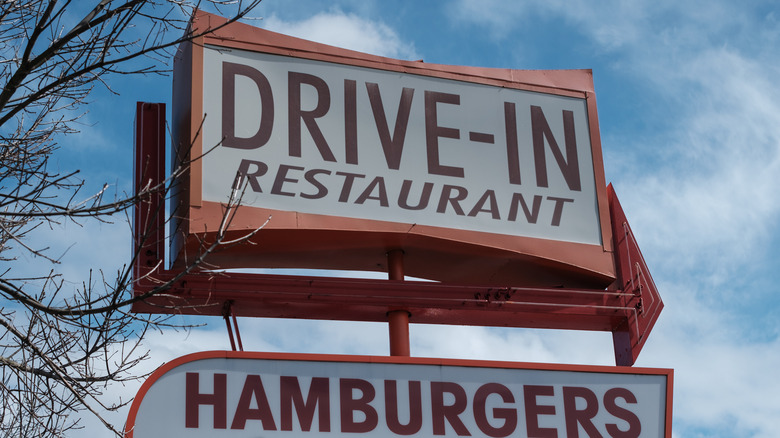
What began as a series of work programs in the 1930s became the nation's first series of interstates in the late 1940s and 1950s. These crisscrossing and interconnecting highways inspired such enduring classics as the song Route 66 and an era of drive-ins that Sonic has kept alive for decades. Fast food as we know it today came out of this era. In fact, McDonald's first location opened in San Bernardino, California, in 1948, on the edge of the famous Route 66. It's still there today in the form of the First McDonald's Museum, where you can see such memorabilia as original menus and an assortment of uniforms.
Drive-thrus were the heralds of a new era. As people became more mobile, they needed more options to eat on the road. Drive-thrus were the solution to this problem. People were able to sit in the privacy of their vehicles while ordering and eating, making them convenient options for hot meals without high prices. The restaurants weren't short on innovation, either. In-N-Out Burger gave customers paper placemats, called lap mats, to use while eating. For decades, other quick-service restaurants followed suit, with the placemats becoming a way to advertise, entertain children, and keep customers' laps clean while eating. When Jack-in-the-Box introduced the first intercom ordering system, signs had to be posted advising people that Jack would talk to them through the speakers.
Dressing up to eat out was common
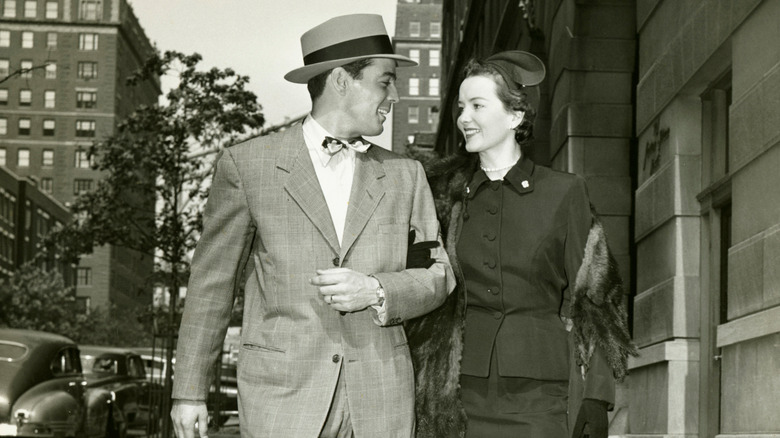
Eating out was quite the affair back in mid-century America. A booming post-war economy led to a surge in luxury restaurants where fine dining met lush interiors. White tablecloths were the standard. Men wouldn't have dreamt of going to an upscale place without a jacket any more than a woman would have gone without high-heeled shoes. Americans embraced this new style of dining as truly lavish restaurants had last been seen in the days before prohibition. After two decades of poverty and war, people were ready to step out in their Sunday best and experience the high life for an hour or two.
Table manners and proper etiquette were part of the social contract of dining out and were taken very seriously. If a man didn't pull out the chair for his partner, the waiter or host certainly would. Manners weren't just about politeness. They were tied to society's perception of wealth, class, and personal discipline. Traditions that many aren't aware of today, such as passing dishes to the right and scooping your soup away from you, weren't suggestions for dining; they were hard and fast rules.
International flavors began to flourish
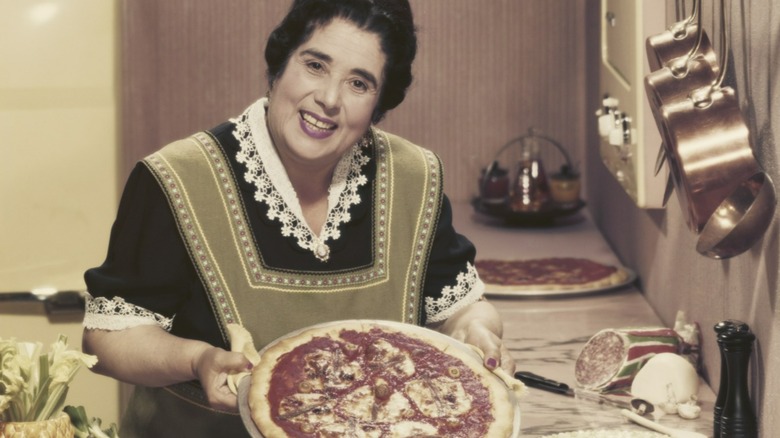
Believe it or not, spices and herbs like oregano weren't always found in kitchen pantries across America. Instead, ingredients like thyme were more commonly used in dishes. However, returning soldiers from WWII brought a taste for new foods back home with them. Recipes for lo mein, beef chow mein, and other Americanized forms of Chinese food began populating menus. In fact, rumaki, a Polynesian dish, became one of the first Tiki bar appetizers when the themed places were becoming popular. Italian food emerged from small neighborhoods and moved to a national stage when things like pizza and spaghetti took hold in the burgeoning suburbs.
Cinnamon, cloves, nutmeg, allspice, and ginger transitioned from spices rarely seen, smelled, or tasted to pre-packaged blends that the public couldn't resist. McCormick began selling its version of pumpkin spice in the 1950s, standardizing the ingredients and creating an iconic taste. The company was able to do this as global trade opened up after the war, making importing dried herbs and spices easier and more economical. And America's willingness to add new things to their pantries continued with the invention of Beau Monde seasoning, a mixture of celery seeds, salt, and onion powder. As simple as those combinations sound now, at the time, they were revolutionary and have contributed to present-day America's international and fusion culinary playground.
Post-war abundance met the rationale of rationing
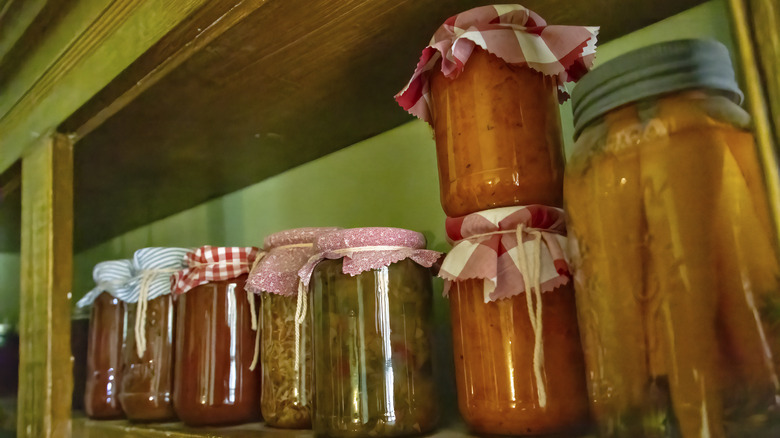
The practicality of canning and preserving food left over from prior decades of deprivation and the novelty of things like gelatin, people in the 1950s were happy to use new foodstuffs in combination with more familiar ingredients. If you've ever seen pieces of fruit cocktail suspended in a Jell-O mold, you'll understand exactly. Such daring new recipes were turning up on menus, and a night out might include beef consume alongside stuffed peppers before finishing with a fruit cobbler.
This was the era of casseroles, thanks to the abundance of canned goods, preserved foods, and new spices. But it was also the birth of frozen foods and T.V. dinners. Restaurant customers were becoming used to convenience, and eateries adapted by using freezers more often. The newly available appliances not only stored food, but they also made it possible to standardize many items, such as french fries and pizza dough. People eating at a McDonald's in California could look forward to the same familiar tastes at a McDonald's in Georgia, thanks to freezers holding bags of the product at every location.
Condiments made their way onto menus
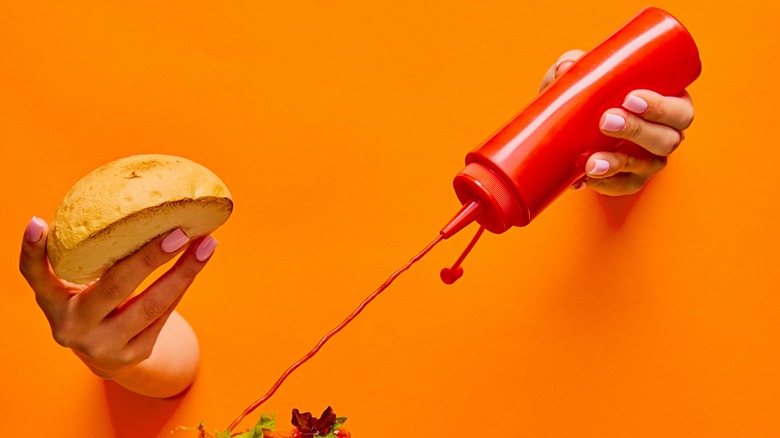
This one might sound strange, but dips and sauces we take for granted today weren't available in the 1950s. For instance, ranch wasn't invented until the early 1950s when a husband and wife team jarred the dry ingredients before mixing them with mayonnaise or buttermilk. Fry sauce, another American classic, was invented in Utah around the same time. The country seemed to be falling in love with creamy, savory dressings.
French dressing transformed from a simple vinaigrette to a recipe with three pages of variations in The Joy of Cooking's 1956 edition. The emulsion no longer contained four ingredients. Instead, the dressing was spruced up with chili sauce, paprika, tomato soup or ketchup, sugar, and citrus juices.
Ketchup itself became synonymous with fast food during this decade. Heinz ketchup was the nation's best seller in the 1950s and '60s, partly because it was considered an essential element to a burger and fries. Mustard, like French's, was also gaining ground, with television commercials calling it a "spicy national habit." Mayonnaise was repurposed from being strictly for sandwiches into savory salads and Jell-O molds. Condiments became a staple part of many Americans' daily meals, thanks to a desire for new flavors coupled with diner and drive-thru convenience foods along the highways.