

How Well Does The 10-Minute Rule For Cooking Fish Actually Work?
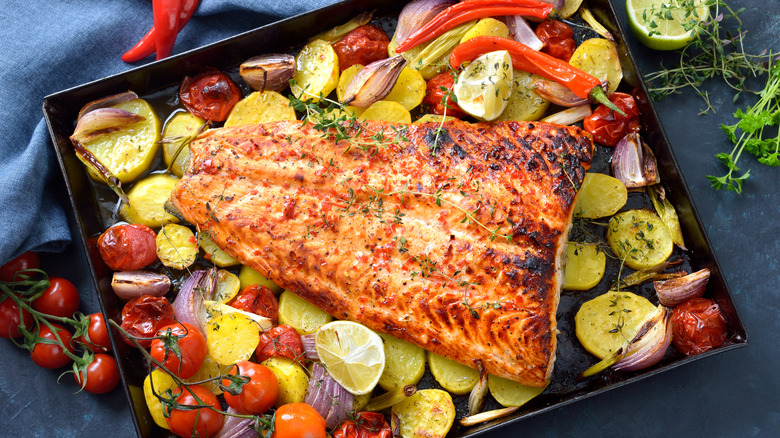
When it comes to making fish, there are plenty of tips and tricks for prepping it, like using a salt hack that makes it easier to remove the skin or simply patting it dry for the crispiest fry. However, there's been one broad piece of advice, known as the 10-minute rule, for how to actually cook it. Edmund 'Ed' McCormick, food science expert and ingredient specialist at Cape Crystal Brands, took the time to explain to Food Republic exactly what the rule is and if it works.
"The traditional wisdom that has been around for ages is to cook fish for 10 minutes for each inch of thickness on medium heat," McCormick said. "The reason behind this hack was that people did not have the luxury of thermometers[,] and fish [were] cut to uniform sizes. However, the problem today is that cooking fish just isn't as uniform."
McCormick pointed to the varying thickness, fat, and moisture content as the primary reason that the general rule may not be effective in achieving perfectly cooked fish. He also noted that methods of cooking outside of baking or grilling (such as air frying or using a sous vide technique) can render the rule ineffective. Instead, he suggested that using temperature is a more reliable indicator of doneness, stating that the majority of fish can be removed from the heat at 120 to 125 degrees Fahrenheit. Just leave a little time for the carryover heat to bring the fish up to the recommended final internal temp of 145 degrees Fahrenheit.
When (and when not) to use the 10-minute rule
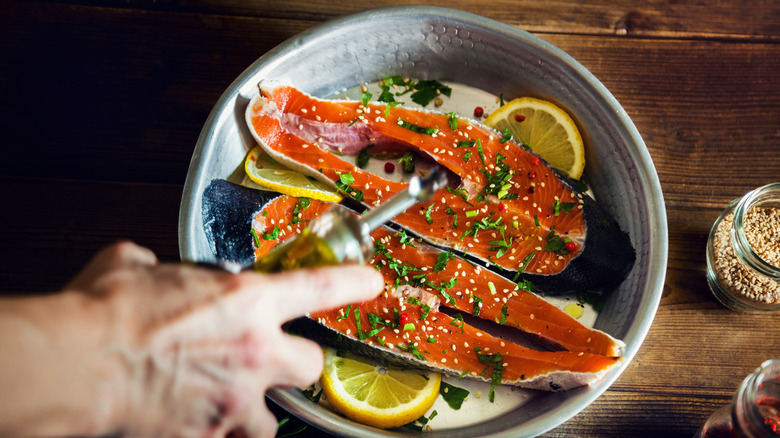
While Ed McCormick doesn't recommend using the 10-minute rule on its own for all fish, he said it can be used as a guide for some. "It is most useful for fish that is thick and forgiving when cooked with low and even heat," he said. "Examples would be fish such as salmon, Arctic char, halibut, and cod that can be cooked through baking, roasting, or grilling with indirect heat. Fish like these contain enough moisture or fat that they won't dry out immediately if cooked by time alone."
If you are making delicate and quick-cooking fish like sole or flounder without a thermometer, McCormick suggested using visual cues as an aid in ascertaining whether the fish is ready to be removed from its cooking source. "The appearance of opaque edges creeping inwards, flaking, or the development of translucency around the center is a much better way of determining whether the meat is cooked rather than relying on time." Additionally, he cautioned against using the 10-minute rule when using high-heat methods like grilling, which, over direct heat, cooks the fish far more quickly.
If preparing fish using the 10-minute rule is still part of your plan, it's important to note that some circumstances require a few minutes more. For fish that's wrapped in foil or being cooked in a sauce that complements it, up the total time by 5 minutes.