

Why Whataburger Is Seemingly Everywhere Now
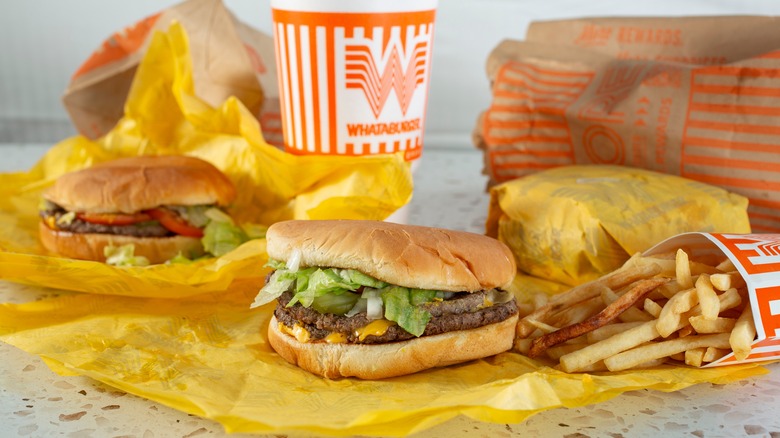
Texan residents will know: Whataburger occupies a cult-like status in the Lone Star State. Whether you're swinging by the chain during breakfast hours for a Honey Butter Chicken Biscuit or chowing down on Aarón Sánchez's favorite fast food burger in the evening (he likes the mustard-based dressing), the experience feels thoroughly Texan. Precisely because of such strong regional affiliation, the chain's ever-growing expansion has come as a surprise to fans.
First opened in 1950, Whataburger wasn't Texas-specific for long — a location opened in Florida in 1959. Yet for decades, the burger restaurant did remain regionally restricted, operating in just 10 states by the early 2020s, despite boasting well over 500 outlets.
With the onset of a new decade, the chain formally announced its proliferation plans in a 2020 press release. Indeed, Whataburger has lived true to those ambitions, growing to 1,100 locations in 17 states as of December 2025. The bulk of the openings have occurred in the Southeast, with inaugural Whataburgers in the Carolinas and Georgia, as well as in outlying states like Colorado. For some, this newfound availability is intriguing, while others cite a decline in quality, making the expansion a contentious topic.
Whataburger's expansion has led to mixed reactions from fans
Stirrings of controversy first rumbled in 2019, when the majority stake of the historically Texas-owned Whataburger was sold to Chicago's BDT Capital Partners. At the time, some projected an upcoming chain expansion, while others remained hopeful that Whataburger would retain the same operations. It took just over a year for the announcement of a regional push to occur, and the momentum has largely continued since.
Yet the ensuing negativity is directed less at the chain's ubiquity and more at a suspected decline in quality. Customers report incorrect orders, poorly assembled dishes, and, especially frustratingly, long lines — although Whataburger management denies any issues. Some claim such experiences are cherry-picked negative stories, likely biased by the Chicago buyout. Nevertheless, Whataburger's economics continue to prosper, with 9.4% sales growth in 2024 (per Franchise Times). With storied Whataburger West Coast rival In-N-Out also expanding nationwide, the question of regional fast food favoritism versus consistency continues. You'll just need to swing by Whataburger's recognizable, and now more easily found, A-frame buildings to find out.