

Why Rick Steves Says You Shouldn't Skip Happy Hour When Traveling In Europe

Many tourists rely on information and advice from travel guru Rick Steves when they're vacationing in Europe. So they listen when the guidebook author and TV show host says ordering the "tourist menu" is an affordable way to dine there, or that having the hotel breakfast is the worst meal mistake to make. Among his many other dining suggestions for travelers in Europe is a clever tip for Italy, where the happy-hour-like aperitivo can be an affordable stand-in for dinner (per Rick Steves).
An aperitivo is a drink with light snacks that Italians have at a bar (what they call a café) before dinner, and is part of the café culture in all parts of the country. The name comes from the Latin "aperire," meaning "to open," and the after-work ritual is considered a way to "open" the stomach for dinner. Because Italians eat dinner late, people usually have their aperitivo during the hours between 6 p.m. and 9 p.m. – and yes, dinner comes after (usually around 9 p.m.).
When you order your drink, there isn't a discount like an American-style happy hour, but the finger food nibbles provided by the bar are included in the price. Steves says that because you can eat as much as you like from the often buffet-style spread, you could "discreetly" make the food on offer into an inexpensive light dinner. However, depending on the bar, you may have to get another drink before going back for more to eat.
What do Italians drink and eat for aperitivo?
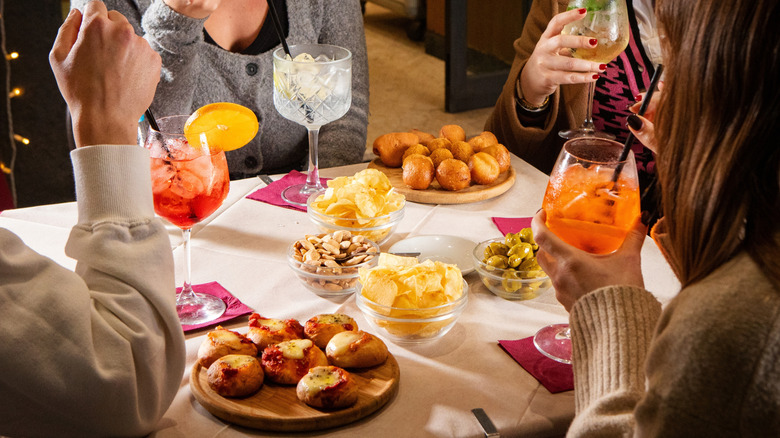
Italians commonly drink bitter, low-alcohol cocktails for aperitivo. Traditional ones include: Aperol spritz, which has Aperol, prosecco, and soda; Negroni, the cocktail that was Anthony Bourdain's favorite, made with Campari, sweet vermouth, and gin; and the Americano, which contains Campari, vermouth, and soda. Red, white, and sparkling wine like prosecco, and beer are also typical choices. While bars serve coffee in the morning and throughout the day, coffee isn't an aperitivo drink.
There are different kinds of antipasti-style food laid out by the bars, such as salumi, olives, crackers, cheeses, grilled vegetables, mini pizzas, finger sandwiches, and arancini (rice balls). The amount and type vary, with some offering more than others — and you may find that the bar you're in only does table service. If so, you can also ask for a drink alone, which is a little cheaper and comes with something simple like potato chips or nuts. Otherwise, simply order the aperitivo, and you'll get a more substantial set of nibbles.
In more recent years, something called "apericena" has become popular in Italy, particularly among students and other young people. The name combines "aperitivo" and "cena," the Italian word for "dinner," and it's seen as a more affordable and casual alternative to a traditional dinner. It essentially is what Steves suggests, having aperitivo for your evening meal, but because it's explicitly meant to replace dinner, apericena food is less snack-like. Although what's available can overlap with aperitivo offerings, there are also more substantial dishes like pasta, regional specialties, and even dessert. It also usually costs a little more, but it is still a low-cost meal.