

What Is South Carolina Slaw?
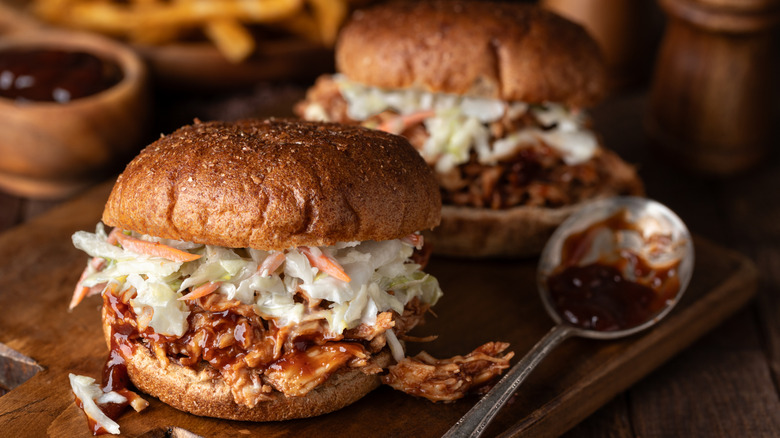
American barbecue is served with proud territorial ties. Not only the styles of meat, but also the accompanying sides and even barbecue sauces are regional. So even when you examine a vegetable dish like South Carolina slaw, local culinary influences come through. To help explain what makes this regional crispy cabbage dish stand out, Food Republic is fortunate for the guidance of Charlie McKenna. As the Chef and Founder of Lillie's Q — a purveyor of sauces, rubs, and spices — he's certainly well-versed in the nuance of South Carolina's flavors.
According to him, the central distinguishing factor comes down to "the use [of] mustard instead of [mayo] as the main component in the coleslaw dressing." He added that vinegar also often appears in the mix — a second condiment that's commonly found in a South Carolina barbecue sauce. The mustard and vinegar present in South Carolina slaw form a familiar part of the state's palate. South Carolina's midland region is referred to as the "mustard belt," while the Northeastern corner is known for serving barbecue alongside hot sauce and vinegar.
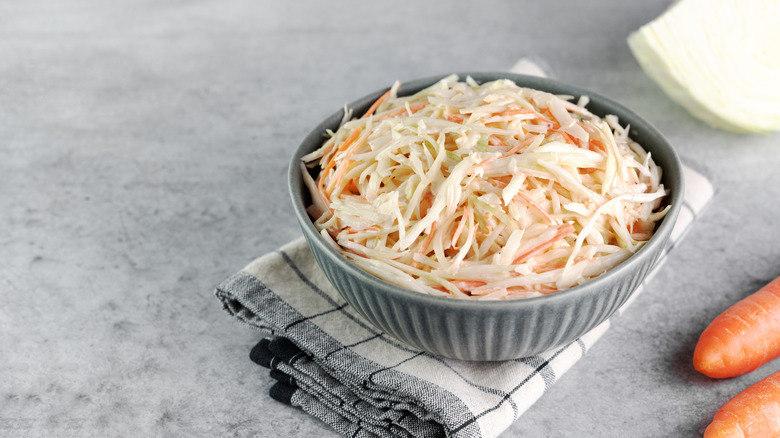
McKenna noted that the use of such sauces emerged "from the [abundance] of German settlers," who migrated to the state's central region. There, the practice of contrasting meats with sharply-flavored components took hold. Thus emerged the South Carolina slaw, which mixes in thinly sliced cabbage and carrots alongside optional bell peppers and onion, all covered with the state's signature-flavored dressing.
why mustard is a natural pair for South Carolina barbecue and how it's incorporated
Pork constitutes South Carolina's go-to barbecue protein, with cuts like perfectly tender pulled shoulder, butt, or even the entire animal all popular. The meat is often enjoyed in sandwich form, with the slaw topping piled right atop. Oftentimes, the vegetables in slaw are cut thinly, thereby performing a role closer to condiment than a salad. As a result, the dish's flavor palate purposefully contrasts pork's decadent composition — "the acid cuts the [fat] and rounds out the flavor profile," said Charlie McKenna.
In fact, vinegar and mustard are incorporated into South Carolina-style barbecued pork during preparation, too. Apple cider vinegar serves as an effective marinade, while dry mustard coats the meat as a flavorful rub. Oftentimes, a paste-like mustard, such as Dijon, is mixed with even more vinegar to make a mop sauce, which bastes pork as it's slow-cooking. The prepared meat is then frequently served alongside a mustard and vinegar-based barbecue sauce, meaning the two ingredients truly permeate the style. The slaw's sharp vinaigrette functions as a final biting garnish, rather than a central vessel for vinegar-mustard flavors.
Still, it's essential to consider what ingredients comprise the slaw. McKenna said, "All types of mustard and vinegar [are] used," with combinations "played with to attain a similar profile." He cited yellow mustard and white vinegar as a simple foundational duo — although apple cider vinegar and dijon mustard are a common pairing, too. So bite into barbecue in the Palmetto State, and know your slaw will come with a kick.