

Giada De Laurentiis Has 3 Tips For Buying The Highest Quality Pasta At The Grocery Store

Every good pasta dish needs to be accompanied by a beautifully made sauce, but before the sauce, the cheese, and the garnish, there's the dried pasta itself. Of course, choosing the right shape counts, but that's only half the story. See, not all pasta brands are created equal. The next time you're walking down the pasta aisle, don't just pick one at random and hope for the best. Instead, borrow these three tips from Food Network legend Giada De Laurentiis to guarantee only the highest quality pasta ends up in your grocery cart. According to De Laurentiis, the pasta only needs water and durum wheat semolina, and it should be bronze-cut or slow-dried and have a rough texture.
De Laurentiis' tips are simple, as they are effective. When putting them all next to each other, the ingredients tip is arguably the most important by a significant margin. Semolina is a coarse, hard wheat flour with high protein and gluten levels, helping the pasta hold its shape and maintain its al dente bite. It should go without saying that dried pasta only needs water and durum wheat. No more, no less. In fact, for Italians, this doesn't represent high quality, but rather the baseline. Over there, the law mandates that any commercially sold "dried pasta" must be made strictly from 100% durum wheat semolina and water.
Unfortunately, the same rule doesn't apply here in the U.S., so some dried pastas are, for lack of better words, "enriched" with additives, preservatives, and certain brands, to the horror of Italians everywhere, even drop the semolina (which just refers to the coarse grind) in favor of finer-ground durum wheat flour, which just can't match the texture of semolina. If you spot any extra add-ins or swaps on the ingredient list, it's a telling sign that brand belongs nowhere near your plate.
You can gauge the quality of pasta just looking at the label
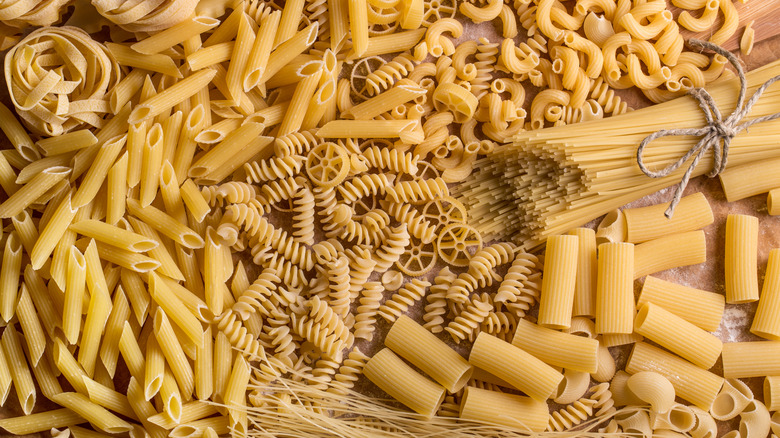
We're putting Giada de Laurentiis' first tip ahead of the other two for a reason. If a box doesn't list just semolina durum wheat and water, chances are it won't pass these other checks either. Her second and third tips involve looking at the packaging. For high-quality pasta that goes above and beyond, look for "bronze cut" and "slow dried" on the box or bag.
Traditional artisan makers dry pasta slowly at low temperatures, and the most patient can take as long as six days. Mass-market brands don't have time to be sitting around, and so they blast the pasta with high heat and have it dry in a matter of hours — you can tell this was the case when the pasta is bright yellow rather than a pale, ivory white. This is about more than just cutting corners. Makers argue that low temperatures preserve the wheat's natural flavor and protect the gluten structure, which helps the pasta cook evenly and keep its bite.
Bronze cut refers to how the pasta is extruded (pushed through a die to be shaped), and it leads right into De Laurentiis' third tip. Traditional makers use dies made of bronze, which leave the pasta's surface rough, matte, and slightly powdery. Most mass-produced pasta is pushed through smooth, Teflon-coated dies instead, which leave it smooth and shiny. To some, this might be more aesthetically pleasing, but that stops mattering once the sauce enters the picture. Pasta's job is to carry the sauce, and the coarse surface of bronze-cut gives it more to cling to, while smooth pasta doesn't have a textured surface for the sauce to grip. Even if the label doesn't say bronze-cut, you can usually tell just by looking whether it has texture or not.