

Johnnie Walker Red Vs Black Label: How The Scotch Whiskies Differ
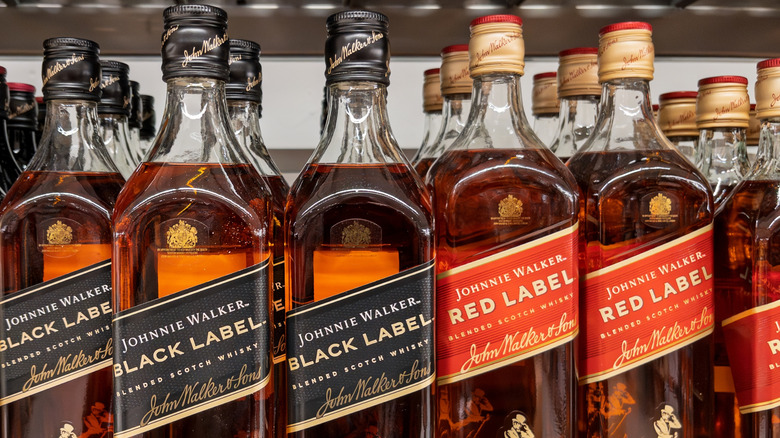
There are plenty of iconic, world-renowned whisky houses, but few can match the prestige and heritage of Johnnie Walker. Starting in a small grocery shop in Kilmarnock, Scotland, in 1820, it has since grown into the world's best-selling brand of Scotch whisky. Instantly recognizable thanks to its signature square bottles and Striding Man logo, Johnnie Walker also sets itself apart through its range of labels. Among its most famous are Red and Black, but aside from the color on the bottle, what exactly sets these two whiskies apart?
Both fall under the same legal umbrella. As Scotch whiskies, they must be made in Scotland from water, yeast, and cereals, then matured in oak casks for at least three years. That shared foundation, however, is where the similarities end. Beyond that baseline, Scotch is divided into different styles, and it's here that Red and Black begin to diverge, most notably in how long each spends maturing before it ever reaches a bottle.
When comparing these two whiskies — or any, for that matter — one of the most telling indicators of their differences is the age statement. Simply put, this tells you the exact number of years the youngest whisky in the bottle has spent maturing in an oak cask. Johnnie Walker Red Label carries no age statement at all, while Black Label carries an impressive 12-year age statement, meaning that every single drop inside has matured in wood for at least 12 years. That extra time in the cask dramatically shapes the spirit's final taste and mouthfeel.
Black Label spends more time aging in oak barrels
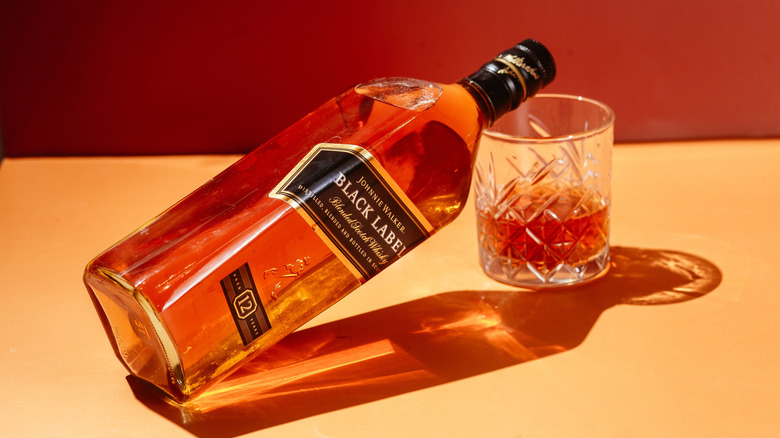
Although neither Black nor Red Label is Johnnie Walker's most luxurious whisky — that distinction arguably goes to its expensive Blue Label bottles — Black Label has roots that stretch back decades further than Red Label's, albeit under a different name. Its precursor, originally called "Walker's Old Highland Whisky," was registered in 1867. In 1906, it was renamed "Extra Special Old Highland Whisky" before officially becoming Johnnie Walker Black Label in 1909. Red Label's precursor, by contrast, was introduced in 1906 as "Special Old Highland Whisky" and underwent a similar rebranding in 1909.
Every one of Johnnie Walker's whiskies is blended. Most expressions, including Red and Black labels, combine single malt and single grain whiskies sourced from various distilleries across Scotland. Master blenders mix these distinct spirits to create a reliable and consistent taste for every label. Black Label is often described as drawing from roughly 40 different whiskies, while Red Label combines up to 35. That alone gives them distinct flavor profiles, but aging does much of the heavy lifting here.
During 12 years in oak casks, the wood and spirit interact to develop specific qualities. Temperature changes cause the oak and liquid to expand and contract, pulling the spirit in and out of the wood. Scotland's generally cool, damp climate slows this breathing effect, meaning Scotch can spend decades aging without becoming overly woody. As Black Label breathes through the porous wood during maturation, gradual oxidation softens the harsher alcohol notes along the way, giving it a smoother mouthfeel than livelier, younger whiskies like Red Label.
Red Label is Johnnie Walker's best-selling Scotch
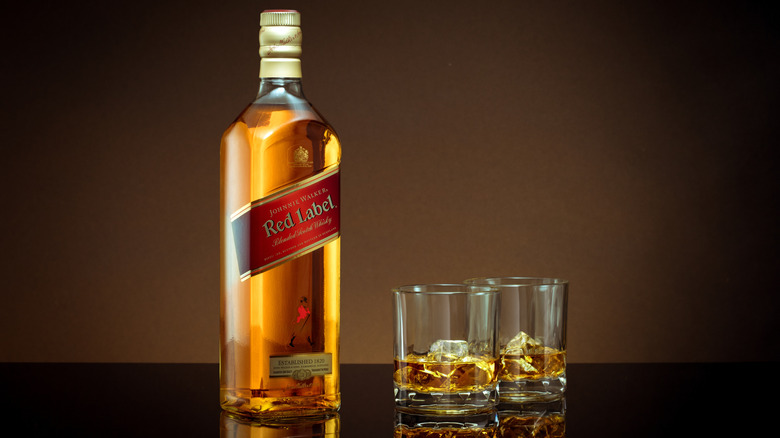
Red Label has an edge as not only the brand's best-selling expression, but also the world's best-selling blended Scotch whisky, a title it reportedly has held since 1945. Part of its mass-market appeal comes down to its approachable price point. It's typically the least expensive expression in Johnnie Walker's core portfolio, and buyers can expect to spend around $26 to $33 per 750-milliliter bottle (though prices may vary). Black Label sits at a somewhat higher price point, retailing for around $30 to $40 a bottle. That price difference largely comes down to its longer maturation, which ties up warehouse space for years and results in a greater loss of liquid to evaporation, known as the "angel's share," as time passes.
Another major difference is how whisky experts often recommend approaching each label. Thanks to its lower price point and bold, straightforward profile, Red Label is well suited to mixing with soft drinks or using in cocktails such as whisky sours or highballs. In contrast, Black Label has spent years developing character in oak casks, making it well suited to sipping neat, with water, or over ice (although it can also hold its own in cocktails). In fact, it's considered an excellent starting point for those looking to dip their toes into the world of Scotch. To appreciate it fully, pour it into a Glencairn glass, although a heavy-bottomed tumbler also works. Before drinking, take a moment to appreciate its aroma, then take small, considered sips. One common trick is to add a few drops of water to the dram, which can help reveal hidden flavors while mellowing the alcohol's burn.