

12 Biggest Mistakes You Might Be Making With Kitchen Knives
Knives are, arguably, the most important tools in any kitchen. They're also among the oldest, serving Stone Age hunter-gatherers more than 2 million years ago and evolving from human-made, sharpened stones into the finely honed stainless-steel blades we use today. They are as essential to preparing our food as refrigeration and indoor plumbing. Yet, despite using them almost daily, most people frequently make mistakes in using and caring for their kitchen knives.
Chief among these mistakes, of course, is cutting ourselves. Between 2015 and 2019 alone, hand and finger lacerations at U.S. emergency rooms accounted for 243,844 and 587,451 visits, respectively. Most of these injuries were caused by knives. From how you hold and cut items with your knives to common mistakes with washing, maintaining, and storing them, a myriad of missteps cannot only cause unnecessary injuries but also damage your knives, shorten their lifespans, and make your job harder. Knives are an important investment, the workhorses of your kitchen, but only if you use them correctly. Here are the biggest mistakes kitchen pros say you may be making with your kitchen knives.
Not investing in the right chef's knife
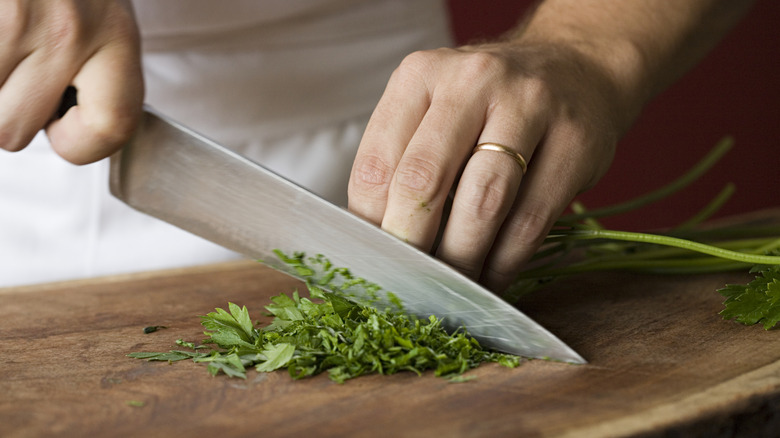
The chef's knife is the king of the kitchen, the most important knife in the block. This 8-inch (or occasionally 10-inch) wonder can handle about 95% of your cutting tasks in the kitchen if it's made well and used properly. The right materials, shape, and design matter. First, consider the three main components that make up a chef's knife: the blade (the part of the knife that cuts the food), the handle (the part you hold with your hand), and the tang (the back part of the blade that extends into, and sometimes through, the handle). Your selection of blade, handle, and tang is critical to ensuring you have a quality chef's knife.
Blade options differ, but you'll generally be looking at either stainless steel, which is durable and corrosion-resistant; high-carbon steel, which is harder than stainless steel but more maintenance-intensive; and the highly sought-after Damascus steel, a layered steel with exceptional sharpness and durability. All blade types have their place, but what makes a good knife is the one that's best for you—with a weight that feels balanced in your hand, a metal that suits your lifestyle, and a blade that makes cutting easy. Look for a handle with a secure, comfortable grip that won't slip out of your hand, and select a full-tang chef's knife with a tang that visibly goes all the way through to the end of the handle for greater control and a longer life.
Not keeping them sharp enough
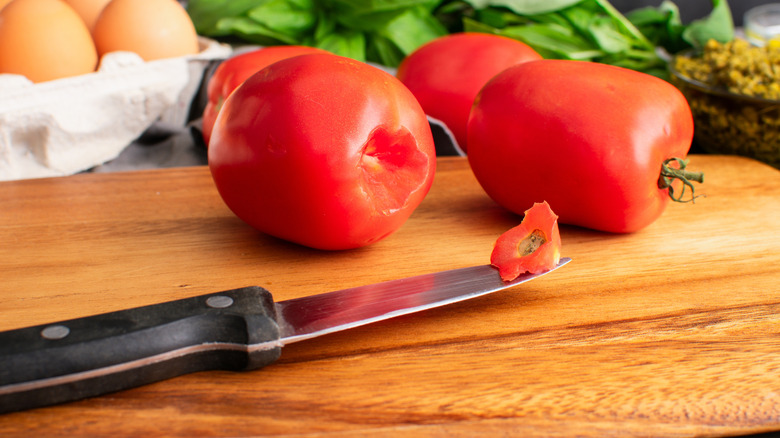
Anyone who's ever shaved with a dull razor and wound up covering the bloody nicks with pieces of toilet paper can probably see why a dull knife is less safe than a sharp one, as contrary as that may sound. Here's why: A good knife is designed to do the work for you, cutting through foods with almost no effort on your part. If you have to apply excessive pressure or repeatedly cut to complete a task, you increase your risk of cutting yourself. Any time you have to push down hard on a blunt knife, you're risking the chance that it wobbles and slides, potentially causing serious injury. Experts say that if you can't easily cut a tomato with your knife, it's not sharp enough.
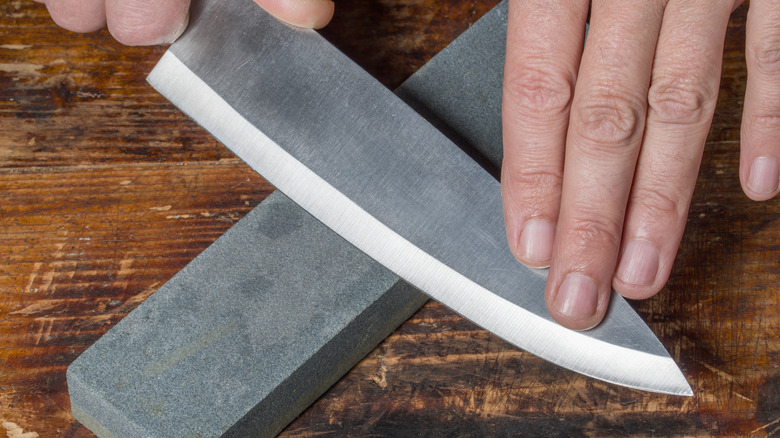
As if safety weren't enough of a reason to keep your knives sharp, here's another: You'll cry less when you chop with a sharp knife. That's because the enzyme in onions that causes tears — Lachrymatory-factor synthase — lives in the cell walls of an onion. Blunt knives make messy cuts on onions, creating more damage and releasing more of that enzyme. But a sharp knife makes for precise, minimal damage, which leads to fewer onion-induced tears. So sharpen up by investing in a home knife sharpener or whetstone (the method many professionals prefer), or have them professionally sharpened at a grocery store or other business.
Choosing the wrong knife for the job
Just as every cook in a professional kitchen has a specific job, so too does every knife in your home kitchen. However, one of the biggest mistakes home cooks make is choosing the wrong knife for the task at hand. Cutting cheese with a butter knife, chopping vegetables with a grapefruit knife, or using a cleaver to cut a loaf of bread all sound like obvious errors, but they're not that far off from the everyday mistakes many of us make in our kitchens. Why does it matter? Because using the right knife saves you time, prevents injuries, gives you greater control and precision, and protects the life of your knives.
Every knife and blade has a job and is designed for a specific purpose. While kitchen professionals differ over the number of essential knives every kitchen needs, you'll find the three knives most needed in your kitchen are the chef's knife, a good serrated bread or slicing knife, and a paring knife. The serrated knife's teeth enable it to easily cut through foods with tough exteriors and soft interiors, such as bread or tomatoes, without squishing what's inside. Meanwhile, a paring knife is meant to act as an extension of your hand, helping you to peel or core small items. Familiarize yourself with the knives in your kitchen and be sure to use them as intended.
Storing knives improperly
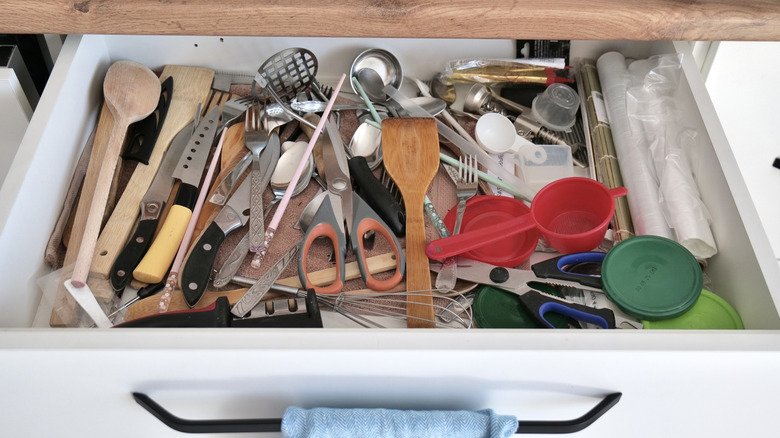
Where you put your knives when you're not using them is as important as where you put them when you are. It matters because every time the sharp blades of your knives bang up against other hard, sharp objects, a little bit of damage occurs to degrade the blade. You could dent it, scratch it, or even chip it, causing permanent damage. Plus, you take a risk that someone in your household will slice off a finger while rooting around in that crowded utensil drawer.
There are easy, affordable ways to store your kitchen knives. First, there's a knife sheath, which is the cheapest and easiest method. This plastic blade guard slides right over the blade of a knife, maintaining the blade's integrity and protecting fingers while allowing you to continue storing the knife in a drawer.
You can also use a knife block, which can be found in many grocery stores or kitchen stores, and they even come with most knife sets. These blocks are designed to sit on your kitchen counter; they feature slots into which you can slide the right-sized individual knives for storage. The slots run either horizontally or vertically; look for horizontal slots, or turn the blades upward in vertical slots so you don't drag the blades repeatedly against the block's wood when removing or replacing them. You can also hang knives from a magnetic block or strip, the way Julia Child used to do.
Washing knives incorrectly
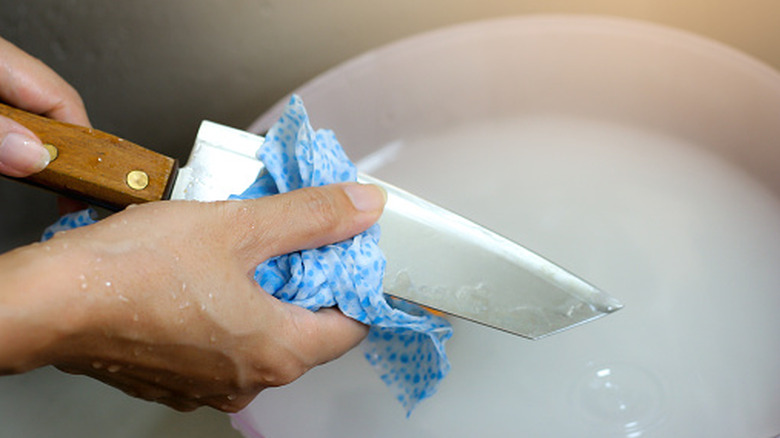
Just as you shouldn't store your kitchen knives loose in a drawer, you also shouldn't leave them lying in your sink with the rest of your dishes when you're done with them. It's not only a risk to the person who reaches in to wash those dishes, but you risk damaging the blade by denting, scratching, or chipping it. Plus, a wet environment is the last place you want to keep a good knife. Water promotes rust and bacterial growth — if left to sit in water, bacteria can build up inside wood or composite handles. Meanwhile, the water can also cause a wooden handle to swell and become warped.
For the same reasons and others, you should never wash a good knife in the dishwasher. First, the person who reaches in to empty the dishwasher can seriously hurt themselves. The knife can nick the dishwasher's plastic lining or damage the trays. Plus, the hot, rushing water and harsh chemicals swirling around the knife can dull, bend, pit, or otherwise warp the blade or even break off the tip. The best way to wash your kitchen knives (except for the butter knives that come with your daily silverware) is the old-fashioned way — by hand, in hot water with gentle soap, right after you use them. And be sure not to let them air-dry; dry them by hand right away after washing them.
Ignoring proper knife maintenance
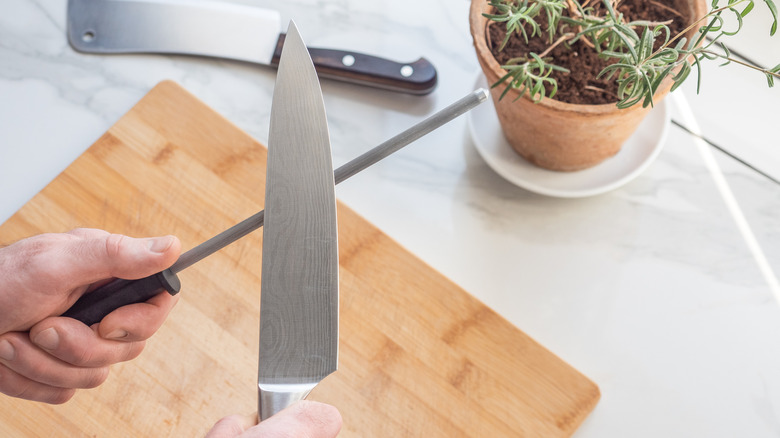
Good knives are an investment, and with proper maintenance, your investment should last a long time. But many people unknowingly fail to care for their knives properly, shortening their lifespans and leaving the impression that the knives themselves are the problem. Good maintenance includes proper cleaning protocols, as described above, but it also includes using the honing steel that came with your knife set.
The long, rough-textured metal rod with a handle is meant for straightening your blade. Though honing is not the same thing as sharpening — both techniques should be performed regularly — it does align all the microscopic serrations on the knife blade that help it to perform its cutting duties. Those tiny serrations get bent and twisted with regular use, and the honing steel puts them back in line. Now and then, run your knife edge firmly along the honing steel, at about a 20-degree angle, on each side several times to help keep your knives sharper longer. Regular honing helps your knives cut more easily and with less force, which helps prevent injuries.
However, once those serrations have all become folded, no amount of honing will address it; that's when you must get a knife sharpened. Even occasional cooks should plan to have their knives sharpened two to four times a year by a professional. It's also a good idea to protect wooden knife handles against cracking and splintering by lightly coating them with mineral oil now and then.
Holding them wrong
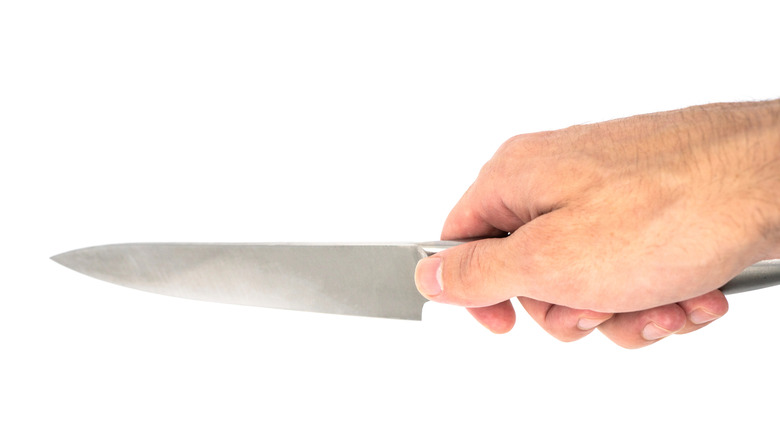
We hate to break it to you, but you're probably holding your knives wrong. Most people tend to wrap their thumb and last three fingers around the knife handle, then extend their pointer finger forward along the back of the blade. It may feel more natural to do this, but this grip is actually pretty dangerous. Extending your forefinger can cause instability as you move the knife up and down; your hand can wobble, increasing the risk of the knife sliding and cutting you. It also increases the tension on the tendons in your hand and wrist.
Instead, practice using the pinch grip with your chopping knives. Grip the knife handle so that your thumb and forefinger pinch the base of the blade's back, giving you maximum control. The rest of the fingers should wrap around the handle. You'll find that this grip makes cutting tasks easier and your cuts straighter. As for the other hand—which guides the food you're cutting—use the claw grip, with the fingers pointed down and very slightly curled under, like an animal's claw.
This maneuver holds the food securely but prevents the knife's blade from touching the tips of your fingers. As you cut, continue pushing the food forward under the blade, always keeping your fingertips curled under. It may take a bit of practice to master it, so go slowly; you'll eventually find that cutting is easier and far less dangerous.
Cutting incorrectly
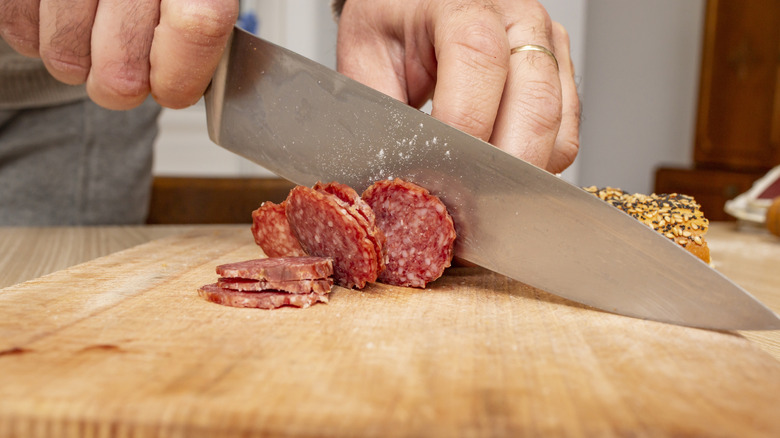
Once you have a proper grip on your knife and the food you're cutting, make sure you're actually cutting it correctly. Many people chop too quickly, or they repeatedly lift the knife off the cutting surface and hammer the blade down hard, which is extremely damaging to the blade. The shape of a knife's blade is intentional and created specifically for each knife's purpose. A bread knife, for example, is serrated, long, and straight, not curved. This is because you don't rock a bread knife back and forth to cut; instead, you use the teeth like a saw, dragging it smoothly back and forth across the bread's crust.
Meanwhile, a chef's knife has a slight curve along the blade that enables a rocking motion, forward and back, to chop produce without ever needing to fully lift the knife off the surface. Grab the knife with your pinch grip, then move your wrist in a circular motion, down, forward, up, and back. Push the belly, or middle, of the blade down to chop, then bring your hand down and slide the knife forward to the tip all in one smooth, subtle motion. Then slide it up and back, repeating the circular motion. The knife never leaves the board, and the belly of the blade does the heavy chopping. And one final word: Don't ever use kitchen knives to cut anything besides food. For that Amazon package, grab your scissors.
Scraping up food from the cutting board
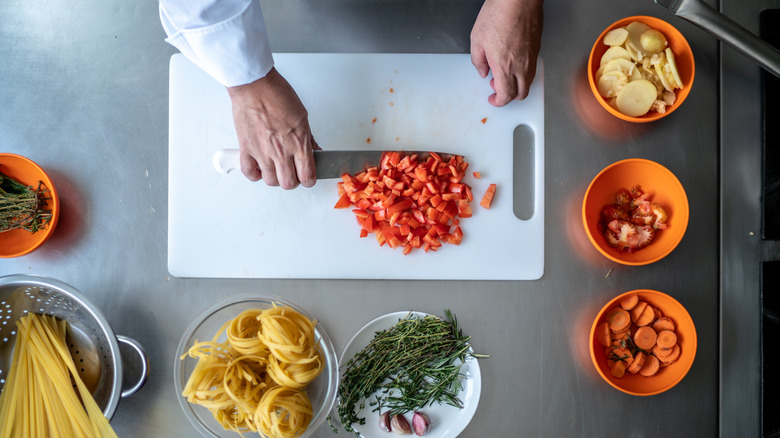
You've just achieved a beautiful dice on those carrots, and you're ready to move them to your Dutch oven. So you make one of the worst mistakes you can make with a great kitchen knife: You drag all those diced carrots across the cutting board with the blade until they drop into your palm. You've just achieved the kitchen equivalent of scraping your nails on a chalkboard. Never, ever drag the blade of your knife, any knife, against the cutting surface.
Knife blades are meant to move in only two directions: up and down. It feels instinctive to quickly use the knife to corral your chopped food this way, but scraping a knife sideways along a cutting board is one of the best ways to quickly dull the blade by curling the micro-serrations along its edge. It can even permanently damage the blade, causing cracks or chipping. So how do you get all those minced garlic pieces or julienned basil off the cutting board? Instead of scraping the board with the edge of your knife, flip the knife over onto its back and use the spine edge to scrape it up. Better yet, use a spatula or dough/bench knife to do this.
Using knives on the wrong cutting surfaces
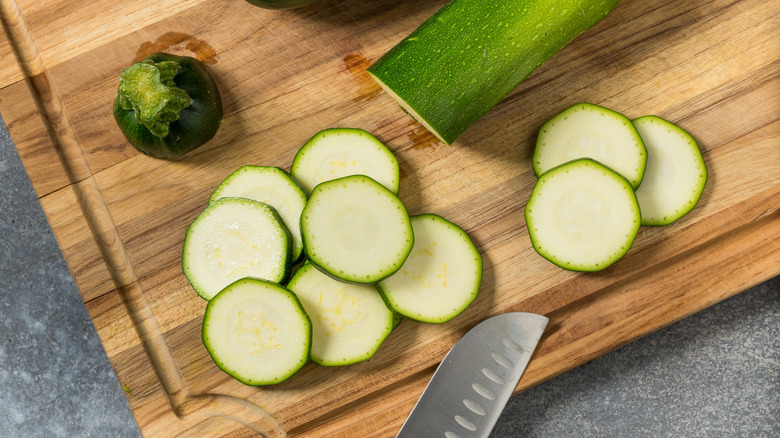
Not every surface is appropriate for chopping food. Even the best, sharpest knife can be damaged by the wrong cutting surface. Glass, bamboo, stone, ceramic, and marble surfaces may look pretty, but using any of these is a major mistake: They're too hard on your knives. Professional chef Chris Piro says, "Nothing wears down a knife faster than a surface that fights back." In fact, the cutting surface should have a little give. Aim for wood, plastic, or even rubber.
Aside from the material the cutting board is made with, consider its proportions and stability, too. Using a great chef's knife on a flimsy little plastic board not only increases the chance of hurting yourself, but it makes a mess and makes your task harder than it should be. Invest in a big wooden cutting board, and you'll immediately feel the difference. Cutting will feel smooth and sturdy. Plus, its weight will keep it from sliding around—another dangerous feature of small, lightweight boards. If all you have is a small board, try laying a damp paper towel or tea towel under the board to add friction, which keeps it from wiggling.
Cutting with the wrong part of the blade
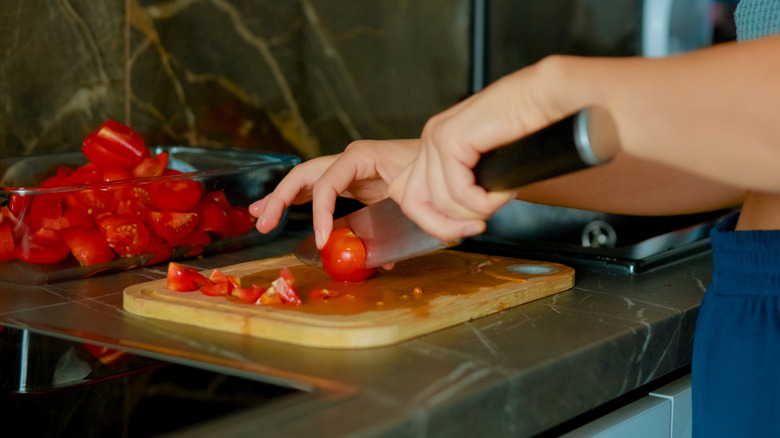
The design of your knife isn't coincidental. Every part of your knife blade is intended for a specific use, but many people simply attack a chopping task without regard for the best, most effective way to use a blade. You've already learned about the belly of the blade, which is the curved portion that enables you to rock it back and forth. But other parts of the blade have jobs, too.
The tip, or pointed end, helps you make precise cuts. You should use the knife tip for scoring meat, performing detailed cuts on small foods (such as a garlic clove), and piercing tough exteriors without squashing what's inside, such as tomato skins. Whether you're using a chef's knife, a paring knife, or a Santoku knife (with a blade that's shorter and wider than a chef's knife), each knife's tip is designed to accomplish a specific task.
Moving downward from the belly of the knife is the heel, the thicker, heavier part of the blade close to the handle. Use this part of the knife to cut through tougher objects, such as carrots, which need a little extra force. The spine, which is the top edge of the blade, is much thicker and duller than the edge. Use the spine to crush garlic cloves or even crack nuts. And as we mentioned above, it can also be used to slide chopped foods off a cutting board in a pinch.
Buying a fancy knife set
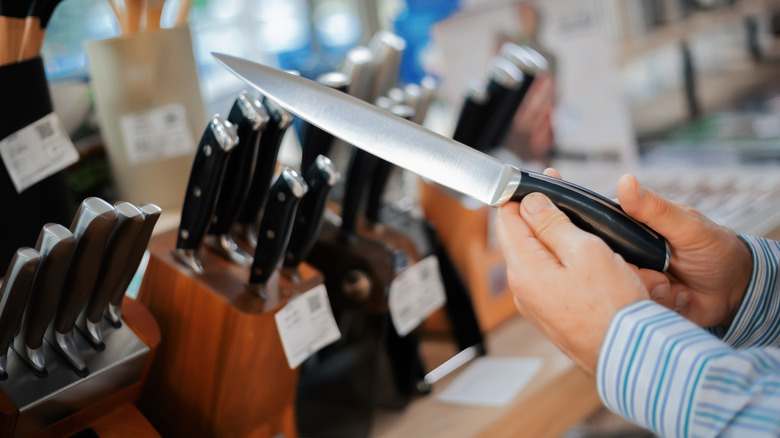
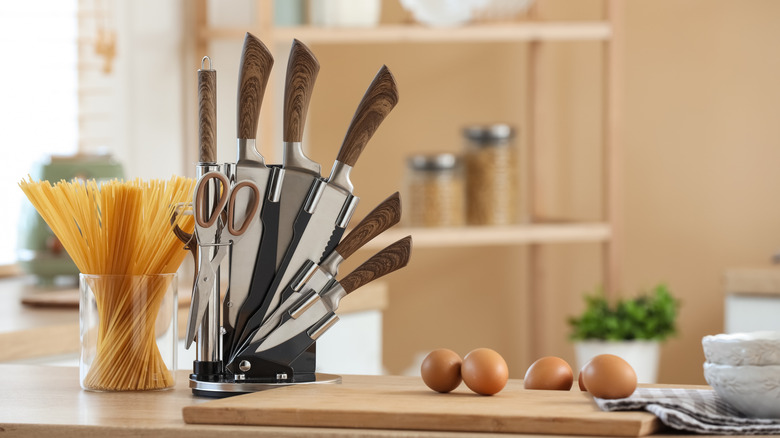
That knife block full of knives sitting on your counter probably contains a bunch of knives you've either never used or used incorrectly. You can probably get away with only three to five great knives: a chef's knife, a paring knife, a bread knife, and maybe a carving knife, a Santoku, or a boning knife. The rest? Probably unnecessary. Experts say many home cooks think the more expensive the knives, the better their quality, or they assume it's just better to have as many knives as possible. Both assumptions are incorrect. In fact, there are many good-quality, affordable knife sets available.
If you're going to invest good money in knives, spend it only on the ones that bring value every time and are useful for the kind of cooking you do regularly. Look for quality construction — a full tang, a comfortable handle, and a blade made of good stainless steel or high-carbon steel forged from a single piece rather than stamped from a sheet. In the end, aim for quality over quantity.