

What Does Halal Food Mean?
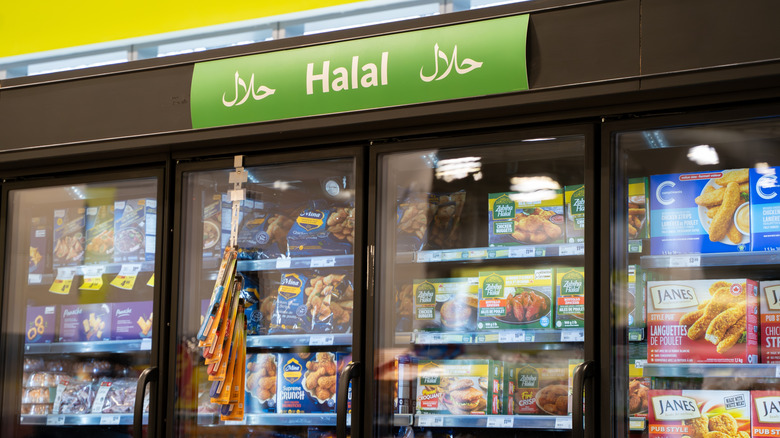
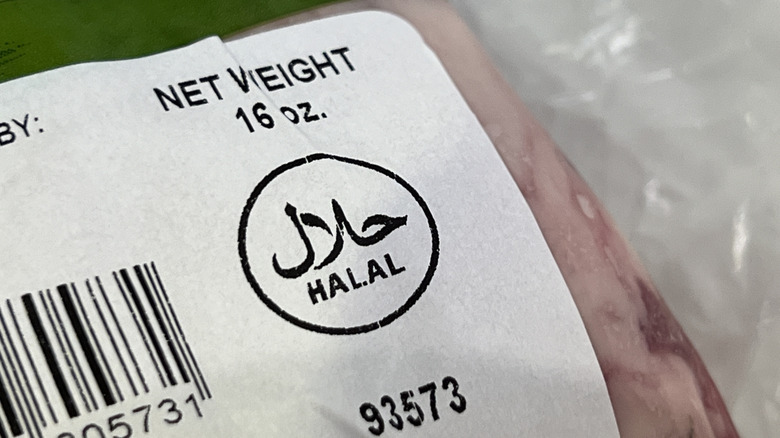
There are plenty of ways stores and restaurants categorize their products, like when beef is labeled as USDA prime or Choice, or perhaps when an Asian restaurant feels like it has to advertise its entire menu as MSG-free – that MSG myth is absolutely rooted in racism. One label you're likely to encounter wherever you find food is halal. But what exactly does this classification mean? Well, it's not exactly a single thing. Halal is an Arabic word meaning "lawful," and it stands as one of the most important tenets of Islamic law. In the broader context of the religion, it refers to any action, behavior, or object allowed under Islamic law, not just food.
When it comes to diet specifically, halal governs what foods can be eaten, how animals must be slaughtered, and which items are prohibited altogether. Under the halal dietary restrictions, pork, carnivorous animals, and alcohol are ruled out entirely. In Islamic tradition, the pig is classified as inherently unclean, and the Quran, Islam's central religious text, explicitly labels pork as spiritually impure. Carnivorous animals with fangs and talons are also banned for similar reasons, as their aggressive, predatory nature makes them haram (unlawful). Alcohol, meanwhile, is impermissible because it intoxicates the mind, may harm the individual consuming it, and removes one's ability to judge right from wrong.
The most likely encounter a non-muslim will have with halal food is at the grocery store or restaurant. While poultry, beef, and lamb are all permissible under Islamic law, they must be slaughtered according to a specific method (known as dhabihah) to be deemed halal. This involves using a very sharp knife to make a swift, deep cut that severs the animal's jugular veins, esophagus, and windpipe. At the time of the cut, the slaughterer must recite the name of God (Bismillah) and a prayer. It's essential that all blood is completely drained from the carcass, as consuming blood is prohibited in Islam.
Islam isn't the only religion with food rules
Perhaps the only religion with more dietary guidelines than Islam is Judaism. Known as kashrut, these laws follow a similar principle of adhering to a diet intertwined with spiritual values. Food considered kosher (proper or fit) shares several common rules with halal, including prohibiting the consumption of pork and blood. Kosher meat must come from healthy animals. These are slaughtered in a distinct way, known as shechita, involving a single swift cut across the throat using an exceptionally sharp, smooth blade to ensure minimal pain to the animal. The meat is then inspected for defects and undergoes thorough washing and salting using flaky kosher salt specific for koshering to pull out all remaining blood. Although shechita and dhabihah seem similar on paper, they're by no means interchangeable.
There are several rules that only kashrut follows. For example, only seafood that has both fins and scales is considered kosher, so that means shellfish (like shrimp and lobster) and fish (like catfish and sturgeon) are strictly off the menu. Alongside pigs, any land animal that does not chew its cud and have split hooves is prohibited — so while common meats like beef, lamb, and goat get the pass, rabbit is omitted. Kosher laws also strictly forbid mixing meat and dairy, and kosher-observant homes even use separate sets of dishes, cookware, and utensils for dairy and meat (they usually have a third set for Pesach, aka Passover, which dictates no leavened grain).
While Islamic and Jewish laws omit pork for their followers' diets, Hinduism — the world's third-largest religion — draws the line at beef. Hindus view cows as sacred creatures, who carry connotations of gods and goddesses, Mother Earth, and are regarded as symbols of ahimsa (non-violence). Ahimsa is a central principle of Hinduism, which is why many of its followers choose to abide by an exclusively vegetarian diet.