

Here's What Seasonings Are In Store-Bought Hot Dogs

Ubiquitous at cookouts, tasty takeout joints, and street vendor carts, nothing shouts "USA! USA!" quite like a hot dog. Along with hamburgers and mac and cheese, it's one of the most quintessentially American foods. But for a dish that's so omnipresent, most people probably don't even know what spices and seasonings go into it. To take a dive into what makes your link so delicious, we compared the ingredients of three behemoths of the scene that are representative of the average beef frankfurter: Ball Park (the American leader by sales revenue, according to Statista), Oscar Mayer (the nostalgic classic), and Kirkland Signature (Costco's tasty food court hot dog).
One of the top seasonings by volume in all three brands is salt. It's added to enhance flavor, but it also helps bind the meat and extend the refrigerated shelf life of the packaged, processed product. Corn syrup (Ball Park and Oscar Mayer) and dextrose (Kirkland) are also high on the list, both used as sweeteners.
Most store-bought hot dogs (including these three) contain paprika to add subtle smoky, dried pepper notes. Oscar Mayer wieners list dried garlic and black pepper, while the other two simply list "flavor" or "spices," which are proprietary seasoning blends likely to contain a combination of dried garlic, ground pepper, beef stock, and other spices. Most manufacturers use similar spice blends, so any given hot dog brand is likely to have a comparable seasoning profile.
Store-bought dogs feature a few other common ingredients
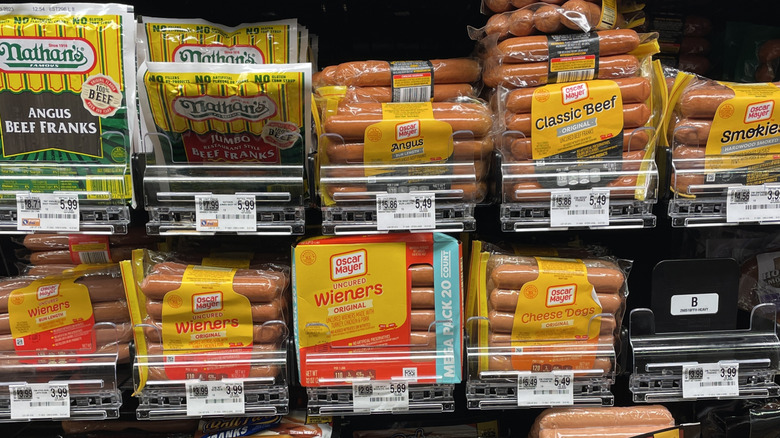
While the seasonings are mostly used for flavor, many of the other ingredients you'll find in your regular ol' dog from the refrigerator case are used as preservatives and curing agents. Sodium lactate and potassium lactate are salts derived from lactic acid that are used as antimicrobials. Sodium lactate enhances the meat's salty flavor, while potassium lactate is often used in low-sodium foods to prevent bacterial growth without adding extra sodium. Sodium diacetate is another common preservative because it is stable, inexpensive, and effective at fighting mold and bacteria. It is a salt derivative of acetic acid (the primary component of vinegar), so it also lends a subtle, tangy bite. Sodium nitrite is added to accelerate curing, preserve the meat, maintain its characteristic pink hue, and act as an antioxidant to prevent rancidity.
Beyond the most common additives, some hot dog brands use ascorbic acid (vitamin C) or its structural cousin, sodium erythorbate, in concert with sodium nitrite to improve the curing process. Of all the brands, however, beef is still the number one ingredient, followed by water. Water, or even ice, is blended with the meat, spices, and preservatives to help everything mix into a uniform product and retain more moisture during cooking. But after a laundry list of sodium compounds, acids, and nitrites, it's heartening to know that beef hot dogs are still primarily made of meat.