

This McDonald's Burger Rule Can Never Be Broken By Employees
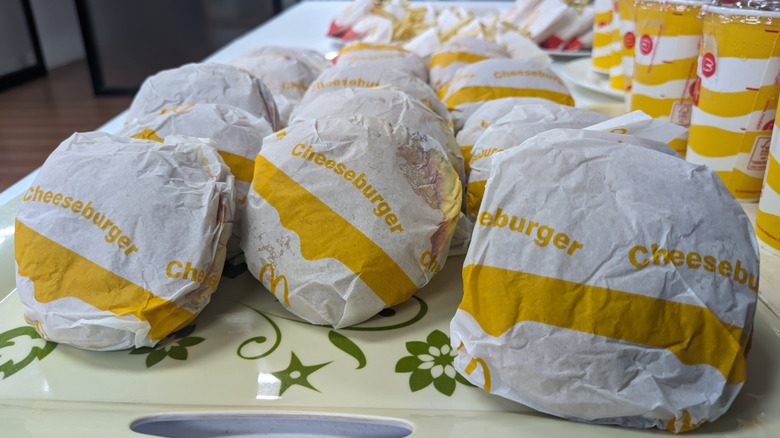
McDonald's, with its nearly 42,000 locations worldwide, has built a fast food empire on cheeseburgers, chicken nuggets, and its greasy, glorious french fries. Naturally, a company that raked in over $26 billion in revenue in 2025 takes every aspect of its business quite seriously, from the difference between its sauces to the supplier of its salt. And employee training, especially at corporate locations, is basically an exact science, complete with digital learning and hands-on experience. One of the main things new employees pick up is that McDonald's has a precise way of doing things, including a rule for making burgers that is basically sacrosanct among workers: The process of assembling a burger must follow the exact same steps, every single time.
For a cheeseburger, for example, after the bun gets toasted, the crown (the top part) receives an application of mustard and then ketchup, a sprinkle of onion, a single pickle, a piece of cheese, and then a hot burger patty. The heel (the bottom part of the bun) is placed last, before the burger gets wrapped up. Each burger on the McDonald's menu might be assembled slightly differently, but rest assured, they all have their own specific process that must be followed.
Uniformity is the backbone of McDonald's success
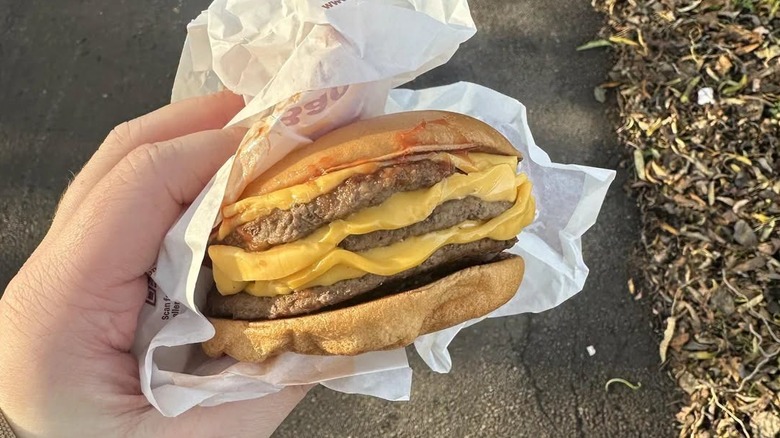
This regularity in the assembly of not just the hamburgers, but its entire menu, has been the backbone of McDonald's success since even before Ray Kroc took over the company. In the early days of the restaurant's operations, when it was owned by the McDonald brothers, the two entrepreneurs made a point of streamlining the ingredients and the process by which they were put together, so that McDonald's could truly deliver fast food.
And the global fast food chain has never abandoned those precepts; in fact, it could be argued, the world's largest seller of burgers has only doubled down on those principles in the years since, as evinced by the strict training McDonald's employees undergo. It ultimately serves dual purposes, too. The first is that, just like in the 1940s, it allows the employees to get the food out to customers super-fast. In fact, the assembly line-like nature enables workers to often quickly memorize processes until it's basically second-nature.
There is also the fact that it ensures consistency no matter what part of the country you're in. Whether you go through the drive-thru in California or order DoorDash in Pennsylvania, you can know that the burger is going to look and taste exactly the same, with the same high-quality standards. Even globally, if you order a hamburger, it's going to taste similar (if not identical) to what you get at home.