

An Italian Sub Should Always Be Sprinkled With This Seasoning

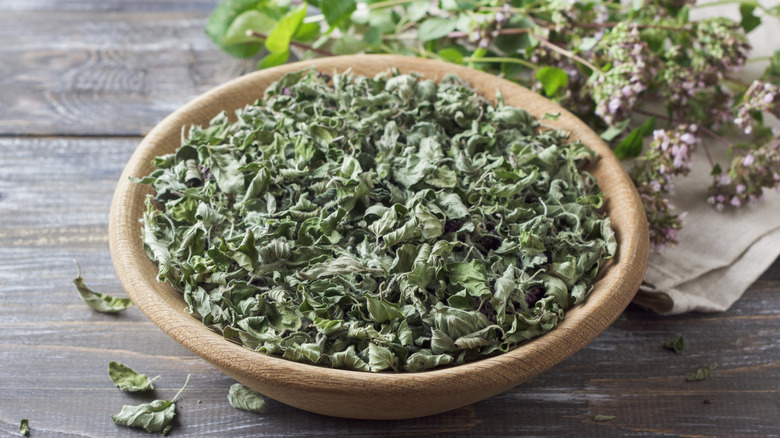
The Italian sub is a thing of beauty, and follows an unbeatable formula that makes you savor every bite. Sandwiched between a crusty roll, you've got an assortment of cured meats bringing the savory punch, provolone playing creamy backup, shredded lettuce and tomato tossed in for crunch, and a drizzle of olive oil or balsamic to add some extra pizzazz. But while these ingredients make up the bulk of the sandwich, no Italian sub is complete without a generous dusting of dried oregano. This herb is what packs the real punch, giving your sandwich that unmistakable Italian-American deli flair that separates it from just any old sub.
Oregano is one of the most iconic herbs to come out of the Mediterranean, and is a foundational player in Southern Italian and Sicilian cooking. It brings a bold, earthy, slightly peppery flavor that shows up on everything from a classic Neapolitan pizza to rich pomodoro sauces looking for a little extra edge. It's also one of those rare instances where the dried version isn't a compromise but an upgrade. Unlike delicate herbs such as basil, oregano's flavor actually gets more potent when it's dried.
When it comes to adding dried oregano to your Italian sub, don't just sprinkle it on at the end like a mere afterthought. Instead, dress your tomatoes, lettuce, and whatever other veggies you're using with a good glug of olive oil, add a generous sprinkle of dried oregano along with salt and pepper, then toss everything together and let it sit for up to 10 minutes. This lets the oregano cling to every piece of vegetable, infusing them with its flavor and mingling with the oil, allowing every single bite of your sub to carry its unmistakable flavor.
The Italian sub is a storied Italian-American evolution
The Italian sub's American story starts with waves of Italian immigrants, mostly from Naples, Calabria, and Sicily, who arrived in the late 1800s and early 1900s and settled in major cities like New York, Boston, and Philadelphia. You'll recognize plenty of the sub's ingredients as standard Italian fare, but it's the way these immigrants adapted them that turned it into something distinctly Italian American. Back in Italy, sandwiches (known as panini) tend to be minimalist affairs, with just a few high-quality ingredients rather than layers upon layers of eclectic fillings.
While plenty of cities lay claim to inventing the sandwich, one of the most compelling arguments points to Portland, Maine, where, in 1902, Italian baker Giovanni Amato tailored the sandwich to satisfy the hearty appetites of local dockworkers. Today, the local favorite is still famously sold at Amato's. Another interesting origin story traces Philadelphia's love affair with Italian subs to Hog Island, an important shipyard during World War I, where Italian workers fueled their lunch breaks with hearty bread loaves loaded with cold cuts and various other fillings. Over time, "Hog Island sandwich" got clipped down to "hoagie."
With the sandwich's varied history across the Northeastern U.S., it's unsurprising that you'll find a different name for the Italian sub depending on where you land. In New York, it's known as the hero. Head over to New England, and you'll find the working man's grinder. Over in Philly, the hoagie became so iconic that it was declared "The Official Sandwich of Philadelphia" in 1992. While there can be minor variations in preparation, the DNA remains consistent everywhere, with cured meats, veggies, cheese, crusty bread, and that essential herbal kick all tying it together.