

What Raising Cane's Does With Its Leftover Food
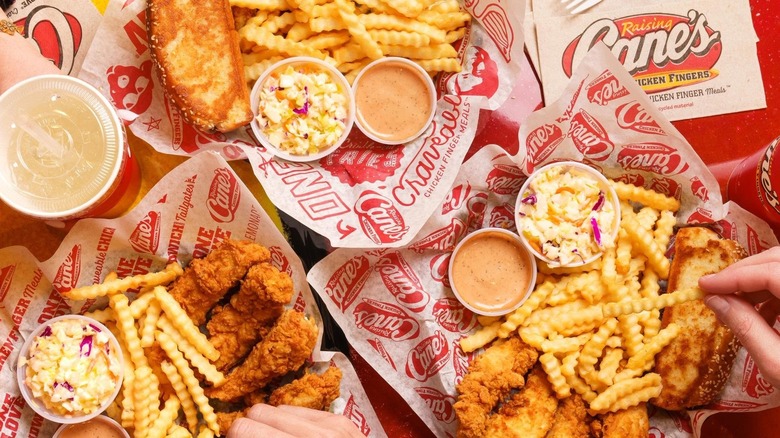
Raising Cane's is a fast food chain specializing in fried chicken fingers. It first opened its doors in 1996 at Louisiana State University's North Gates, and prides itself on providing each diner with freshly made food. The company also boasts its charitable contributions and community involvement. Nevertheless, what happens to the excess food can come as a shock to a new employee, especially considering the humanitarian flavor of the company's branding.
A self-identified new employee on Reddit recounted witnessing upwards of 20 meals being discarded within their first two days of working at Raising Cane's. "It just makes me a tad uncomfortable [that] the business whose model is active community involvement won't save some meals for a shelter or even give it to their employees," they wrote. Another user added that they'd "worked [at Raising Cane's] for years at multiple restaurants, and all [locations] waste a minimum of 20 [pounds] of food per day."
@jtightbabytooth @Raising Cane's @Raising Cane's ME too many hungry people in the world to just be throwing chicken away like this. we gotta do better to be better. Too many hungry people in the world. #fyp #news #update #reverse #behindthescene #foodwaste #raisingcanes #fyp #foodporn
It may not all be due to unsold food, though. The same user added that many chicken fingers are discarded "because they were shaped weird, too bent, too short, [or had] too much breading coming off." Ironically, lackluster breading is exactly why Raising Cane's scored fairly poorly on our fast food fried chicken ranking, suggesting that despite the extra waste, the chain might still struggle with consistency.
Why doesn't Raising Cane's donate its food waste?
So, why doesn't the restaurant chain simply give its leftover food away to people in need? One Redditor offered this reasoning: "Say they do give it to a shelter and someone contracts food poisoning from it ... this is where the negatives outweigh the good and it's better to just throw it away."
However, other users were quick to counter that argument, referencing the Bill Emerson Good Samaritan Food Donation Act, which would protect Raising Cane's from legal repercussions if it unknowingly donated spoiled food. Nevertheless, another Reddit user added that while the company doesn't risk getting sued for donating bad food, "it would definitely be a PR nightmare."
It's important to look at the issue from the perspective of the organizations receiving food donations, though. Chicken fingers require cold storage or a warmer, such as a heat lamp (which Raising Cane's never uses), to keep them safe for consumption. Some nonprofits may not have the facilities to do all this. And the chicken finger chain may not even have the space or equipment to do the same. This is why organizations typically provide lists of specific items they need during donation drives.
What is actually more helpful to those in need is the money that Raising Cane's donates to "local school districts, food banks, homeless shelters, and youth activities, amongst other things," according to one self-identified employee on Reddit. In my experience working with nonprofit organizations, monetary donations better enable such organizations to acquire exactly what they need to serve their clients rather than having to figure out what to do with 60 pounds of cold chicken fingers or tenders.