

How Much Watermelon Cost In The '70s Vs 2026
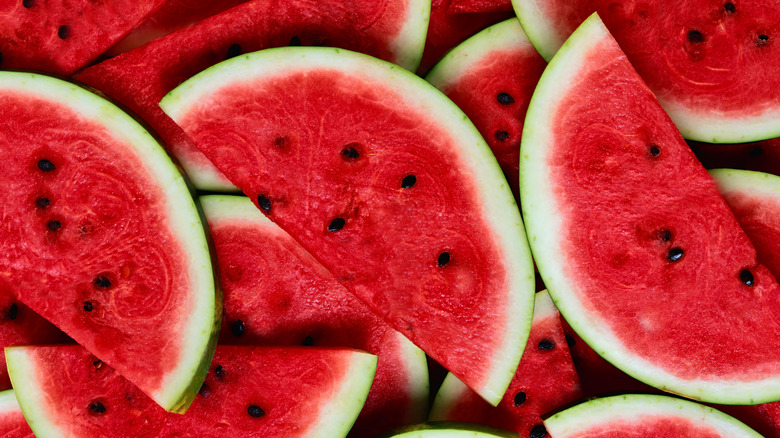
Watermelon is the quintessential summer treat that was as refreshing for people in the past as it is for us today. In fact, it's long been a Southern tradition to add a sprinkle of salt to make the fruit taste even better. But does it cost more to enjoy the fruit now than it did in the 1970s? Prices from a few decades back can seem shockingly low to us because of the effect of inflation over time, so you have to look at what the cost then translates to in 2026 dollars.
Watermelon was nine cents a pound in 1973, the equivalent of 71 cents now. Meanwhile, its June 2026 U.S. retail price is some 53 cents a pound, according to agrifood market data provider Selina Wamucuii. So that means watermelon is actually 18 cents per pound cheaper today by comparison, or just over 25%.
Looking at what it goes for at Albertson's, one of the nation's largest grocery store chains, a watermelon (seedless or seeded) is just a little higher at 59 cents a pound. An organic seedless melon costs more at 79 cents. The per-pound price goes up from there if they're cut up. For a quarter of the fruit, it's $1.99. It's $2.49 for a pack of several diamond-cut triangular slices, and cubed melon is the most at around $3.50, depending on the container size, reflecting the extra work involved.
How watermelon has changed since the '70s
The watermelon that was available in the '70s is also different from what most Americans get now. More than 90% of watermelon grown in the U.S. today is seedless (per Watermelon.org), which wasn't widely available back then. While it was actually created in 1939 in Japan, it didn't start showing up in grocery stores until decades later. It was still only a very small percentage in America into the 1980s, and only started putting up bigger sales numbers in the 1990s, before taking the lead in the 2000s. Not only is it easier to not have to deal with seeds, the melon stays good longer without them; seeds give off a gas that speeds up ripening.
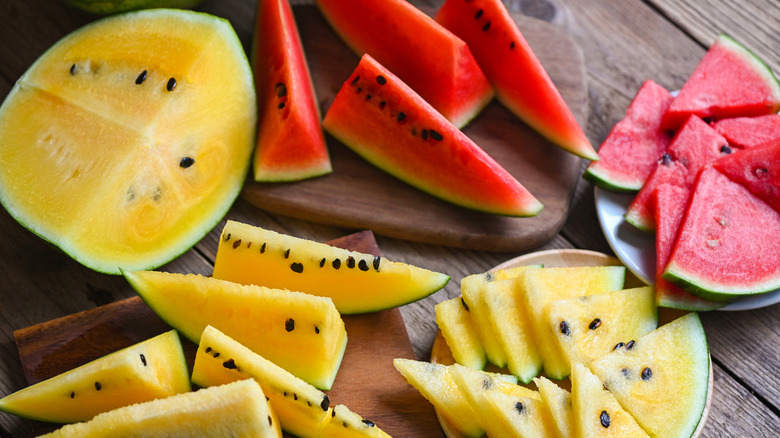
Other options that are also available today include round mini watermelons, which have a thinner rind; less commonly, you may find yellow and orange ones available. Those specialty varieties don't have the lycopene that makes a watermelon's flesh red, a vibrant color it didn't always have either. Their taste is a little different too, with the yellow adding a sweet honey or apricot flavor, and the orange featuring a milder tropical sweetness.
Even though today's price works out to be cheaper, you still want to get the most for your money. So, instead of throwing out the rinds, use that edible part of the fruit too. The most popular preparation is pickling them, but you could eat them in other creative ways — cut small ones into a relish or salad, or cook them in a stir-fry.