

The Crustless Italian Sandwich That Was Created In The 1920s

Italy has birthed some of our favorite dishes, leaving a deep imprint on U.S. food culture. Who hasn't tried lasagna (which looked different in the Middle Ages), pizza Margherita, coffee-laden tiramisù, or even the classic panini? But one of the country's most beloved staples — the crustless tramezzino, an ubiquitous sight in cafes, restaurants, and local spots across the peninsula — was directly influenced by American culture and became the source of a naming dispute.
The tramezzino is Italian comfort food 101: soft, usually untoasted slices of crustless bread filled with anything from prosciutto and cheese to artichokes and mayo, or butter and anchovy, as in the original recipe. The sandwich traces its origins to the 1920s, when it was first concocted at Turin's Caffè Mulassano after the owner's husband returned from a visit to the U.S. and was inspired by the practicality of toasted American-style sandwiches, unlike the typically heartier rusticity of Italian panini. The tramezzino was such a success that it was quickly adopted by other cafes across the country, and in the following decades became an unmissable feature of thousands of establishments. Some noteworthy classics include Padua's Bar Nazionale and Rome's Ciampini.
The tramezzino is a staple across cafes in Italy
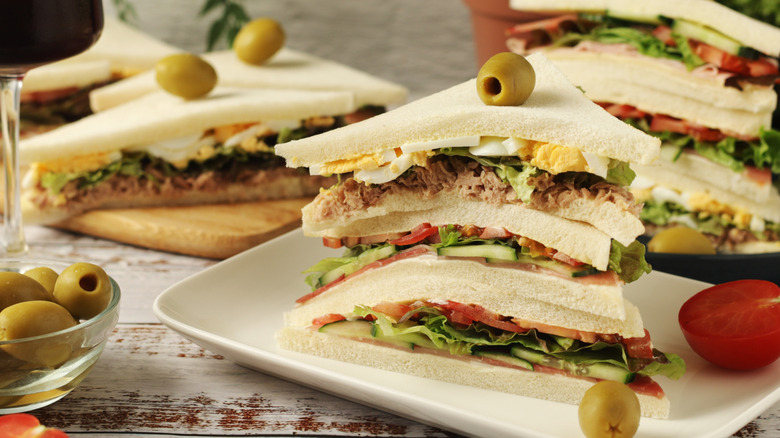
The tramezzino is part of an endless vocabulary of Italian culinary terms. While this specific recipe may have been directly inspired by American food, its name — which literally translates to "something small in between" — is distinctly Italian, and was supposedly coined by politician Gabriele d'Annunzio, who suggested it as a replacement for the English word "sandwich." Behind this decision, however, was not some quirky linguistic preference. Under Fascist rule, English and other foreign loanwords were discouraged or banned as part of an effort to preserve and promote Italy's national heritage. Turning the sandwich into "tramezzino" wasn't a question of taste, but of cultural control.
The tramezzino ultimately tells the story of a country with a proud, but complex, relationship with food and national identity. While Italians often take deep patriotic pride in their culinary lineage, especially now that elements of the country's cuisine are inscribed on UNESCO's Intangible Cultural Heritage lists, Italian food itself has been shaped by recent external — even American — influences more than many people realize. For instance, carbonara, a Roman classic, was born in the 1940s to cater to U.S. soldiers in the Italian capital.
Italian cuisine has long sat at the intersection of tradition and innovation, and the Italian diaspora has helped create a two-way exchange of culinary influences — something that has often been met with suspicion by governments. As with the tramezzino's naming dispute, it is not the first time Italian politics has meddled in food. The current Italian government, for instance, has imposed restrictions on the labeling of some plant-based foods in an effort to preserve the country's culinary traditions. The tramezzino perfectly encapsulates the essence of Italy's food history: innovative, receptive to foreign ideas, and ultimately susceptible to political control.