

Here's How Much A Prime Rib Dinner Set Back Diners In The 1960s
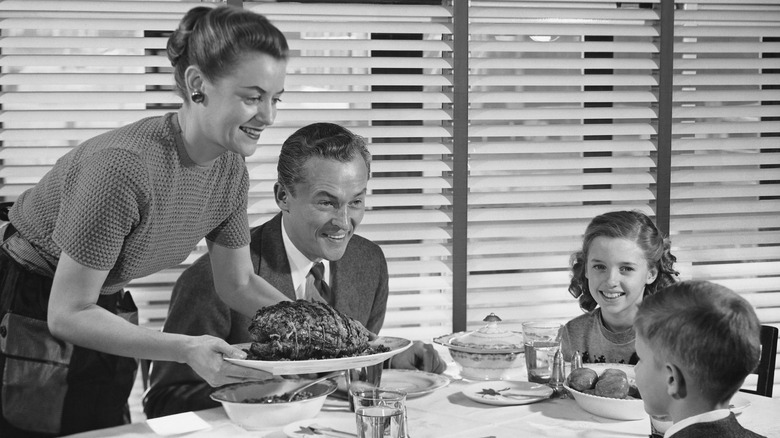
America entered into its twin booms of economic prosperity and the arrival of the baby boom children after the end of World War II. As returning soldiers and their wives moved out to the suburbs and raised their families, many foods became popular in those mid-century years. Peanut butter and jelly sandwiches were the lunchtime staple that fed all those kids, for instance, and TV dinners provided quick and easy meals for the family. When Americans had dinner out, prime rib was a popular menu choice, and many prime rib restaurants opened in the 1950s and '60s to capitalize on its popularity. But was the richly flavorful and tender cut as expensive then as it is now?
We looked at vintage menus from the 1960s to see what diners were paying for it and used the U.S. Bureau of Labor's inflation calculator to convert the prices to today's dollars from 1964. Prime rib at the Raleigh Hotel in Washington, D.C., which came with baked potato, salad, and rolls, was $4.00, which is $42.75 now. Al Reiner's Prime Rib in Philadelphia served it with a vegetable, salad, baked potato, and rolls for $3.45, which converts to $36.87. Thiensville, Wisconsin's Chalet on the Lake had prime rib with soup and salad for $4.50, today's $48.09. Finally, Lawry's The Prime Rib in Beverly Hills, California, an iconic restaurant that built its dynasty on the roasted beef, had a "Lawry Cut" for $4.25, which is $45.42 now, that came with mashed potatoes, salad, and Yorkshire pudding, popovers' British cousin.
How the 1960s prices compare to today's and why there's a difference
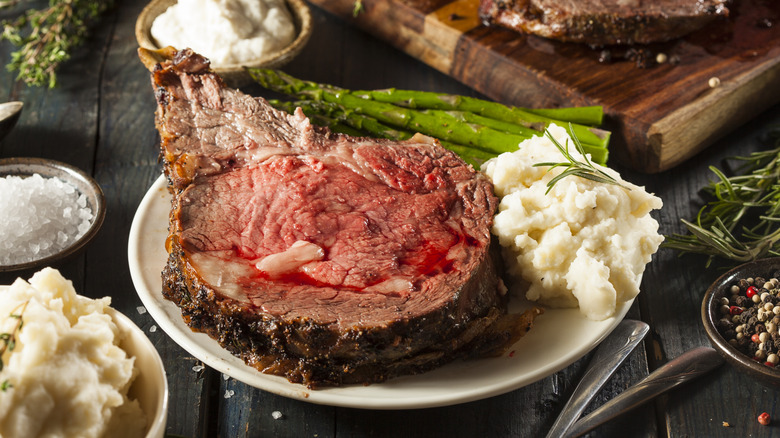
How do those converted 1960s prices compare to what restaurants sell prime rib for today? Looking at places from the same areas for comparison, 1799 Prime Steak & Seafood, just outside Washington in Alexandria, Virginia, sells Herb Crusted Prime Rib with no included sides for $64. Philadelphia's Rittenhouse Grill has prime rib for $58, and it's $60 at Milwaukee Steakhouse near Thiensville, both sans sides. Since Lawry's is still around, we can do a same-restaurant comparison. Its traditional Lawry Cut, which still comes with the same sides, is $72. Lawry's had the biggest increase over inflation of $26.58, while the Wisconsin restaurants' was lowest at $11.91. The difference between the D.C. and Philly ones was nearly identical at a little over $21. Notably, all the 1960s places included sides, but only Lawry's does now.
Several factors contribute to why prime rib is more expensive today, even after adjusting for inflation. One is that there's a demand for it as a high-quality cut that people like, but there aren't as many produced as some other beef cuts. It's particularly desired during the Christmas season as the favorite holiday roast for Alton Brown and many others, and it's when 70% of them are sold, according to the National Cattlemen's Beef Association (per the New York Times).
Additionally, the price of beef in general has soared in more recent years as the number of U.S. cattle is at its lowest in many decades due to drought. Along with other contributors like pandemic aftereffects, the drought has raised costs for expenses like feed, and many producers slaughtered cattle they could no longer afford, reducing the supply.